Wayground logo

Free Printable Worksheets

Font size

S
M
L
XL
Worksheets

Muscles Y13 Revision

Total questions: 60

Worksheet time: 35mins

Name
Class
Date
1.

The point at which the nerve cell reaches the sarcolemma of the muscle fibre is the _____.

a)

Neurotransmitter

b)

Acetylcholine

c)

Synaptic cleft

d)

Neuromuscular Junction

2.

What is the specific neurotransmitter that stimulates the movement of skeletal muscles?

a)

GABA

b)

Acetylcholine

c)

Serotonin

d)

Dopamine

3.

Once the action potential reaches the end of the axon terminal what takes place?

a)

ACh is released into the synaptic cleft.

b)

Calcium is pumped into the sarcolemma.

c)

Calcium is pumped into the AT.

d)

The muscle contracts.

4.

Once calcium is pumped into the axon terminal what happens?

a)

The muscle contracts

b)

ACh is released into the synaptic cleft.

c)

Sodium pumps into the sarcolemma.

d)

The muscle contracts.

5.

What is the name of the component that houses the neurotransmitters?

a)

Synaptic cleft

b)

Acetylcholine

c)

Receptors

d)

Synaptic vesicles

6.

Once ACh binds to receptor cells on the sarcolemma, what takes place?

a)

Sarcolemma becomes temporarily permeable to sodium.

b)

The muscle contracts.

c)

Calcium is pumped into the axon terminal.

d)

Synaptic vesicles move to the end of the terminal.

7.
The part of the neuron that receives messages from other neurons
a)
axon
b)
dendrite
c)
cell body
d)
Schwann cell
8.
What is the gap between the axon terminal of one neuron and the dendrite of the next neuron called?
a)
Synapse
b)
Node of Ranvier
c)
Joint
d)
Neuromuscular Junction
9.

16.What type of cell creates a myelin sheath?

a)

Schwann cell

b)

Oligodentrite

c)

Osteocyte

d)

Cell Body

10.
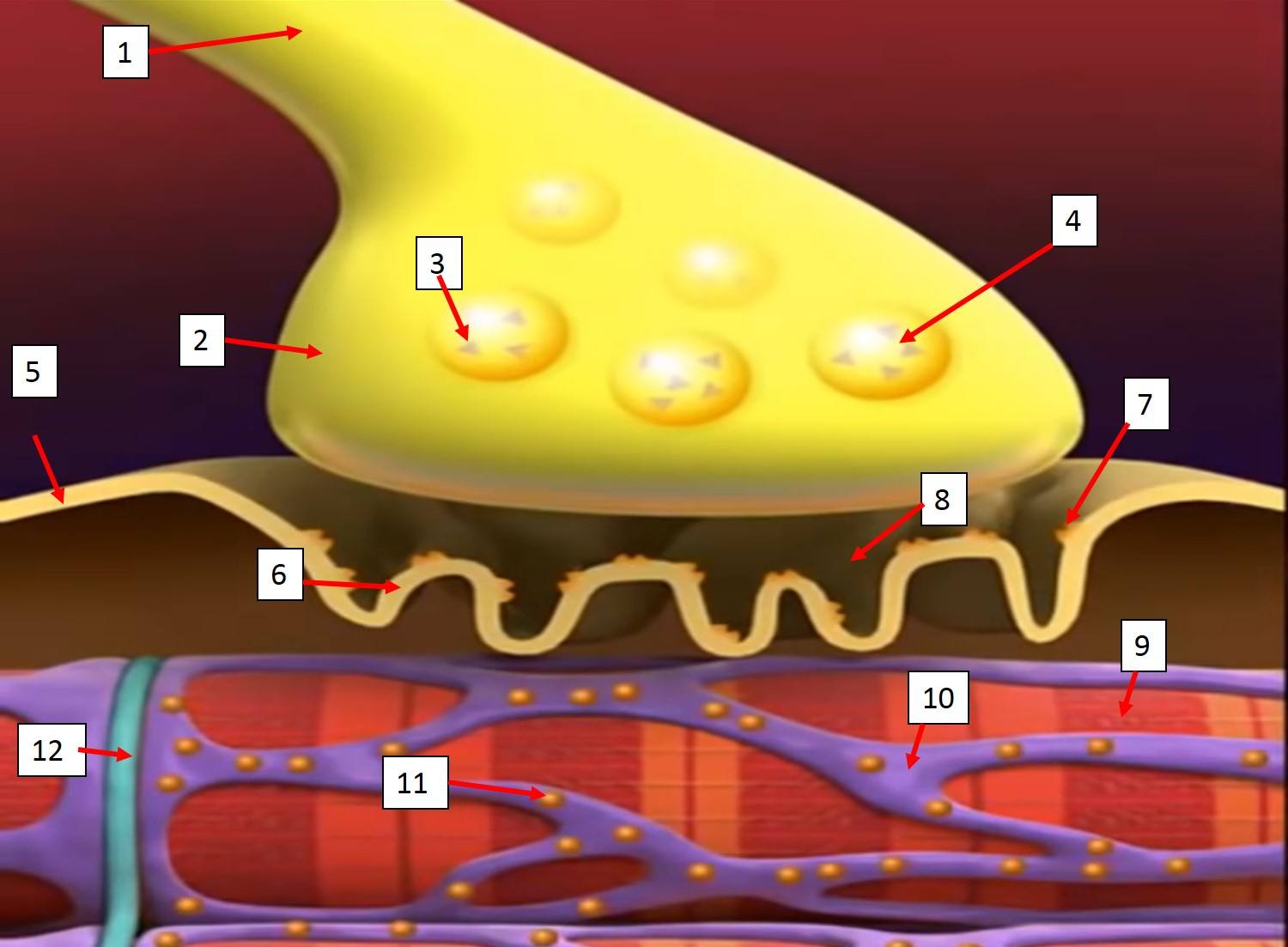
The organelle that stores ACh in the axon is identified as #4
a)
Motor Neuron
b)
Axon Terminal of Motor Neuron
c)
Sarcolemma
d)
 Vesicle
11.
The organelle containing actin and myosin identified as #9
a)
ACh
b)
Sarcolemma
c)
Vesicle
d)
Myofibril
12.
Another name for a muscle cell.
a)
Fiber
b)
Sacrolemma
c)
Sacromere
d)
Fascicle
13.
Contractile unit of a muscle.
a)
sarcomere
b)
motor unit
c)
fascicle
d)
myofibril
14.
Thick filaments are in a myofibril are
a)
ATPase
b)
Sarcoplasmic reticulum
c)
Actin
d)
Myosin
15.
Thin filaments in a myofibril are
a)
Sarcomeres
b)
Sarcoplasm
c)
Actin
d)
Myosin
16.
The plasma membrane of a skeletal muscle cell is called the:
a)
sarcomere
b)
myofilament
c)
sarcolemma
d)
sarcoplasm
17.
What two chemicals are necessary for muscle contraction to occur?
a)
Niacin and Potassium
b)
Calcium and ATP
c)
Sodium and Potassium
d)
Ach and Potassium
18.
Calcium:
a)
causes ATP binding to actin
b)
increases the action potential along the sarcolemma
c)
binds to proteins on myosin
d)
triggers the binding of myosin to actin
19.
What is a crossbridge?
a)
Where myosin binds to actin
b)
Where the calcium crosses into the cytoplasm
c)
Where calcium binds with troponin
d)
None of the answers are correct.
20.

Calcium binds to ___of the troponin-tropomyosin complex.

a)

troponin

b)

tropomyosin

c)

actin

d)

myosin

21.

Calcium is stored in the ___.

a)

sarcoplasm

b)

sarcolemma

c)

sarcoplasmic reticulum

d)

transverse tubules

22.

A ___extends from one Z disc to another Z disc.

a)

Sarcolemma

b)

Neuromuscular junction

c)

Sarcomere

d)

Motor end plate

23.

___gets shorter during contraction.

a)

actin

b)

myosin

c)

troponin-tropomyosin

d)

none of these

24.

___slides inward during muscle contraction.

a)

actin

b)

myosin

25.
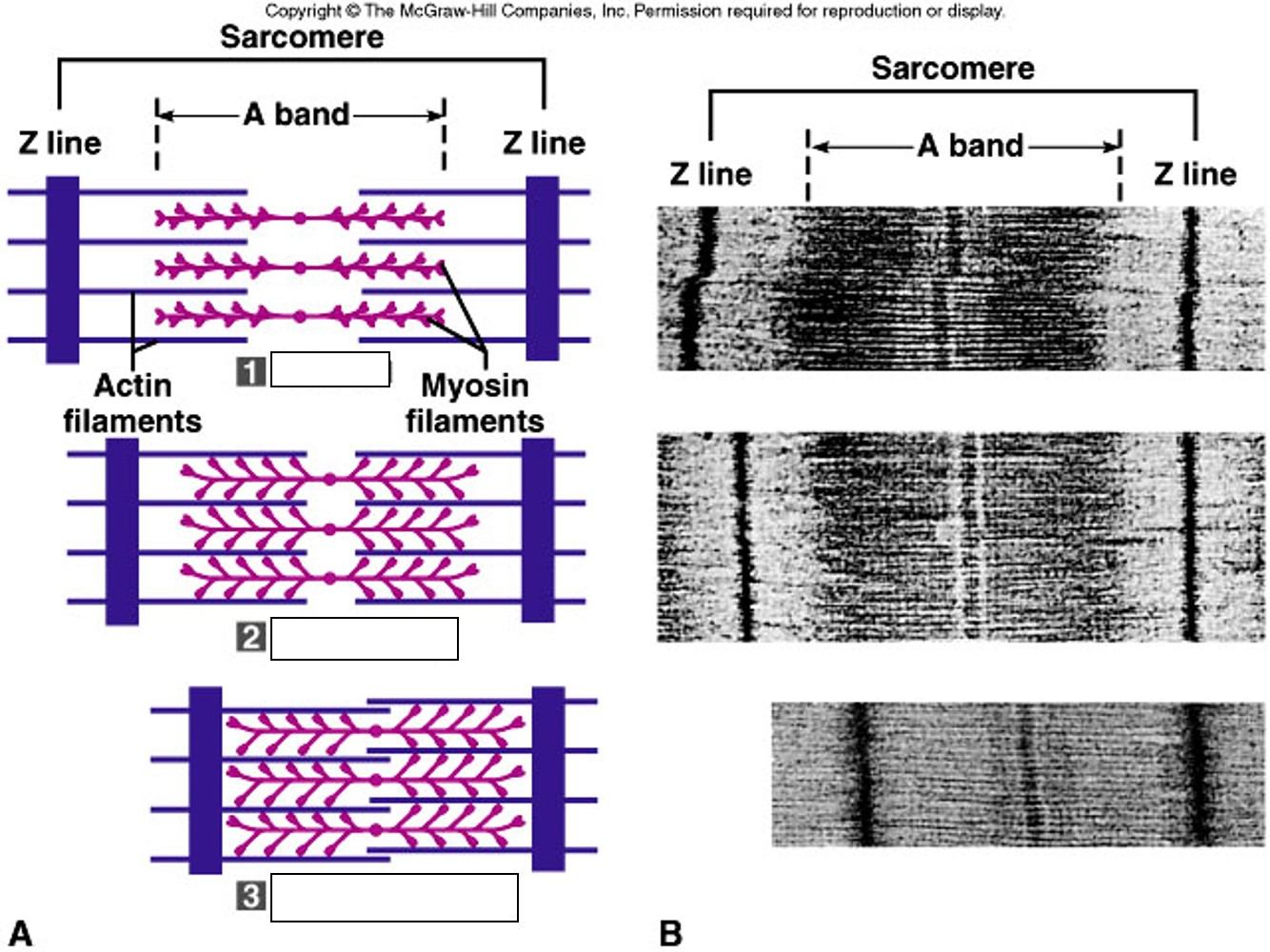
What state is the sarcomere in #1
a)
Relaxed
b)
Contracting
c)
Fully Contracted
d)
None of the above
26.
What state is the sarcomere in #2
a)
Relaxed
b)
Contracting
c)
Fully Contracted
d)
None of the above
27.
The axon terminal is represented by
a)
7
b)
8
c)
9
d)
10
28.
The receptors are represented by
a)
8
b)
9
c)
10
d)
11
29.
The sarcolemma is represented by
a)
9
b)
10
c)
11
d)
12
30.

Identify the muscle type

a)

cardiac

b)

skeletal

c)

smooth

31.

Identify the muscle type

a)

skeletal

b)

smooth

c)

cardiac

32.

What is the sliding filament theory?

a)

A description of the shapes of muscles

b)

A theory explaining that lengthening the sarcomeres causes a muscle to move

c)

An explanation for how muscle contraction occurs

d)

A description of how myosin filaments move.

33.

The sliding filament theory of muscle contraction says

a)

Actin and myosin filaments condense, thus causing the filament to shorten which in turn shortens the muscle

b)

Myosin rotates and wraps actin around it making the muscle shorter

c)

Friction is reduced between thin and thick filaments causing the thick filaments to move inside the thin

d)

Actin filaments slide over myosin filaments, making the muscle shorter

34.
Which of the following statements about H zones and I bands is TRUE?
a)
the H zones contain only actin, while the I bands contain only myosin
b)
the H zones contain only myosin, while the I bands contain both actin and myosin
c)
the H zones contain only myosin, while the I bands contain only actin
d)
the H zones and the I bands each contain both actin and myosin
35.
In a contracting muscle the Z lines come closer together.
a)
True
b)
False
36.
Each actin filament is composed of
a)
a single strand of actin molecules.
b)
four strands of actin molecules wrapped together.
c)
hundreds of strands of actin molecules wrapped together.
d)
two strands of actin molecules wrapped together.
37.
As actin and myosin filaments slide past each other during muscle contraction,
a)
actin filaments shorten, while myosin filaments do not.
b)
myosin filaments shorten, while actin filaments do not.
c)
neither actin nor myosin filaments shorten.
d)
both actin and myosin filaments shorten.
38.
The bond between the actin and myosin head is broken when…
a)
an ATP molecule binds to the myosin head.
b)
an ATP molecule binds to the actin molecule.
c)
ADP and phosphate bind to the myosin head.
d)
an ATP molecule breaks down on the actin molecule.
39.

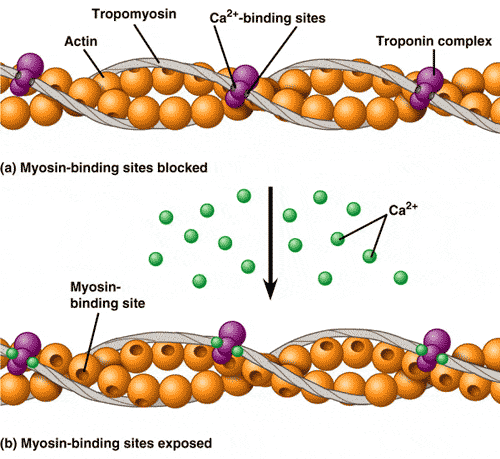
Low calcium concentrations myosin binding sites on actin are covered by tropomyosin?

a)

True

b)

False

40.

T tubules transport acetylcholine across the neuromuscular junction

a)

True

b)

False

41.
Which of the following actions is NOT facilitated by ATP?
a)
re-uptake of calcium ions into the sarcoplasmic reticulum
b)
unbinding of the myosin head
c)
binding of calcium to troponin
d)
all of the choices
42.
This protein contains a binding site for the myosin head.
a)
myosin
b)
troponin
c)
actin
d)
tropomyosin
43.

The light colored band (#7)

a)

I band

b)

A band

c)

Z line

d)

M line

44.

The dark band (#6)

a)

I band

b)

A band

c)

Z line

d)

M line

45.

#4

a)

actin

b)

myosin

c)

sarcomere

d)

Z line

46.

#3

a)

actin

b)

myosin

c)

sarcomere

d)

I band

47.

According to the sliding filament theory, which of the following change in length during isotonic muscle contraction?

I. A band

II. H Zone

III. Sarcomere

a)

I and II only

b)

I and III only

c)

II and III only

d)

I, II and III

48.

Ca2+ will be released from the sarcoplasmic reticulum when

a)

impulse reaches neuromuscular junction

b)

impulse transmitted along T tubule

c)

ATP binds to sarcoplasmic reticulum

d)

acetyl choline binds to ligand gated ion channels

49.

Rigor mortis occur because

a)

Lack of calcium ions attach to tropomyosin

b)

Lack of ATP attach to the myosin head

c)

Muscle stiff due to lack of heat

d)

Lactic acid accumulates in muscle

50.

How is Ca2+ move back into sarcoplasmic reticulum?

a)

Simple diffusion

b)

Facilitated diffusion

c)

Endocytosis

d)

Active transport

51.

Power stroke will occur when

a)

ATP binds to myosin head

b)

Myosin head releases ADP and Pi

c)

Myosin head hydrolyse ATP

d)

Myosin binds to actin

52.
The _____ of a cell would be responsible for synthesis of the myofibril proteins.
a)
Mitochondria and Leukoplasts
b)
Ribosomes and Golgi Apparatus
c)
Rough and Smooth ERs
d)
Nucleus and Mitochondria
53.
During full muscle contraction the A Band will...
a)
Disappear
b)
Get wider
c)
Stay the same
d)
Get narrower
54.

What is this structure? It consists of one motor neuron and all the muscle fibers its stimulates.

a)

axon terminal

b)

synaptic cleft

c)

synaptic vesicle

d)

motor unit

e)

motor end plate

55.

Identify X? A protein that covers the mysoin binding sites on the actin filament in a relaxed muscle, preventing contraction.

a)

actin

b)

myosin

c)

tropomyosin

d)

troponin

e)

cross bridge

56.

Which step of muscle contraction listed below?

"Neurotransmitter is released, diffuses across synapse"

a)

step one

b)

step two

c)

step 3

d)

step 4

e)

step 5

57.

Which step of muscle contraction listed below?

"Contraction ends, muscle fiber relaxes"

a)

step 6

b)

step 7

c)

step 3

d)

step 4

e)

step 5

58.

What is the part of the muscle cell labeled A?

a)

mitochondria

b)

thin filament (actin)

c)

thick filament (myosin)

d)

myofibril

e)

Sarcolemma

59.

What is the part of the muscle cell labeled D?

a)

mitochondria

b)

sarcoplasmic reticulum

c)

sarcoplasm

d)

T- tubules

e)

Sarcolemma

60.

What is the part of the muscle cell labeled E?

a)

mitochondria

b)

sarcoplasmic reticulum

c)

sarcoplasm

d)

T- tubules

e)

Sarcolemma