
Font size
 Worksheets
Electrode Potentials Practice
Total questions: 48
Worksheet time: 2hrs 42mins
In a Galvanic Cell, the anode is...
positive
negative
In a Galvanic Cell, the cathode is...
positive
negative
Oxidation occurs at the...
anode
cathode
Reduction occurs at the...
anode
cathode
In a Galvanic cell, the electrons flow from the...
anode to the cathode
cathode to the anode
Ecell =
Ered - Eox
Ered + Eox
Eox - Ered
Eox + Ered

In the list of standard electrode potentials, the strongest reducing agent is...
Li
Li+
F2
F-

In the list of standard electrode potentials, the strongest oxidising agent is...
Li
Li+
F2
F-
In a redox reaction, the oxidising agent... (choose two options)
is oxidised
is reduced
increases its oxidation number
decreases its oxidation number
In a redox reaction, the reducing agent... (choose two options)
is oxidised
is reduced
increases its oxidation number
decreases its oxidation number
In a Galvanic cell, the cations in the salt bridge...
flow the same way as the electrons flow in the wire
flow the opposite way to the electron flow in the wire
stay in the salt bridge
In a Galvanic Cell, the salt bridge...
completes the circuit so that electrons can flow through the wire
maintains charge balance
is soaked in an unreactive electrolyte such as KNO3
all of the above
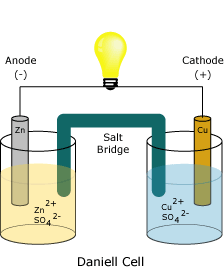
In the above Galvanic Cell, which half cell is undergoing reduction?
Cu | Cu2+
Zn | Zn2+
In any Galvanic Cell, which half cell will undergo reduction?
The half cell with the lower standard electrode potential
The half cell with the higher standard electrode potential
If an electrochemical reaction is spontaneous, what will Ecell be?
positive
negative
Consider the galvanic cell reaction Zn (s) + Cu2+ (aq) → Cu (s) + Zn2+ (aq) When the cell is running spontaneously, which is the only true statement?
The copper electrode loses mass and the zinc electrode is the cathode.
The copper electrode gains mass and the copper electrode is the cathode.
The zinc electrode gains mass and the zinc electrode is the anode.
The zinc electrode loses mass and the zinc electrode is the cathode.
A certain galvanic cell has for its spontaneous cell reaction: Zn + HgO → ZnO + Hg
Which is the half-reaction occurring at the anode?
HgO + 2 e- → Hg + O2-
Zn2+ + 2 e- → Zn
Zn → Zn2+ + 2 e-
ZnO + 2 e- → Zn
What is the standard electrode which all other standard electrode potentials are measured against?
helium
hydrogen
magnesium
potassium
Cu2+(aq) + 2e- → Cu(s); E0 = 0.34 V
Fe3+(aq) + e- → Fe2+(aq); E0 = 0.77 V
The oxidant and reductant reacting in this galvanic cell are, respectively:
Cu2+(aq) + Sn2+(aq) → Cu(s) + Sn4+(aq)
In this cell, we would expect to observe:

The standard redox potentials for these half-cells are:
Ag+(aq) + e- → Ag(s); E0 = 0.89 V
Ni2+(aq) + 2e- → Ni(s); E0 = -0.23 V
In this cell:

What is Gas X and what is the polarity of electrode N?
Pb4+(aq) + 2e- → Pb2+(aq); E0 = 1.69 V
Pb2+(aq) + e- → Pb(s); E0 = -0.13 V
What metal should be used for the electrode for the Pb4+/Pb2+ half-cell and what would be the potential difference across the cell?
CH4(g) + O2(g) → CO2(g) + 2H2O(l)
If an alkaline electrolyte is used, the equation for the reaction at the positive electrode is:
F2(g) + 2e-→ 2F-(aq); E0 = 2.87 V
O2(g)+ 4H+(aq)+ 4e-→ 2H2O(l); E0 = 1.23 V
Cu2+(aq) + 2e-→ Cu(s); E0 = 0.34 V
Fe2+(aq) + e- → Fe(s); E0 = -0.41V
2H2O(l) + 2e- → H2(g) + 2OH-(aq); E0 = -0.83 V
Mg2+(aq) + 2e- → Mg(s); E0 = -2.38 V
If all of these substances were available, what galvanic cell could be set up using these substances that would steadily deliver approximately 1.6 V?
Zn(s) + Ag2O(s) + H2O(l) → 2Ag(s)+ Zn(OH)2(s)
This cell delivered 1.50 V. The half-equation for the silver half-cell is:
Ag2O(s)+ H2O(l)+ 2e-→ 2Ag(s)+ 2OH-(aq); E0 = 0.34 V
The standard redox potential for the zinc half-cell must be:

Which of the following deductions about this cell is correct?

The product(s) of the half-reaction occurring in half-cell 1 is (are)

For this cell, the

For this cell, the overall equation will be
Half-cell 1: Cr3+(aq)+e-→Cr2+(aq)
Half-cell 2: Cr(s)→Cr2+(aq)+2e-
Sutable materials for the electrodes of te two half-cells are

- silver rod dipping into a 1.0 M solution of AgNO3 (aq)
- nickel rod dipping into a 1.0 M solution of Ni(NO3)2 (aq)
The solutions are connected to each other with a salt bridge consisting of an inverted U-tube containing ammonium nitrate solution.
Which of the following alternatives correctly describes the polarity of, and the reaction that occurs at, the anode of this cell?

On the basis of the polarity of the electrodes shown, which one of the following reactions would NOT be expected to occur spontaneously?
AlF6 3– + 3 e– → Al + 6 F– 1
Which of the following occurs in the reaction?
AlF63– is reduced at the cathode.
Al is oxidized at the anode.
Aluminum is converted from the –3 oxidation state to the 0 oxidation state.
Aluminum is converted from the –3 oxidation state to the 0 oxidation state.

Which of the following statements applies to the change in mass of the electrodes involved in this electrochemical cell?
Electrode A is the anode and it gains mass
since metal ions are being converted to metal
atoms which often adhere to the electrode.
Electrode B is the anode and it gains mass
since metal ions are being converted to metal
atoms which often adhere to the electrode.
Electrode A is the cathode and it gains mass since metal ions are being converted to metal atoms which often adhere to the electrode.
Electrode B is the cathode and it gains mass since metal ions are
being converted to metal atoms which often adhere to the electrode.

A student wishes to construct a thermodynamically favorable galvanic cell using electrodes made of chromium and silver. Each half cell will consist of the electrode partially submerged in a 1.0 M solutions of its nitrate salt. The two electrodes will be connected by separate wires to a voltmeter and the two half-cells will be connected with a salt bridge.
The student constructs another galvanic cell still using
silver and chromium electrodes, but substitutes a 0.50 M
solution of silver nitrate for the 1.0 M solution of silver
nitrate in the silver half-cell. Which of the following best
describes the effect this substitution has on the initial reading on the voltmeter?
The voltage will increase in both cells.
The voltage will decrease in both cells.
The voltage will increase due to fewer reactants being present.
The voltage will decrease due to fewer reactants being present.

Which of the following occurs if a 50-milliliter sample of a 2-molar Cd(NO3)2 solution is added to the left beaker?
Voltage increases.
Voltage decreases.
Voltage becomes zero and remains at zero.
No change in voltage occurs.
What occurs to the mass of copper electrode in the following reaction?
Zn/Zn2+ // Cu2+/Cu
increases
decreases
remains the same
Which metal is the negative electrode?
Zn/Zn2+ // Cu2+/Cu
zinc
copper
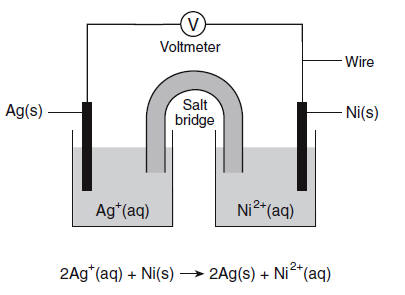
What reaction occurs at the anode?
Ag+/Ag = 0.80V
Ni2+/Ni = -0.25V
Ag+ + e- →Ag
Ag → Ag+ + e-
Ni2+ + 2e- → Ni
Ni → Ni2+ + 2e-
What would be the theoretical cell potential of the previous electrochemical cell?
Ag+/Ag = 0.80V
Ni2+/Ni = -0.25V
1.05V
-1.05V
0.55V
-0.55V

