
Font size
 Worksheets
Honors Fingerprints
Total questions: 47
Worksheet time: 36mins
What type of fingerprint is easily visible with the naked eye? (you may select more than one choice)
latent
patent
plastic
What type of fingerprint is not intentionally transferred to a substance, not visible to the naked eye, and caused by the transfer of sweat and oils?
latent
patent
plastic
What type of fingerprint is the result of an impression made in a soft substance such as clay?
plastic
patent
latent
Donna's hands are covered in blood. She leaves a bloody fingerprints on the wall on her way out the door. What type of fingerprints are these?
latent
patent
plastic
Friction ridge skin is found (check all that apply):
on the palms of the hands
on the soles of the feet
on the belly
on the nose
True or False? Identical Twins have the same fingerprints.
True
False
Level 1 Analysis of fingerprints includes (check all that apply):
overall ridge flow & pattern type of impressions from the distal joint of the finger
individual friction ridge paths and ridge events
arches, loops and whorls
edge shapes and pores
Level 2 Analysis of fingerprints includes (check all that apply):
minutiae such as ridge endings, islands, trifurcations, and brides
individual friction ridge paths and ridge events
arches, loops and whorls
edge shapes and pores
Level 3 Analysis of fingerprints includes:
overall ridge flow & pattern type of impressions from the distal joint of the finger
individual friction ridge paths and ridge events
arches, loops and whorls
edge shapes and pores
Which of the following are statements approved in latent print examination testimony and/or lab reports?
identification
inconclusive
exclusion
absolute certainty
Identification of a fingerprint
is the determination that two friction ridge prints originated from the same source because there is sufficient quality & quantity of corresponding information such that the examiner would not expect to see that arrangement of features repeated in another source
is the determination that there is insufficient quality and quantity of corresponding information such that the examiner is unable to identify or exclude the source of the print
is the determination that two friction ridge prints did not originate from the same source because there is sufficient quality and quantity of information in disagreement
Inconclusive
is the determination that two friction ridge prints originated from the same source because there is sufficient quality & quantity of corresponding information such that the examiner would not expect to see that arrangement of features repeated in another source
is the determination that there is insufficient quality and quantity of corresponding information such that the examiner is unable to identify or exclude the source of the print
is the determination that two friction ridge prints did not originate from the same source because there is sufficient quality and quantity of information in disagreement
Exclusion
is the determination that two friction ridge prints originated from the same source because there is sufficient quality & quantity of corresponding information such that the examiner would not expect to see that arrangement of features repeated in another source
is the determination that there is insufficient quality and quantity of corresponding information such that the examiner is unable to identify or exclude the source of the print
is the determination that two friction ridge prints did not originate from the same source because there is sufficient quality and quantity of information in disagreement
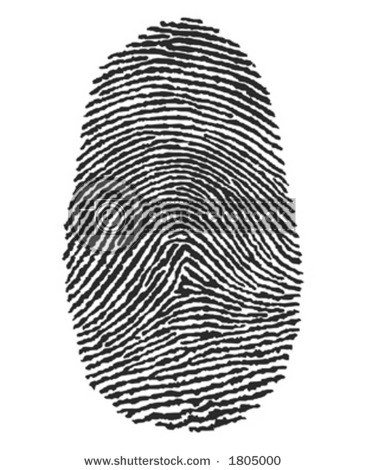
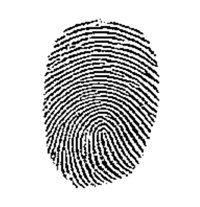
What pattern is this? (right hand)
ulnar loop
Arch
Whorl
radial loop

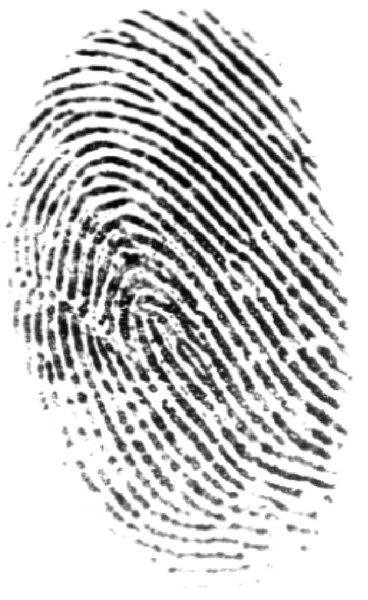
What pattern is this? (left hand)
ulnar loop
Arch
Whorl
radial loop


What pattern is this? (Right Hand)
Tented Arch
Plain Arch
Ulnar Loop
Plain Whorl

What type of fingerprint is this?
Whorl
arch
Accidental Whorl
arch

What type of fingerprint is this?
Plain Arch
Tented Arch
Accidental Whorl
Radial Loop

What type of fingerprint is this?
Central Pocket Whorl
Ulnar Loop
Accidental Whorl
Double Loop Whorl

What is the name of this minutiae?
Bifurcation
Splitting Ridge
Delta
Y

What is the name of this minutiae?
Enclosure/Eye
Island
Dot
Bifurcation

What is the name of this minutiae?
Ending Ridge
Spur
Half-Ridge
Partial Ridge

What is the name of this minutiae?
Bridge
Junction
Connector
Zigzag

What is the name of this minutiae?
Island
Speck
Dash
Hyphen

What is the name of this minutiae?
Spur
Hanging Ridge
Overhang
Mini-fork

What are the red triangles?
deltas
useless
forks
loops


Name this minutiae type
Enclosure
Island
Bifurcation (fork)
Ridge ending

Name this minutiae type
Enclosure
Island
Bifurcation (fork)
Ridge ending


Identify circle 3
bifurcation
ridge ending
spur
lake

Identify circle 4
spur
short ridge
bridge
ridge ending

Identify circle 6
lake
bridge
bifurcation
spur

Identify circle 4
Short Ridge
Bridge
Ridge Ending
Spur

Identify circle 3
Ridge ending
Bridge
Dot
Bifurcation
What type of fingerprint is visible due to ink, blood, etc?
Latent
patent
Plastic
Which of the following is a double loop whorl?


Which print matches this one?



