
 Worksheets
Bacteria and Viruses
Total questions: 44
Worksheet time: 50mins
Which of the following is true for both bacteria and viruses?
both contain genetic material
can be killed using antibiotics
have a cell membrane
have a protein coat
Which statement is true about viruses?
Viruses can eat and metabolize food.
Viruses can reproduce only using a host cell.
Viruses can reproduce on their own at any time.
Viruses contain DNA, so they are alive.
The use of what modern technology has cause the rise in resistant bacteria
vaccines
antibiotics
fertilizers
solar panels
One important way to control the spread of viruses in through
the use of vaccines
drinking a lot of tea
the use of other types of bacteria
the use of antibiotics
Which of these is characteristic of both viruses and bacteria?
They get their energy from their environment.
They can reproduce on their own.
They can form crystals and become dormant.
They contain proteins and nucleic acids.
A bacterium reproduces asexually by dividing to form two new bacterial cells. What is the name of the process by which bacteria reproduce?
meiosis
mitosis
budding
binary fission
Which of the following is a risk of overusing antibiotics to treat infections>
Bacteria may become resistant to antibiotics.
Antibiotics increase the rate of infection.
Antibiotics cause other diseases to develop.
Antibiotics only work once.
Which of the following is true?
Viruses and bacteria are both prokaryotes.
Bacteria are eukaryotes and viruses are prokaryotes.
Some bacteria are prokaryotes and some are eukaryotes.
All bacteria are prokaryotes.

What process is this?
phagocytosis
lytic cycle (active virus)
lysogenic cycle (latent virus)
formation of antibodies
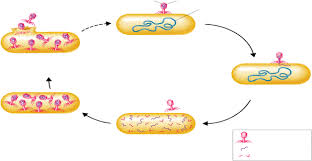
Which viral life cycle kills its host cell by lysing (bursting)?
Lysogenic Cycle (latent virus)
Lytic Cycle (active virus)
Binary Fission
Conjugation
Which of the following is a viral infection?
cholera
influenza
strep throat
tuberculosis
Can a virus be cured with antibiotics?
yes
no
A viral infection that weakens a person's immune system for the rest of their life is..
strep throat
HIV/AIDS
tuberculosis
the plague
The flu is caused by a virus.


Why do doctors suggest that people get a flu vaccine each year?
Viruses replicate more rapidly over time.
Viruses can mutate from year to year.
Vaccines are absorbed by the body after a year.
Vaccines get stronger over time.

Which type of bacterium is this?
Spirilum
Coccus
Bacillus
Bacteriolocisirus

Which type of pathogen is this?
Virus
Bacterium
Parasite
Fungus
A disease causing microorganism such as fungi, protozoans, parasites, bacteria, and viruses.
Pathogen
Infectious Disease
Virus
Bacteria
Conversion of nitrogen into a form that plants can use
fixation
anaerobic
replication
Causes illness when released by bacteria
endospore
replication
pasteurization
toxin
Virus that is inactive inside a cell
latent
hidden
fixation
aerobe
Process in which food is heated to a temperture that klls most harmful bacteria
immunization
pasteurization
fermentation
inoculation
Produced with the help of bacteria
capsule
fission
yogurt
cytoplasm
Caused by eating food contaminatd y certain bacteria
AIDS
food poisoning
latent
fixation
Bacteria that can live without oxygen
aerobic
anaerobic
tyrobe
cytoplasm
Protective protein produced by the immune system to fight off a foreign substance in your body
antibody
antibiotic
vaccine

