wayground logo

Free Printable Worksheets

NEW

Font size

S
M
L
XL
Worksheets

Newton's Laws of Motion

Total questions: 45

Worksheet time: 40mins

Name
Class
Date
1.

Unless acted upon by an outside force, an object at rest stays at rest; an object in motion stays in motion.

a)

Newton's 1st Law

b)

Newton's 2nd Law

c)

Newton's 3rd Law

2.

The magnitude of force is equal to the mass multiplied by the acceleration of an object.

a)

Newton's 1st Law

b)

Newton's 2nd Law

c)

Newton's 3rd Law

3.

For every action there is an equal and opposite reaction.

a)

Newton's 1st Law

b)

Newton's 2nd Law

c)

Newton's 3rd Law

4.
An object is resting motionless on a surface. According to Newton's 1st Law, the object will only start to move if
a)
the net forces on the object equal zero
b)
an unbalanced force is applied to the object
c)
the upward force of the object is equal to its acceleration
d)
two forces that are equal and opposite are applied to the object
5.
As the wheels of a train push down on the track, the track pushes back against the wheels. Which of Newton's laws is used to explain these forces.
a)
An object at rest tends to stay at rest unless acted upon by an unbalanced force.
b)
The net force of an object is its mass times its acceleration.
c)
For every action, there is an equal and opposite reaction.
d)
Any 2 objects exert a gravitational force of attraction on each other.
6.
Which example best explains Newton's Third Law of Motion?
a)
When a glass slid across a table, it spilled water when it stopped suddenly.
b)
An engine used less work to move a lighter car than when it moved a heavier car.
c)
When you sit on a chair, your body exerts a downward force on the surface of the chair, while the chair exerts an equal and upward force on your body. 
7.
A truck that is travelling at a constant speed is carrying some boxes.  If the truck comes to a sudden stop, what will most likely happen to the boxes?
a)
They will stay in the middle of the truck.
b)
They will slide toward the front of the truck.
c)
They will slide toward the back of the truck.
d)
They will fall off the side of the truck.
8.
A _______ is a push or pull.
a)
Newton
b)
Acceleration
c)
Momentum
d)
Force
9.

What is the standard unit force is measured in?

a)

Newton

b)

Kilogram

c)

Pound

d)

Meter

e)

m/s2

10.
What Newton's law does this picture represent?
a)
Newton's 2nd law
b)
Newton's 1st law
c)
Newton's 3rd law
d)
Newton's 5th law
11.
Which has more inertia--
a)
Truck
b)
Cat
c)
Ant
d)
Skateboard
12.

1000 kg is the -----

a)

Force

b)

Mass

c)

Acceleration

d)

Weight

e)

Speed/Velocity

13.

45 m/s is the--

a)

Acceleration

b)

Mass

c)

Speed/Velocity

d)

Force

e)

Time

14.
If an object is stationary (not moving) the forces acting upon it are---
a)
Balanced
b)
Unbalanced
c)
Weak
d)
Hulk Smash?
15.
If you double the mass of an object with the same force apply on it, the acceleration will
a)
double
b)
cut in half
c)
the same
d)
zero
16.
What kind(s) of objects have inertia?
a)
all objects with mass
b)
only objects at rest
c)
only objects in motion
d)
only objects whose motion is being changed
17.
Which one needs a greater net force to move, a kilogram of feathers or a kilogram of iron? 
a)
feathers 
b)
iron
c)
same
d)
depends on their friction
18.
After a cannonball is fired into frictionless space, the amount of force needed to keep it going equals
a)
twice the force with which it was fired
b)
the same amount of force with which it was fired
c)
1/2 the force with which it was fired
d)
zero, since no force is required to keep it moving. 
19.
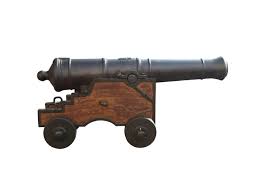
When a cannon fires a cannonball we observe Newton's third law. Which force is the reaction force?
a)
The cannon moving forward
b)
The cannonball moving forward
c)
The cannon moving backward
d)
The cannonball moving backward
20.

Which one of Newton’s Laws of Motion best explains why the dishes do not move when the table cloth is removed?

a)

Newton's 1st Law

b)

Newton's 2nd Law

c)

Newton's 3rd Law

d)

Newton's Law of Biology

21.
What is happening at C?
a)
Stationary
b)
Accelerating
c)
Fast steady speed; moving away from the starting position
d)
Slower steady speed; moving away from the starting position
22.
What is happening at D?
a)
Stationary
b)
Accelerating
c)
Fast steady speed; moving away from the starting position
d)
Slower steady speed; moving away from the starting position
23.

What is this graph showing?

a)

At rest

b)

Acceleration

c)

Constant speed of 1 m/s

d)

Gradually speeding up

24.

What is this graph showing?

a)

Constant speed

b)

Gradually speeding up

c)

Gradually slowing down

d)

At rest

25.

What is this graph showing?

a)

Fast constant speed

b)

Slow constant speed

c)

At rest

d)

Accelerating

26.

What is the graph showing?

a)

Speeding up moving away from start

b)

Speeding up moving towards start

c)

Slowing down moving towards start

d)

Slowing down moving away from start

27.

What is the graph showing?

a)

Constant high speed

b)

Stopped

c)

Accelerating

d)

Constant low speed

28.

What is the graph showing?

a)

Constant speed away from start

b)

Constant speed toward start

c)

Accelerating away from start

d)

Stopped toward start

29.
Will it take more force to push an empty shopping cart or a shopping cart that is full?
a)
The empty shopping cart
b)
The full shopping cart
c)
They will take the same amount of force
30.
Which shopping cart will have more acceleration?  
a)
The empty shopping cart
b)
The shopping cart that's full
c)
They will be the same
31.

A 20 kg bike accelerates at 10 m/s2. What is the force?

a)

25 Newtons

b)

20 Newtons

c)

200 Newtons

d)

10 Newtons

32.
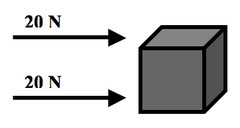
What is the net force?
a)
40 N left
b)
0 N Balalnced
c)
400 N right
d)
40 N right
33.

Which wagon will require more force to move?

a)

Top wagon, because it has more weight.

b)

Top wagon, because it has more mass.

c)

Bottom wagon, because it has more weight.

d)

Bottom wagon, because it has more mass.

34.

A force of 20 N acts upon a 5 kg block. Calculate the acceleration of the object.

a)

100 m/s2

b)

70 m/s2

c)

15 m/s2

d)

4 m/s2

35.

An object of mass 30 kg experiences a force of 60 newtons. Calculate the acceleration.

a)

180 m/s2

b)

90 m/s2

c)

20 m/s2

d)

2 m/s2

36.

If the object accelerates at a rate of 2 m/s/s, what is the mass of the object?

a)

2 kg

b)

4 kg

c)

6 kg

d)

8 kg

37.

If the object accelerates at a rate of 3 m/s/s, what is the object's mass?

a)

3 kg

b)

5 kg

c)

60 kg

d)

75 kg

38.
A box sliding down an inclined plane attains a velocity of 27 m/s in 3 seconds from rest.  Find the acceleration.
a)
30 m/s
b)
24 m/s2
c)
9 m/s2
d)
81 km/hr
39.
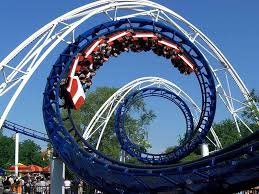
A roller coasters accelerates from an initial velocity of of 6.0 m/s to a final velocity of 70 m/s over 4 seconds.  What's the acceleration?
a)
24 m/s2
b)
18 m/s2
c)
16 m/s2
d)
16 m/s
40.
A dog runs with an initial speed of 7.5 m/s on a waxed floor.  It slides to a stop in 15 seconds.  What is the acceleration?
a)
-7.5 m/s
b)
-7.5 m/s2
c)
-0.5 m/s2
d)
7.5 mi//hr
41.
Acceleration only takes place when things speed up. 
a)
True
b)
False
42.

What is the standard unit acceleration is measured in?

a)

Newton

b)

Kilogram

c)

Pound

d)

Meter

e)

m/s2

43.

What is the standard unit weight is measured in?

a)

Newton

b)

Kilogram

c)

Pound

d)

Meter

e)

m/s2

44.
Dave runs a 400 m race with a speed of 4 m/s. What time will it take him to finish the race?
a)
400 minutes
b)
100 minutes
c)
100 seconds 
d)
.25 seconds 
45.
What is the speed of a helicopter that traveled 1200 miles in 7 hours?
a)
70,000 seconds
b)
171 hours
c)
8,400 mi/hr
d)
171 mi/hr