wayground logo

Free Printable Worksheets

NEW

Font size

S
M
L
XL
Worksheets

Weather and Water 7/8/9

Total questions: 50

Worksheet time: 28mins

Name
Class
Date
1.
What part of the water cycle does this picture show?
a)
condensation
b)
precipitation
c)
evaporation
2.
Which of these is an example of precipitation?
a)
snow
b)
air
c)
clouds
d)
vapor
3.
If you place your hand above a candle flame and feel heat before your hand reaches the candle, that is evidence of energy transfer by _____.
a)
radiation and convection
b)
conduction and convection
4.
Which method of heat transfer is shown in this image?
a)
conduction
b)
convection
5.
When the particles of a material lose kinetic energy, the material is most likely to ______.
a)
heat up and become less dense
b)
cool down and become more dense
6.
Which location on the map would have low pressure?
a)
A
b)
B
7.
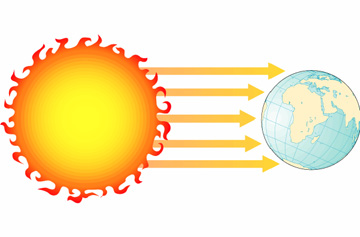
Which method of heat transfer is shown in the image?
a)
radiation
b)
conduction
8.
A northeasterly wind blows from _____ to _____.
a)
north to east
b)
northeast to southwest
9.
the process by which liquid water changes into water vapor
a)
condensation
b)
evaporation
10.
the continuous process by which water travels through plants and releases as water vapor
a)
transpiration
b)
evaporation
11.
the process by which water vapor changes into liquid water, usually on a surface
a)
condensation
b)
evaporation
12.
when air contains as much water vapor as it can at a certain temperature
a)
saturated
b)
dew point
13.
Which location is in front of a cold front?
a)
A
b)
B
14.
In which location will it probably be windiest?
a)
A
b)
B
15.
What causes high winds?
a)
warm fronts
b)
isobars close together
16.
Which of these factors do not contribute to the patterns of ocean currents?
a)
The direction ocean organisms move
b)
Differences in salinity
17.
How does the ocean affect the climate of nearby locations?
a)
Cities near the ocean have less temperature variation.
b)
Cities near the ocean are hotter than cities farther inland.
18.
How does the ocean affect the climate of nearby locations?
a)
Cities near the ocean have less temperature variation.
b)
Cities near the ocean are hotter than cities farther inland.
19.
Why does plastic collect in the Great Pacific Garbage Patch?
a)
Surface winds across the ocean push the garbage to that spot.
b)
Ocean gyres push the garbage to that spot.
20.
Why do meteorologists use weather balloons?
a)
They can get information from conditions in the troposphere.
b)
They can get clear images of the clouds from above.
21.
Which of the following would be the most helpful for you to predict next month’s weather?
a)
the current temperature
b)
last year’s data for your city
22.
Flow of warm water in the eastern Pacific Ocean that causes changes in weather in other places
a)
Gyre
b)
El Nino
23.
A large system of rotating ocean currents
a)
Gyre
b)
El Nino
24.
The amount of salt concentration
a)
Gyre
b)
Salinity
25.
Why doesn't your path match the path of the classic water cycle?
a)
Water in nature cycles in a certain order.
b)
The water may cycle in any order, depending on circumstance.
26.
In which location are you most likely to find precipitation?
a)
A
b)
B
27.
A student hung her clothes out to dry. What happened to the water as the clothes dried? 
a)
The water particles increased in kinetic energy and moved into the air as water vapor.
b)
The water particles decreased in kinetic energy and turned into air.
28.
Which of the following statements about evaporation is true?
a)
A water sample must gain energy to evaporate.
b)
A water sample must decrease kinetic energy to evaporate
29.
What is the difference between water vapor and clouds?
a)
Water vapor is an invisible gas, and clouds are made of liquid water droplets
b)
Water vapor is an invisible gas, and clouds are made of water vapor.
30.
When a sample of air drops in temperature to the dew point, what can happen to water in the air?
a)
Water vapor can condense
b)
Water vapor can evaporate.
31.
What happens to gas particles in a closed container when you increase the pressure?
a)
The particles condense because they have less space to move around.
b)
The particles have more collisions, and their kinetic energy increases.
32.
Where does dew come from when it forms on the outside of a can?
a)
from the liquid inside the can
b)
from water vapor in the air
33.
Where does frost come from when it forms on the outside of a can?
a)
water vapor in the air
b)
ice inside of can
34.
High level clouds are called
a)
Cirro
b)
Alto
35.
As Pressure increases, 
a)
temperature decreases
b)
temperature increases
36.
a)
Low Clouds
b)
Low Temperatures
c)
Light Wind
d)
Low Air Pressure
37.
a)
Warm Front
b)
High Air Pressure
c)
Cold Front
d)
High Temperatures
38.
a)
High Air Pressure
b)
High Temperatures
c)
Heavy Rain
d)
Hail
39.
a)
High Pressure
b)
Warm Front
c)
Cold Front
d)
Mountains
40.
High Pressure is associated with this type of weather...
a)
Cloudy/Overcast Weather
b)
Cold Weather
c)
Warm Weather
d)
Fair Weather
41.
Low Pressure is associated with this type of weather...
a)
Cloudy/Overcast Weather
b)
Cold Weather
c)
Warm Weather
d)
Fair Weather
42.
A cold front moving into an area can bring this type of weather...
a)
Warmer Temperatures, Clear Skies
b)
Colder Temperatures, Clear Skies
c)
Warmer Temperatures, Clouds
d)
Colder Temperatures, Clouds, and Precipitation
43.
Air pressure is greatest:
a)
closer to Earth
b)
farther from Earth
44.
Which city is close to a warm front?
a)
Chicago
b)
New York
c)
Boise
d)
Denver
45.

What weather would you forecast at letter A

a)

clear skies and warmer temperatures

b)

Thunderstorms followed by warmer temperatures

c)

Thunderstorms followed by cooler temperatures

d)

rain and fog for many days

46.

What weather would you forecast at letter B

a)

clear skies and warmer temperatures

b)

Thunderstorms followed by warmer temperatures

c)

Thunderstorms followed by cooler temperatures

d)

rain and fog for many days

47.

What weather is currently happening at letter A?

a)

dry, clear weather

b)

wet, rainy weather

c)

cloudy, cold wather

48.

What weather is currently happening at letter C?

a)

gentle rain

b)

thunderstorms

c)

fog

d)

clear skies

49.

Low pressure systems cause what type of weather?

a)

clear, dry weather

b)

cloudy, wet weather

50.

High pressure systems cause what type of weather?

a)

clear, dry weather

b)

cloudy, wet weather