Wayground logo

Free Printable Worksheets

Font size

S
M
L
XL
Worksheets

Review

Total questions: 123

Worksheet time: 3hrs 56mins

Name
Class
Date
1.
The most abundant elements in the atmosphere are
a)
oxygen and carbon
b)
hydrogen and oxygen
c)
nitrogen and oxygen
d)
silicon and oxygen
2.
The most abundant elements in Earth's crust/lithosphere are
a)
oxygen and carbon
b)
nitrogen and oxygen
c)
oxygen and silicon
d)
hydrogen and oxygen
3.
The most abundant elements in the hydrosphere are
a)
hydrogen and oxygen
b)
carbon and silicon
c)
oxygen and nitrogen
d)
silicon and oxygen
4.
A metal spoon heating up in a bowl of hot soup
a)
Conduction
b)
Convection
c)
Radiation
5.
Getting a sunburn on while spending the day on the beach
a)
Conduction
b)
Convection
c)
Radiation
6.
Feeling the hot air when opening the oven
a)
Conduction
b)
Convection
c)
Radiation
7.
Burning your tongue on a hot soup
a)
Conduction
b)
Convection
c)
Radiation
8.
The movement of liquid in a lava lamp
a)
Conduction
b)
Convection
c)
Radiation
9.
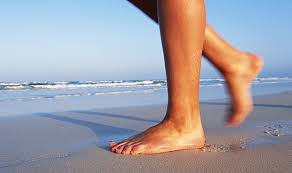
The sand burning your feet while walking on the beach on a hot day
a)
Conduction
b)
Convection
c)
Radiation
10.
Sitting by a campfire 
a)
Conduction
b)
Convection
c)
Radiation
11.
Pancakes cooking on a pan
a)
Conduction
b)
Convection
c)
Radiation
12.
Popcorn cooking in a microwave
a)
Conduction
b)
Convection
c)
Radiation
13.
Water boiling in a pot
a)
Conduction
b)
Convection
c)
Radiation
14.
Magma creating a current in the mantle to move tectonic plates
a)
Conduction
b)
Convection
c)
Radiation
15.
Turning on a ceiling fan to cool down a room
a)
Conduction
b)
Convection
c)
Radiation
16.
Burning your hand on an iron
a)
Conduction
b)
Convection
c)
Radiation 
17.
Using a blow drier to dry your hair
a)
Conduction
b)
Convection
c)
Radiation 
18.
A hot air balloon rising 
a)
Conduction
b)
Convection
c)
Radiation
19.

Identify the correct energy transformation for the image below. 

a)

Chemical --> Radiant --> Thermal

b)

Sound --> Thermal --> Radiant

c)

Kinetic --> Potential --> Sound

d)

Electrical --> Sound --> Thermal

20.

Identify the correct energy transformation for the image below.

a)

Elastic --> Kinetic --> Sound

b)

Thermal --> Potential --> Gravitational

c)

Kinetic --> Gravitational --> Sound

d)

Sound --> Elastic --> Kinetic

21.
a)

thermal & kinetic

b)

gravitational & potential

c)

radiant & gravitational

d)

elastic & gravitational

22.

What is the energy transformation that occurs in an electric pencil sharpener?

a)

mechanical energy → electrical energy

b)

electrical energy → kinetic energy

c)

radiant energy → sound energy

d)

chemical energy → kinetic energy

23.

Which object shows an energy transformation from electrical → kinetic → sound?

a)
b)
c)
d)
24.

Which of the following energy transformations occur when a lamp that is plugged into a wall socket is functioning correctly?

a)

Chemical → light

b)

Electrical → chemical

c)

Electrical → light

d)

Chemical → electrical

25.

What energy transformations take place when a battery-operated radio is in use?

a)

Electrical → chemical → light

b)

Sound → chemical → thermal

c)

Chemical → electrical → sound

d)

Light → electrical → thermal

26.

Electrical Energy is transferred to _____ Energy.

a)

Thermal

b)

Solar

c)

Electrical

d)

None

27.

A student listens to music with a digital music player, similar to the one shown below. Which best describes the energy transformations that take place in the music player?

a)

Kinetic → chemical → electrical

b)

Chemical → sound → electrical

c)

Chemical → electrical → sound

d)

Electrical → heat → sound

28.

What energy transformation occurs during photosynthesis?

a)

Chemical --> Radiant

b)

Thermal --> Chemical

c)

Radiant --> Chemical

d)

Mechanical --> Thermal

29.

What energy transformation occurs as a mouse produces body heat?

a)

Chemical --> Thermal

b)

Thermal --> Chemical

c)

Electrical --> Thermal

d)

Thermal --> Mechanical

30.
According to the Law of Conservation of Energy, energy cannot be _________ or ____________. 
a)
destroyed, destroyed
b)
created, saved
c)
created, destroyed
d)
lost, found
31.
What is energy changing from one form to another?
a)
energy conservation
b)
energy transformation
c)
energy creation
d)
mechanical energy
32.

Which items would have this energy transformation: electrical energy → thermal energy + light energy?

a)

toaster

b)

candle burning

c)

windmill turning

d)

using scissors

33.

Which items would have this energy transformation: chemical energy → electrical + light + thermal energy?

a)

turning on a flashlight

b)

dog chasing a ball

c)

digesting an apple

d)

writing, using a pen

34.

Which items would have this energy transformation: electrical energy → thermal energy?

a)

climbing a tree

b)

person running

c)

iron for your clothes

d)

candle burning

35.

What best describes the energy conversion that occurs when you turn on a hair dryer?

a)

electric → kinetic → thermal + sound

b)

chemical → thermal → light + sound

c)

kinetic → electrical → thermal + sound

d)

thermal + sound → potential

36.

Turning on a lamp is an example of energy transformation from electrical to 3 forms of energy. Which of these is NOT created by the lamp?

a)

radiant

b)

light

c)

heat

d)

chemical

37.

A blacktop parking lot getting warm on a summer day

a)

Radiant --> Thermal

b)

Kinetic --> Sound

c)

Elastic --> Thermal

d)

Thermal --> Sound

38.

Setting off fireworks on 4th of July

a)

Chemical --> Sound --> Radiant

b)

Sound --> Radiant --> Chemical

c)

Electrical --> Sound --> Thermal

d)

Thermal --> Chemical --> Electrical

39.
The Law of Conservation of Energy states:
a)
Energy can created or destroyed but not transformed 
b)
Energy cannot be created or destroyed, it can only transformed
c)
Energy can't be created, destroyed or transformed
40.
According to the Law of Conservation of energy, the amount of energy before and after a reaction must be the same. Which statement below is true?
a)
The total amount of energy is conserved
b)
The total amount of energy is less after a reaction
c)
The total amount of energy is more after a reaction
41.
Which energy transformation below matches?
A book falling?
a)
chemical to sound and heat
b)
kinetic to sound and heat
c)
electrical to sound and heat
42.
Which energy transformation below matches?
Water moving over a dam to move a generator?
a)
kinetic to chemical
b)
kinetic to electrical
c)
solar to electrical
43.
Which energy transformation below matches?
Green plants?
a)
chemical to mechanical
b)
chemical to heat
c)
solar to chemical
44.
Which energy transformation below matches?
Animals eating food?
a)
electrical to potential
b)
chemical to kinetic
c)
potential to chemical
45.
Which energy transformation below matches?
Burning coal or carbon-based fuel at a powerplant?
a)
chemical to heat to electrical
b)
mechanical to chemical to sound
c)
electrical to chemical to heat
46.
Which energy transformation below matches?
An electrical circuit?
a)
chemical to heat, sound, light, mechanical
b)
solar to heat, sound, light, mechanical
c)
electrical to heat, sound, light, mechanical
47.
Potential or kinetic?
Stretched bow and arrow?
a)
kinetic
b)
potential
48.
Potential or kinetic?
Running?
a)
potential
b)
kinetic
49.
The kind of heat transfer that travels through space in electromagnetic waves is ______________________.
a)
insulation.
b)
Radiation
c)
Conduction
d)
Convection
50.
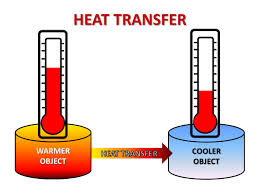
In heat transfer, heat always flows from the _______________ substance to the _______________ substance.
a)
Hotter to colder
b)
Colder to hotter
c)
Hotter to hotter
d)
Colder to colder
51.
The type of heat transfer that happens through direct contact of molecules or particles with each other is ___________________.
a)
Convection
b)
Conduction
c)
Radiation
d)
insulation.
52.
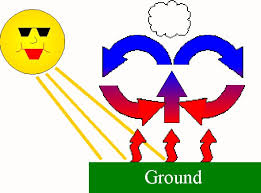
___________________ is the type of heat transfer that occurs in fluids, such as warm air rising and cold air sinking; creating wind.
a)
Convection
b)
Conduction
c)
Radiation
d)
insulation.
53.
Which statement is true?
a)
The quicker a molecule moves, the colder it is.
b)
The slower a molecule moves, the warmer it is.
c)
The quicker a molecule moves, the warmer it is
d)
The movement on molecule don�t affect its temperature
54.
Two objects at different temperatures are in contact. Which of the following happens to their thermal energy?
a)
Their thermal energies remain the same.
b)
Thermal energy passes from the cooler object to the warmer object
c)
Thermal energy passes from the warmer object to the cooler object.
d)
Thermal energy passes back and forth equally between the two objects.
55.
Heat from warm sand at the beach moves through the atmosphere by what method of heat transfer?
a)
Convection
b)
Conduction
c)
Radiation
d)
insulation.
56.
Marcie played with her friends out in the cold, cloudy weather, wearing her wool hat. After the group had finished building snowmen and having snowball fights, Marcie went back inside to warm up and drink some hot chocolate. When she took her hat off, she realized that it was very warm. What happened?
a)
The radiant energy from the sun warmed up her hat and the hat kept that heat from the sun.
b)
�� Her hat was warm because wool fabric is warmer than other fabrics.
c)
The humidity outside made her hat warm.
d)
Conduction between Marcie�s warm body and the hat occurred and the hat remained warm because it is an insulator.
57.
Students in a science class performed an experiment with hot and cold water. They dyed the hot water red and the cold water blue. When the students layered the water, they noticed that the hot water rose to the top and the cold water sank. What was this demonstrating?
a)
Radiation
b)
Air Pressure
c)
Evaporation
d)
Density
58.
When you use a microwave, what is the main way that heat is transferred?
a)
Convection
b)
Conduction
c)
Radiation
d)
insulation.
59.
The handle of a metal spoon warms up when it is placed in a hot bowl of soup because of
a)
Convection
b)
Conduction
c)
Radiation
d)
insulation.
60.
Which of the following is NOT a conductor?
a)
oven mitt
b)
curling iron
c)
iron skillet
d)
copper pipe
61.
A large house being heated by heater warms a house when the air is circulating.
a)
Convection
b)
Conduction
c)
Radiation
d)
insulation.
62.
Which of the following is the best example of conduction?
a)
A light bulb warming a lampshade
b)
An egg cooking in a frying pan
c)
Water boiling in a pot
d)
Gases circulating in the atmosphere
63.
Which statement is true about radiation?
a)
Radiation is the transfer of heat through electromagnetic waves
b)
Radiation is the transfer of heat through direct contact.
c)
Radiation is more dangerous than conduction.
d)
Radiation is the transfer of heat through liquids and gases
64.
Which situation best represents convection?
a)
Heat from a campfire
b)
A hot air balloon taking off
c)
Touching a hot piece of metal
d)
Getting sunburned
65.
Which situation best represents conduction?
a)
Heat from a campfire
b)
A hot air balloon taking off
c)
Touching a hot piece of metal
d)
Getting sunburned
66.
How much energy radiated by the sun reaches Earth?
a)
about 80%
b)
about two-billionths
c)
about 50%
d)
about one one-hundredth
67.
The process by which gases in the atmosphere absorb thermal energy and radiate it back to earth is called
a)
the thermal effect.
b)
the greenhouse effect.
c)
global warming.
d)
radiation balance
68.
When the amount of energy received from the sun and the amount of energy returned to space are about equal, it is called
a)
radiation balance
b)
seasonal equality.
c)
solar reradiation.
d)
global warming.
69.
What is the definition of CONVECTION
a)
When heat transfers through waves.
b)
When heat transfers from objects that are touching.
c)
a  hot liquid or air that  expands, becomes less dense, and rises or becomes more dense, and sinks.
d)
Heat traveling from the sun
70.
The cycle that powers the ocean currents, weather, and tectonic plates it called
a)
conduction current
b)
radiation
c)
condition current
d)
convection current
71.
Heat transfers from an area of ____temperature to an area of ___ temperature.
a)
high to low
b)
low to high
c)
high to high
d)
It can travel high to low and low to high. 
72.
What kind of heat transfer happens when the sun is heating your body?
a)
Conduction
b)
Radiation
c)
Convection
d)
Density
73.
Warm air rises and the cool air sinks demonstrates this type of heat transfer. 
a)
conduction
b)
convection
c)
radiation
d)
Insolation 
74.
The baby chickens are kept warm from the heat lamps demonstrates this type of heat transfer. 
a)
conduction
b)
convection
c)
radiation
75.
Walking on the warm sand sand with your bare feet demonstrates this type of heat transfer. 
a)
conduction
b)
convection
c)
radiation
76.
Johnny accidentally grabbed the handle of the hot pot.
a)
conduction
b)
convection
c)
radiation
77.
A group of friends gather around a fire to stay warm.
a)
conduction
b)
convection
c)
radiation
78.
Transfer of thermal energy through "space"
a)
conduction
b)
convection
c)
radiation
79.
Transfer of thermal energy through "flow"
a)
conduction 
b)
convection
c)
radiation
80.
Transfer of thermal energy through "touch"
a)
conduction
b)
convection
c)
radiation
81.

movement of energy that occurs due to differences in temperature and density

a)

radiation

b)

conduction

c)

convection

82.
Which is an example of conduction?
a)
Steam is rising from a cup of hot coffee.
b)
A hot biscuit is warming the plate it is on.
c)
The sun is shining through a window and warming a table.
d)
Grilling a hot dog over a campfire.
83.
Which is an example of convection?
a)
the heat coming from a campfire
b)
a spoon in a bowl of soup becoming warmer
c)
warmer water at the surface of a swimming pool
d)
a hamburger being warmed by a campfire
84.
Radiation is when energy is transferred...
a)
by contact
b)
by flow of fluid in liquid or gas
c)
by waves or rays
d)
this is not an energy-transfer process
85.
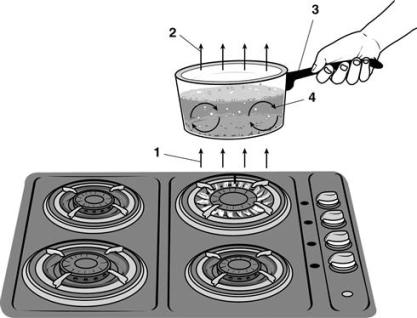
Which numbered part of the picture represents the way that energy from the sun reaches Earth?
a)
1
b)
2
c)
3
d)
4
86.
What is the original source of most of the energy that people use?
a)
Energy that reaches Earth by radiation from the sun.
b)
Energy that reaches the earth by convection from the sun.
c)
Energy that reaches the earth by radiation from the core.
d)
Energy that reaches the earth by conduction from the core.
87.

A crayon placed on a dark driveway in bright sunlight melted into a colorful puddle. What caused the crayon to melt?

a)

Solar radiation heated the driveway and then heat transferred to the crayon by conduction.
b)

Solar radiation heated the driveway and then heat transferred to the crayon by radiation.

c)

Solar convection heated the driveway and then heat transferred to the crayon by radiation.

d)

Solar convection heated the driveway and then heat transferred to the crayon by conduction.
88.
How many kinds of heat transfer are there?
a)
1
b)
2
c)
3
d)
4 or more
89.
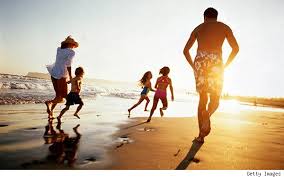
The sun shines down on this family as the play on the beach.
a)
conduction
b)
convection
c)
radiation
90.
A group of friends gather around a fire to stay warm.
a)
conduction
b)
convection
c)
radiation
91.
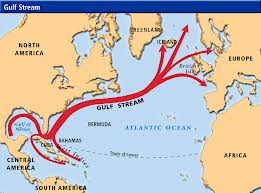
The Gulf Stream is a current that brings warm ocean water from the south to the north.
a)
conduction
b)
convection
c)
radiation
92.
Walking on the warm sand sand with your bare feet.
a)
conduction
b)
convection
c)
radiation
93.
Blow drying your wet hair.
a)
conduction
b)
convection
c)
radiation
94.
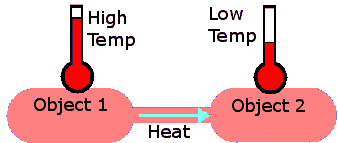
Which direction will the heat flow while this person holds a hot cup of tea?
a)
from the cup to her hand
b)
from her hand to the cup
c)
no heat is transferred
95.
Which direction will the heat flow while this ice cap melts?
a)
there is no heat transfer
b)
from the icecap to the water
c)
from the water to the icecap
96.
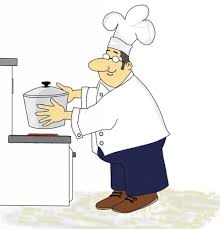
The man goes to take the hot pot off the stove with his bare hands.
a)
conduction
b)
convection
c)
radiation
97.
In some cultures, walking on fire is the ultimate sign of strength.
a)
conduction
b)
convection
c)
radiation
98.
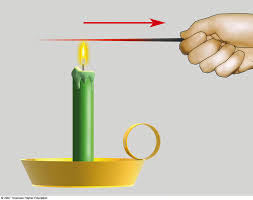
The candle will slowly heat the metal and transfer the heat directly to the mans hand.
a)
conduction
b)
convection
c)
radiation
99.
The chocolate bunny and the iron.
a)
conduction
b)
convection
c)
radiation
100.
The chocolate bunny and the blow dryer.
a)
conduction
b)
convection
c)
radiation
101.
How many kinds of heat transfer are there?
a)
1
b)
2
c)
3
d)
4 or more
102.
What is the definition of CONDUCTION?
a)
When heat is transferred from objects like rays of light or electromagnetically.
b)
a  hot liquid or air that  expands, becomes less dense, and rises or becomes more dense, and sinks.
c)
When heat transfers from objects that are touching.
d)
When heat transfers through the heater or AC in your house.
103.
What is the definition of CONVECTION
a)
When heat transfers through the heater or AC in your house.
b)
When heat transfers from objects that are touching.
c)
a  hot liquid or air that  expands, becomes less dense, and rises or becomes more dense, and sinks.
d)
 hot liquid or air that  expands, becomes less dense, and rises or becomes more dense, and sinks.
104.
What is the definition of RADIATION
a)
 hot liquid or air that  expands, becomes less dense, and rises or becomes more dense, and sinks.
b)
When heat is transferred from objects like rays of light or electromagnetically.
c)
When heat transfers from objects that are touching.
d)
When heat transfers through the heater or AC in your house.
105.
What kind of heat transfer happens when the sun is heating your body?
a)
Conduction
b)
Radiation
c)
Convection
d)
Density
106.
What heat transfer happens when you burn your hand by touching a fire?
a)
Radiation
b)
Conduction
c)
Convectio
d)
I don't know!!!!!!!!!!!
107.
Which of the following is needed for convection to happen?
a)
Fluid/s
b)
Light in the form or rays
c)
Electromagnetic waves
d)
Fire
108.
When a pot is  touching a stove that is on, what heat transfer is happening?
a)
I don't know??????
b)
Radiation
c)
Conduction
d)
Convection
109.
The heat from a hot burner to a pot is transferred by ______.
a)
convection
b)
insulation
c)
radiation
d)
conduction
110.
The way the heat is moving from the hot coffee is called...
a)
convection
b)
radiation
c)
insulation
d)
conduction
111.
This is a lava lamp. When the light bulb heats the wax, the wax rises. When the wax cools, it falls. This cycle of rising/falling is an example of:
a)
Conduction.
b)
Convection.
c)
Radiation.
112.
Warm air rises and the cool air sinks demonstrates this type of heat transfer. 
a)
conduction
b)
convection
c)
radiation
d)
Insolation 
113.
The baby chickens are kept warm from the heat lamps demonstrates this type of heat transfer. 
a)
conduction
b)
convection
c)
radiation
114.
Heat transfers from an area of ____temperature to an area of ___ temperature.
a)
high to low
b)
low to high
c)
high to high
d)
It can travel high to low and low to high. 
115.
Walking on the warm sand sand with your bare feet demonstrates this type of heat transfer. 
a)
conduction
b)
convection
c)
radiation
116.
Ironing a shirt is an example of...
a)
condensation
b)
conduction
c)
convection
d)
radiation
117.
Warm air is __________ dense than cold air and rises creating convection currents.
a)
more
b)
less
118.
A toaster toasting bread is an example of 
a)
condensation
b)
conductio
c)
convection
d)
radiation
119.
Johnny accidentally grabbed the handle of the hot pot.
a)
conduction
b)
convection
c)
radiation
120.
The man goes to take the hot pot off the stove with his bare hands.
a)
conduction
b)
convection
c)
radiation
121.
A group of friends gather around a fire to stay warm.
a)
conduction
b)
convection
c)
radiation
122.
The candle will slowly heat the metal and transfer the heat directly to the mans hand.
a)
conduction
b)
convection
c)
radiation
123.
The chocolate bunny and the lamp.
a)
conduction
b)
convection
c)
radiation