
 Worksheets
Space Review
Total questions: 62
Worksheet time: 45mins


What happens when the area in which you live tilts AWAY from the sun?
It is summer.
It is spring.
It is winter.
It is fall.

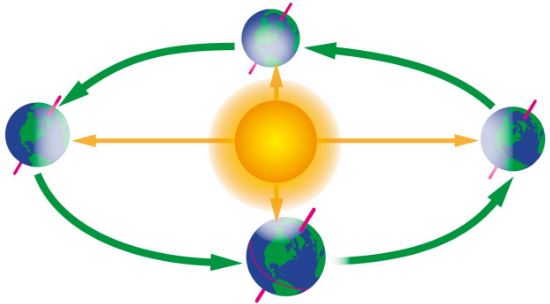
In spring/summer for the northern hemisphere, the axis of the earth is pointed away or toward the sun?
towards
Neither away or toward
away


Eugene's hemisphere
northern
southern

What is the name of this moon phase?
New Moon
Full Moon
Black Moon
This is not a moon

How long does it take the moon to make one complete revolution around the Earth?
2 days
One year
About 28 days
About 14 days

The moon ____________ around the Earth.
revolves
rotates
up
down
The moon __________ around the Earth.
rotates
revolves
axis
The Earth __________ around the sun.
rotates
revolves
axis
The Earth __________ on its axis.
rotates
revolves
axis
Is Earth's axis was at 0°, we would have the same number of daylight hours every day.
true
false
Is Earth's axis was at 90°, we would have the same number of daylight hours every day.
true
false
Is Earth's axis was at 0°, we would have very different temperatures every day.
true
false
How old is the Earth?
10 million years
4.5 billion years
5 million years
4 million years
Gravity is a ________.
force
movement
space
The more _______ an object has, the more gravity is has.
gravity
size
mass
volume
Which planet in our solar system has the most gravity?
Mercury
Venus
Jupiter
Neptune

Which planet in our solar system has the least gravity?
Mars
Venus
Jupiter
Neptune
The Earth's gravity pulls objects _____
towards its center.
down
up
The action of moving on an axis.
rotation
revolution
axis
The movement of an object in a circular or elliptical course around another object.
rotation
revolution
axis
An imaginary line on which an object rotates.
rotation
revolution
axis

Earth's tilted axis is at what angle?
32.5 degrees
23.5 degrees
15.3 degrees
3.5 degrees
The Earth ______________ around the sun.
rotates
revolves
axis
The Earth ______________ on its axis.
rotates
revolves
axis
The Moon ______________ around the Earth.
rotates
revolves
axis
Which of these causes Earth's day/night cycle?
Earth's revolution around the sun.
Earth's rotation on its axis.
The Moon's revolution around Earth.
Which of these causes Earth's year cycle?
Earth's revolution around the sun.
Earth's rotation on its axis.
The Moon's revolution around Earth.
Which of these causes Earth's month cycle?
Earth's revolution around the sun.
Earth's rotation on its axis.
The Moon's revolution around Earth.

Which of these causes Earth's seasons?
Earth's tilted axis
Earth's revolution
Earth's rotation
This takes 365 1/4 days to complete.
Earth's rotation on its axis.
The Moon's revolution around the Earth.
Earth's revolution around the sun.
The takes 24 hours to complete.
Earth's rotation on its axis.
The Moon's revolution around the Earth.
Earth's revolution around the sun.

This is tiled 23.5 degrees.
A
B
C
D
G
This is the reason we see the sun move across the sky during the day.
A
B
C
D
G
This takes about 28.5 days (a month) to complete.
A
B
C
D
G
This takes 24 hours to complete.
A
B
C
D
G
This takes 365 1/4 days to complete.
A
B
C
D
G
How many planets are in our solar system?
7
8
9
Which planet is closest to the sun?
Mercury
Venus
Earth
Which of these describes the type of planet that Earth is?
rocky/terrestrial
gas giant
ice giant
Which of these describes the type of planet that Jupiter is?
rocky/terrestrial
gas giant
ice giant
Which of these describes the type of planet that Neptune is?
rocky/terrestrial
gas giant
ice giant
Which of these describes the type of planet that Saturn is?
rocky/terrestrial
gas giant
ice giant
Besides Earth, which of these is a rocky/terrestrial planet?
Mercury
Neptune
Jupiter

