wayground logo

Free Printable Worksheets

NEW

Font size

S
M
L
XL
Worksheets

7th Grade Unit 05 Adaptations

Total questions: 45

Worksheet time: 23mins

Name
Class
Date
1.

Organisms better suited to their environment survive easier and longer than those who aren't

a)

Natural Selection

b)

Adaption

c)

Artificial Selection

d)

Speciation

2.

Scientist who proposed the theory of natural selection

a)

Robert Hooke

b)

Charles Darwin

c)

Alfred Wegener

d)

Albert Einstein

3.

Species movement from one location to another due to climate or a food source.

a)

Hibernation

b)

Migration

c)

Dormancy

d)

Pollination

4.

The action of an organism changing to better suit its new or old environment.

a)

Natural Selection

b)

Physical Trait

c)

Camouflage

d)

Adaptation

5.

A state organisms go into to spend the winter in close quarters in a dormant condition

a)

Hibernation

b)

Dormancy

c)

Homeostasis

d)

Pollination

6.

What adaptation is represented by the image?

a)

Dormancy

b)

Camouflage

c)

Hibernation

d)

Seed Dispersal

7.

What adaptation is represented by the image?

a)

Camouflage

b)

Beak Design

c)

Hibernation

d)

Seed Dispersal

8.

What adaptation is represented in the image?

a)

Hibernation

b)

Camouflage

c)

Dormancy

d)

Pollination

9.

___ structures are found on the outside of living things.

a)

Internal

b)

External

10.
Coloring or another physical characteristic that help an organism blend in with its environment
a)
mimicry
b)
camouflage
c)
hibernation
d)
migration
11.
When an organism copies a characteristic of something else in order to better its chances for survival and reproduction
a)
hibernation
b)
camouflage
c)
mimicry
d)
migration
12.
The seasonal movement of an organism from one place to another
a)
camouflage
b)
migration
c)
hibernation
d)
function
13.
When an organism slows its life functions for a period of time to better its chances for survival during harsh conditions
a)
camouflage
b)
migration
c)
mimicry
d)
hibernation
14.

What does external mean?

a)

It means something on the inside.

b)

It is a part of the environment that you see.

c)

It means on the outside, or something you can see.

d)

It means it is something you place on the outside.

15.

What is meant by adaptation?

a)

An animal can swim in warm water and cold water.

b)

It is any characteristic that helps a plant or animal survive in its environment.

c)

It is a habitat that animals can change.

d)

They develop over long periods of time.

16.

Plants must adapt to their environment, too. Plants that live in dry climates usually have

a)

big, round stems

b)

wide leaves to absorb sunlight

c)

small leaves coated in thick wax

d)

short, small leaves

17.

Is the xylem a tissue or is it a cell?

a)

cell

b)

tissue

18.

What is the main function of the xylem?

a)

transport water from the root to the stem then to the leaf

b)

transport water from the leaves to where it is needed

c)

protecting the plant against infectious diseases

d)

organic food from the leaves to where it is needed

19.

Which internal adaptation allows dish to breathe underater?

a)

fins

b)

gills

c)

scales

d)

spawning

20.

Which internal adaptation allows a bird to fly?

a)

feathers

b)

hollow bones

c)

wings

d)

beaks

21.

Which internal adaptation allows water to be transported through the roots of a plant?

a)

pollen

b)

phloem

c)

xylem

d)

stem

22.

Which of these is not an internal structural adaptation?

a)

light skeleton

b)

large lungs

c)

four-chambered heart

d)

thick fur

23.

Which statement best summarizes the internal structure adaptations frame?

a)

Internal structure adaptations have developed inside organisms to allow specific functions to support reproduction.

b)

Internal structure adaptations have developed inside organisms to allow specific functions to support the environment.

c)

Internal structure adaptations have developed inside organisms to allow specific functions to support survival.

d)

Internal structure adaptations have developed inside organisms to allow an organism to hunt other organisms.

24.

A stimulus type that occurs within the organisms body is

a)

external

b)

inside

c)

within

d)

internal

25.

An inherited trait that helps those organisms that have it to survive.

a)

niche

b)

structure

c)

characteristic

d)

adaptation

26.

When an organism slows its life functions for a period of time to better its chances for survival during harsh conditions.

a)

camouflage

b)

migration

c)

mimicry

d)

hibernation

27.

Function is _________.

a)

the way something looks

b)

how something sounds

c)

what something does

d)

the role of an organism

28.
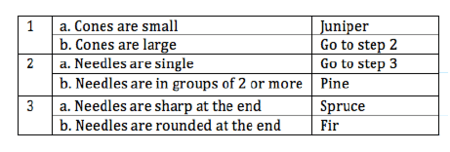
A dichotomous key for trees is provided. Hikers found a tree that has large brown cones and single sharp needles. What species of tree have the hikers found?
a)
Juniper
b)
Pine
c)
Spruce
d)
Fir
29.
A dichotomous key for insects is given. To what order does an insect with two pairs of scaly wings belong?
a)
Coleoptera
b)
Heteroptera
c)
Diptera
d)
Lepidoptera
30.
What step do we always start with when using dichotomous keys?
a)
1
b)
2
c)
3
d)
4
31.
When using a dichotomous key to identify organisms, what do we look at?
a)
physical features
b)
weather patterns
c)
environment
d)
diet
32.
What do plants give off after photosynthesis?
a)
Oxygen
b)
carbon
c)
nitrogen
d)
hydrogen
33.
Plants need ________from the air for photosynthesis
a)
oxygen
b)
soil
c)
carbon dioxide
d)
sugar
34.
What molecule absorbs sunlight during photosynthesis?
a)
Epidermis
b)
thylakoid
c)
the leaf
d)
chlorophyll
35.
Which statement about photosynthesis is correct?
a)
Plants get the energy they need for photosynthesis from water.
b)
Plants get the energy they need for photosynthesis from soil.
c)
Plants get the energy they need for photosynthesis from sunlight.
d)
Plants do not require energy to perform photosynthesis.
36.
The products of photosynthesis are
a)
water and carbon dioxide
b)
oxygen and water
c)
sugar and cabon dioxide
d)
oxygen and sugar (glucose)
37.
Drawn observed several different types of finches.  Why are there so many different types?
a)
Finches live in different places, but eat the same food.
b)
Finches live in the same place, but eat different types of food.
c)
Finches live in different habitats and eat different types of food.
d)
Finches are found all over the world.
38.
The differences among a species, like different bird beaks, are called
a)
genes.
b)
variations.
c)
traits.
d)
theories.
39.
Organisms with the most beneficial traits will survive.  This is commonly known as
a)
theory of evolution.
b)
variations.
c)
survival of the fittest.
d)
ecosystems.
40.
This scientist developed the theory of evolution as he studied the finches.
a)
Charles Darwin
b)
Isaac Newton
c)
Albert Einstein
d)
Marie Curie
41.
Where the better adapted organisms survive to pass traits along to offspring.
a)
Evolution
b)
Natural Selection
c)
Extinction
d)
Artifical Selection
42.
The purpose of selective breeding is to 
a)
Get bigger animals
b)
get smaller animals
c)
create animals with desirable traits
d)
create animals with bad traits
43.
Which is another term for selective breeding?
a)
Artificial selection
b)
Natural Selection
c)
Intelligent selection
44.
A farmer has bred his pineapple plants from the sweetest pineapples from his last harvest to get even sweeter pineapple plants. What is this an example of?
a)
Selective breeding
b)
Natural selection
c)
Extinction
d)
Mutagenesis
45.
Evidence shows that the wolf is the ancestor to all of the breeds of dogs shown below. How did this variation arise in a relatively short period of time?
a)
A.  Genetic manipulation
b)
Natural selection
c)
Random chance
d)
Selective breeding