Wayground logo

Free Printable Worksheets

Font size

S
M
L
XL
Worksheets

Mid-Year review.

Total questions: 96

Worksheet time: 2hrs 40mins

Name
Class
Date
1.
The plaque build up in the blood vessels is known as-
a)
atherosclerosis
b)
cyanosis
2.
Cholesterol ( increases viscosity) in the blood and can cause all the following EXCEPT-
a)
increase in blood pressure
b)
slowing of the blood flow
c)
increase in the blood flow.
d)
possible coronary heart disease
3.
Exercise effects on the body include all of the following EXCEPT
a)
increased heart rate
b)
decreased heart rate
c)
increase of blood flow to the muscles
d)
increase in blood pressure
4.
Which part of the immune systems response is faster/ quicker.
a)
Innate- (Born with) 
b)
Acquired ( response to an antigen)
5.
The first line of defense from pathogens is the -
a)
skin
b)
mucus membranes
c)
macrophages 
d)
t-cells
6.
Which of the following is not a 1st or 2nd line of defense of the immune system.
a)
mucous membranes
b)
fever
c)
inflammation
d)
antibodies ( B-cells & T cells)
7.
Antibodies are produced in response to a foreign Antigen
a)
True
b)
False
8.
Antibiotics are effective against both BACTERIA and VIRUSES.
a)
True
b)
False
9.
Which characteristic of water will allow a paperclip to remain floating on water when the paperclip is gently placed on top of the water?
* it has to be lighter than the hydrogen bonds
a)
adhesion
b)
surface tension
c)
solvent properties
d)
nonpolar
10.
Water is often called the "universal solvent" because many substances can be dissolved in water. What property of water allows it to be such a versatile solvent?
a)
purity
b)
polarity and cohesion
c)
high heat capacity
d)
expansion upon freezing
11.
Water has a high specific heat which means it responds slowly to changes in _____________.
a)
temperature
b)
polarity
12.

What is the main difference between prokaryotic and eukaryotic cells?

a)

Prokaryotic cells have a nucleus and Eukaryotic cells do not

b)

Prokaryotic cells are unicellular and Eukaryotic cells are multicellular.

c)

Prokaryotic cells do not have a nucleus, Eukaryotic cells do have a nucleus.

d)

Prokaryotic cells are plant cells and Eukaryotic cells are animal cells.

13.

The main function of chloroplasts is:

a)

To control what enters and leaves the cell.

b)

To break down food to release energy for the cell.

c)

To control all activities of the cell.

d)

To produce food for the cell using the sun's energy.

14.

Which types of organisms are Prokaryotes?

a)

Animals

b)

Plants

c)

Fungi

d)

Bacteria

15.

This is referred to as the energy currency of the cell

a)

ADP

b)

ATP

c)

Mitochondria

d)

Nucleus

16.
Vaccinations are used for
a)
Curing the illness
b)
Preventing the Illness
c)
Getting the illness
17.
What type of microbe is used in a vaccine?
a)
it doesn't really matter
b)
a damaged one
c)
a weakened or inactivated one
d)
a normal one
18.
Vaccines stimulate the body to produce...
a)
autoimmune diseases
b)
helper t-cells
c)
fever
d)
antibodies
19.
Antibiotics work against most
a)
Bacteria
b)
Bacteria & Viruses
c)
Vaccines
d)
Viruses
20.
The shrew provides energy for the _______?
a)
cricket
b)
grasshopper
c)
frog
d)
snake
21.
Soil is an example of...
a)
Biotic Factor
b)
Abiotic Factor
c)
living organism
d)
autotroph
22.

The efficiency of energy transfer from a lower trophic level to the next highest level is roughly

a)

1%

b)

10%

c)

100%

d)

1000%

23.

The arrows in a food chain or web represents what?

a)

They point to the organism that is being eaten.

b)

It shows how sunlight flows within an ecosystem.

c)

They show what direction the energy is flowing between organisms.

d)

They represent how water is transferred within a habitat.

24.

High blood viscosity means

a)

There is a high concentration of blood cells and solutes

b)

The blood is more thick and the heart has to pump harder

c)

Blood pressure goes up

d)

All are correct

25.

Atherosclerosis is caused by

a)

a buildup of fat in the arteries

b)

a buildup of protein in the arteries

c)

a buildup of calcium in the arteries

d)

a buildup of sodium in the arteries

26.

Which of these molecules stores the most energy?

a)

NADH

b)

NAD+

c)

ADP

d)

ATP

27.

Which of the following organisms are LEAST closely related?

a)

organisms that share a domain

b)

organisms that share a family

c)

organisms that share a genus

d)

organisms that share a species

28.

Cells that do not have a true nucleus are called....

a)

eukaryote

b)

prokaryote

c)

unicellular

d)

multicellular

29.

Cells that have a true nucleus are called....

a)

eukaryotes

b)

prokaryotes

c)

unicellular

d)

multicellular

30.

Cells that have a true nucleus are called....

a)

eukaryotes

b)

prokaryotes

c)

unicellular

d)

multicellular

31.

Should experiments be repeated over and over to see if the results are the same each time?

a)

yes

b)

no

32.

Under a microscope, a student observes a specimen containing a cell wall, nucleus, and chloroplasts. Which of the following could the specimen being observed belong to?

a)

oak tree leaf

b)

human

c)

bacteria

d)

cat hair

33.
Which of the following would help you determine if the image shown comes from a plant or an animal?
a)
the number of mitochondria
b)
the size of the vacuole
c)
the presence of a cell wall
d)
all of these could be used
34.

Which of the following does a bacteria cell NOT have in common with a plant cell?

a)

cytoplasm

b)

cell membrane

c)

genetic material (DNA)

d)

nucleus

35.

What is the purpose of an enzyme?

a)

give permission for the reaction

b)

raise activation energy

c)

speed up reactions

d)

control how many reactions occur

36.
Which of the following is the correct matching of brain lobe regions?
a)
White=parietal, Pink=temporal, Blue=frontal, & Green=occipital
b)
White=frontal, Pink=parietal, Blue=occipital & Green=temporal
c)
White=temporal, Pink=occipital, Blue=frontal & Green=parietal
d)
White=frontal, Pink=occipital, Blue=temporal, & Green=parietal
37.

What are the reactants (what's needed) for photosynthesis?

a)

glucose and oxygen

b)

light, water, and carbon dioxide

38.

What is the purpose of photosynthesis?

a)

make glucose

b)

make ATP

c)

make light

d)

release carbon dioxide

39.

What type of organism uses photosynthesis?

a)

plants

b)

bacteria

c)

animals

d)

both plants and bacteria

40.

What is the gas we breath out that plants use for photosynthesis?

a)

sulfur

b)

carbon dioxide

c)

oxygen

d)

hydrogen

41.

Unlike active immunity, passive immunity causes

a)

long term resistance to disease

b)

short and long term resistance to disease

c)

no resistance to disease

d)

short term resistance to disease

42.
What is one way in which all living things on Earth are alike?
a)
All living things have hair.
b)
All living things are made of cells and come from other cells.
c)
The cells of all living things have chloroplast.
d)
All living things can move. 
43.

What might happen if you remove a primary consumer from the ecosystem?

a)

There would be more food for secondary consumers.

b)

The number of primary consumers would increase.

c)

The number of plants would increase.

d)

The number of secondary consumers would increase.

44.
Darwin wrote that organisms with traits that are best suited to the environment will ________________
a)
increase in number
b)
become extinct
45.
Which species’ DNA is most similar to the DNA of the toothed whale? 
a)
Hippopotamus 
b)
Baleen Whale
c)
Grazing Mammals
d)
Camels
46.
Letter D
a)
Frontal
b)
Parietal
c)
Occipital
d)
Temporal
47.
a)
Cerebrum
b)
Cerebellum
c)
Brain Stem
d)
Diencephalon
48.
Letter H
a)
Pituitary gland
b)
hypothalamus
c)
thalamus
d)
midbrain
49.
Letter J
a)
pons
b)
medulla oblongata
c)
midbrain
d)
 cerebellum
50.
Letter K
a)
pons
b)
medulla oblongata
c)
cerebellum
d)
midbrain
51.
Letter N
a)
frontal
b)
parietal
c)
temporal
d)
occipital
52.

What is one way that someone can get active acquired immunity?

a)

genetic disposition

b)

gamma globulin

c)

antitoxins

d)

having a disease

53.
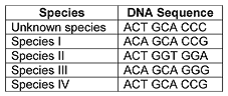
According to this data, the unknown bacterial species is most closely related to: 
a)
Species I
b)
Species II
c)
Species III
d)
Species IV
54.
The similarities of organisms in which two areas numbered in the picture provide the best evidence for common ancestry?
a)
1 and 2
b)
3 and 4
c)
5 and 6
d)
7 and 8
55.

What are the results of high blood pressure?

a)

Leaking Arteries

b)

Heart attack or stroke

c)

Lifestyle Diseases

d)

Insomnia

56.

What helps prevent High Blood Pressure?

a)

Physical Excersise

b)

Stress Management

c)

All of the Above

d)

Low Sodium Diets

57.

A well-tested concept that explains a wide range of observations is called a(an):

a)

hypothesis

b)

experiment

c)

cause and effect

d)

scientific theory

58.

What is another name for natural selection?

a)

survival of the smartest

b)

survival of the fastest

c)

survival of the biggest

d)

survival of the fittest

59.

__________ immunity is when the bodies makes its own antibodies.

a)

passive

b)

active

c)

cell mediated

d)

false

60.

____________ immunity occurs when an individual receives antibodies.

a)

active

b)

passive

c)

false

d)

cell mediated

61.

A possible explanation to a problem that has not yet been tested.

a)

data

b)

theory

c)

hypothesis

d)

fact

62.
a)
frontal
b)
temporal
c)
occipital
d)
parietal
63.

Where does cellular respiration occur?

a)

Nucleus

b)

Mitochondria

c)

Vacuole

d)

Chloroplast

64.

Which of the following is a risk factor of heart disease?

a)

Working out for 30 minutes

b)

Smoking

c)

Playing video games

d)

Drinking fruit juice

65.

Atherosclerosis can lead to heart disease. What is Atherosclerosis?

a)

Blood clots

b)

A weakening of heart muscles

c)

A disease of the arteries that deposits plaques of fatty material on their inner walls

d)

Structural problems

66.
Scientist sometimes compare the limbs of these organisms to look for evidence of common ancestry.
These limbs provide evidence of common ancestry because they— 
a)
have the same basic structure
b)
are the same size
c)
are parts of mammals
d)
perform the same function
67.
The study of the early stages of development that is one evidence of evolution is:
a)
Homologous Structures
b)
Embryology
c)
Vestigial Organs
68.
Letter A
a)
frontal
b)
parietal
c)
occipital
d)
temporal
69.
The male parts of a plant composed of anther and filament
a)
Stamen 
b)
Pistil
c)
Style
d)
Ovary 
70.
The female parts of a flower composed of the stigma, style and ovary.
a)
pistil
b)
stamen 
c)
anther
71.

Which structure is shown by A ?

a)

Stigma

b)

Style

c)

Ovary

d)

Petal

72.

Which female structure contains the ovules (eggs) located below the style.

a)

ovary

b)

stigma

c)

anther

73.

Which structure is shown by E ?

a)

Stigma

b)

Style

c)

Ovary

d)

Petal

74.

Which male structure produces POLLEN?

a)

Anther

b)

Filament

75.

Which structure is shown by B ?

a)

Stamen / Anther

b)

Style

c)

Ovary

d)

Petal

76.

The main products of cellular respiration are : select 3

a)

Carbon Dioxide

b)

Water

c)

ATP- Energy

d)

Oxygen

77.
1. How are cellular respiration and photosynthesis related, in terms of energy? 
a)
The energy captured in photosynthesis is used to power cellular respiration. 
b)
The energy transformed in cellular respiration is used to power photosynthesis
78.
The diagram below shows the relationship between photosynthesis and cellular respiration and the organelles in which they occur. Which statement describes how photosynthesis and cellular respiration are interrelated?
a)
Carbon dioxide and water released by cellular respiration are used in photosynthesis.
b)
Glucose is used during cellular respiration to produce food that is broken down during photosynthesis.
79.
The following is the formula for 
a)
photosynthesis
b)
cellular respiration
80.
The following is the equation for 
a)
photosynthesis
b)
cellular respiration
81.
Which gas is released in the bubbles in the experiment shown?
a)
oxygen
b)
carbon dioxide
82.
Which of the following are the reactants of photosynthesis? 
a)
water and glucose
b)
glucose and carbon dioxide
c)
carbon dioxide and water
d)
 oxygen and water
83.

Which colors of lights are best absorbed by the CHLOROPLAST in photosynthesis.

a)

greens and yellows

b)

reds and blues

84.

Photosynthesis takes place in the - ________ found in the leaf of a plant.

a)

chloroplast

b)

vacuole

c)

cell wall

85.

Cellular respiration occurs in the _____________ in both plant and animal cells.

a)

mitochondria

b)

cellular respiration

86.
The stomata is important in plants leaves because is where the exchange of _______________ (carbon dioxide and oxygen takes place).
a)
gasses
b)
minerals
c)
water 
d)
ntrients
87.

The GUARD CELL protects the SOMATA- if the STOMATA is closed the plant is trying to conserve-

a)

water

b)

oxygen

88.
A well substantiated explanation based on facts that have repeatedly confirmed through an observation. 
* can't be proven but there is evidence that supports it.
* can be change if new evidence is found.
a)
Theory
b)
Law
89.
In order for an experiment to be excepted it has to be reliable, valid and and pass approval by a _________ review.
* experimental results have to reviewed before approval.
a)
peer
b)
pear
c)
pier
d)
pere
90.
Which organism receives the least amount of energy from the producers?
a)
Lizard
b)
Hawk
c)
Mouse
d)
Snake
91.
Very rarely do ecosystems contain more than four trophic levels, because there is not  enough energy to support more.In which trophic level is there the least energy available?
a)
tertiary consumer
b)
secondary consumer
c)
primary consumer
d)
producer
92.
Removal of which organism would effect all other organisms in the food web?
a)
krill
b)
zooplankton
c)
phytoplankton
d)
killer whale
93.
What percent of energy is passed on to the next trophic level?
* most energy is lost in the form of heat.
a)
10%
b)
90%
c)
50%
d)
100%
94.
Bacteria and Fungi return nutrients into the environment they are classified as-
a)
prokaryotes
b)
eukaryotes
c)
decomposers
d)
producers
95.
Organisms that create their own food are classified as _________________ (plants) and organisms that receive energy from others are classified as-________________.
a)
autotrophs, heterotrophs
b)
heterotrophs, autotrophs
96.
The maximum number of individuals  an area can support is called its -
a)
carrying capacity
b)
carrying load