wayground logo

Free Printable Worksheets

Font size

S
M
L
XL
Worksheets

Midterm Review

Total questions: 100

Worksheet time: 9hrs 31mins

Name
Class
Date
1.

Different forms of a gene are called ______________

a)

Alleles

b)

Dominant

c)

Recessive

d)

Chromosomes

2.

Characteristics inherited from a parent (such as red hair) are called

a)

Genetics

b)

Dominant

c)

Recessive

d)

Traits

3.

Using the picture of the Punnet Square...

What is "a"

a)

Dominant

b)

Recessive

4.

They physical appearance of an organism is its...?

a)

Genotype

b)

Phenotype

c)

Recessive

d)

Carrier

5.

Which of the following are examples of a homozygous genotype (select all that apply)

a)

Aa

b)

aa

c)

AA

d)

Bb

e)

CC

6.

For this problem assume that round eyes are dominant over oval eyes. R-round, r-oval

Mr. Dawons is heterozygous for round eyes. What is his genotype?

(a)  

7.

For this problem assume that round eyes are dominant over oval eyes. R- round, r- oval.

Ms. Carmoney has oval eyes. What is her genotype?

(a)  

8.

Using the picture of the Punnet Square...

What is the probability that the pea will be green?

a)

0%

b)

25&

c)

100%

d)

75%

9.

What is Biology?

a)

The study of land, water and air on Earth

b)

The study of the living world

c)

The study of plants and animals

d)

The study of the environment

10.

The (a)   system is the measurement system that scientists around the world use for recording data.

11.

Testing hypotheses often involves designing experiments. Which of the following is the factor that is observed and measured in an experiment?

a)

Control Group

b)

Experimental Group

c)

Independent Variable

d)

Dependent Variable

12.

The teacher places a pillow and a full gallon of milk on a table and the students tell the teacher the gallon of water is heavier than the pillow. This would be an example of ____

a)

An Inference

b)

A Variable

c)

Data

d)

Observation

13.

Scientists publish the details of important experiments so that their work can be repeated, their experimental procedures can be reviewed and others can try to reproduce results.

a)

True

b)

False

14.

Holly's Aunt is taking part in an experiment to determine how well a new cancer treatment. In this experiment, the people in Group A are getting the new treatment. The people in Group B, including Holly's Aunt, are getting the treatment that does not contain the new medication. In this experiment, what is Group B?

a)

The Control Group

b)

The Independent Variable

c)

Dependent Variable

d)

Experimental Group

15.

While in Arizona, Morgan goes for a walk with her Mom. She isn't used to the heat and becomes very thirsty. This would be an example of what?

a)

Growth

b)

Metabolism

c)

Homeostasis

d)

Development

16.

Biologists have certain criteria that must be met if something is to be considered living. Living things MUST be able to do what?

a)

Reproduce (either sexually or asexually)

b)

Have a metabolism

c)

Have eyes

17.

The cells of all organisms contain DNA. In cells of which of the following groups is the cellular DNA enclosed in a nucleus?

a)

Virus

b)

Prokaryotes

c)

Eukaryotes

d)

Bacteria

18.

List the parts from least complex to most complex?

a)

muscle tissue, muscle cell, stomach

b)

muscle cell, muscle tissue, stomach

c)

stomach, muscle tissue, muscle cell

d)

stomach, muscle cell, muscle tissue

19.

The main purpose of meiosis is to get daughter cells that

a)

Are identical to the parent cells

b)

have 1/2 the number of chromosomes as the parent cell and have some genetic variation

c)

Get bigger

d)

Are able to adapt

20.

The synthesis (S) phase is characterized by

a)

Cell division

b)

DNA Replication

c)

Anaphase

21.
Building blocks of proteins are
a)
Simple sugars
b)
Amino acids
c)
Monosaccharides
d)
Polysaccharides
22.
Controls what goes in and out of the cell
a)
Cell membrane
b)
Cell wall
c)
Chloroplasts
d)
Nucleus
23.
One of the main difference between prokaryotic and eukaryotic cells is that - 
a)
eukaryotic cells have a more advanced cellular organization
b)
eukaryotic cells have a smaller cell nucleus
c)
prokaryotic cells do not have a plasma membrane
d)
prokaryotic cells are always much larger
24.
The organelle that provides energy for the cell and acts like the "power house" is the
a)
Nucleus
b)
Lysosome
c)
Golgi bodies
d)
Mitochondria
25.
The passive transport of water across a selectively permeable membrane is called___
a)
Osmosis
b)
Facilitated diffusion
c)
Active transport
d)
Exocytosis
26.
Sugar, starch and cellulose are examples of
a)
Lipids
b)
Carbohydrates
c)
Proteins
d)
Nucleic Acids
27.
Fats, oils and waxes are examples of 
a)
Nucleic Acids
b)
Carbohydrates
c)
Lipids
d)
Proteins
28.
Diffusion is the movement of molecules from____
a)
an area of low concentration to an area of high concentration
b)
an area of high concentration to an area of low concentration
c)
an area of equilibrium to an area of high concentration
d)
no movement at all
29.
Most cellular activities are processes regulated by the action of ____
a)
Polysaccharides
b)
Lipids 
c)
Enzymes
d)
Carbohydrates
30.
Bacteria can not grow very large because ___
a)
diffusion of nutrients into the cell's interior would be too slow
b)
energy expenditures would be too great
c)
respiratory rate would be too high
d)
locomotion of the organism would be too slow
31.
What is the difference between aerobic and anaerobic environments?
a)
Anaerobic uses oxygen and aerobic does not
b)
Aerobic and anaerobic environments both use oxygen
c)
Aerobic uses oxygen and anaerobic does not
d)
Aerobic and anaerobic both do not use oxygen
32.
Photosynthesis uses solar energy from the sun to create
a)
High energy sugars like glucose
b)
High energy proteins
c)
High energy lipids
d)
High energy nucleic acids
33.
How are photosynthesis and cellular respiration related processes?
a)
Both provide plant cells with energy
b)
Both provide animal cells with energy
c)
The reactants of respiration are the products of photosynthesis.
d)
The reactants of respiration are the reactants of photosynthesis.
34.
What is an enzyme?
a)
A biological catalyst that works in living cells to speed up chemical reactions.
b)
A biological catalyst that works outside living cells to speed up chemical reactions.
c)
A protein that increases activation energy
d)
A product of chemical reactions.
35.
What is the difference between passive and active transport?
a)
Active transport does not require energy.
b)
Passive transport does require energy.
c)
Passive transport does not require ATP energy, but active transport does.
d)
Active transport does not require ATP energy, but passive transport does.
36.
Facilitated diffusion allows large molecules to pass through the cell membrane with the help of protein channels, but does not require energy. It is a ________ process.
a)
Passive
b)
Active
c)
ATP
d)
Protein
37.
The variable that is being tested or changed
a)
independent variable
b)
dependent variable
c)
control variable
38.
The variable that is being measured
a)
independent variable
b)
dependent variable
c)
control variable
39.
the variable that is kept the same to make sure results are caused by the thing being tested
a)
independent variable
b)
dependent variable
c)
control variable
40.
What is being kept constant?
a)
ramp height
b)
speed of the ball rolling
c)
type of ball
41.

Examine the line graph below. If the population of Centerville continues to increase at the same rate, what will the population be in the year 2010?

a)

16,000 people

b)

6500 people

c)

9500 people

d)

8000 people

42.

The scatterplot shows the amount of rainfall during six thunderstorms and the length of time that each storm lasted. Based on the scatterplot, which statement is true?

a)

During each storm that lasted longer than 1 hour, there was less than 1 inch of rain.

b)

During each storm that lasted longer than 1 hour, there was more than 1 inch of rain.

c)

No storms produced more than 2 inches of rain.

d)

No storms lasted longer than 1 hour.

43.
What type of transport requires energy? 
a)
Active Transport
b)
Facilitated Diffusion
c)
Simple Diffusion
d)
Passive Transport
44.
The cell below is in a _________ solution.
a)
Hypotonic
b)
Hypertonic
c)
Isotonic
45.
The cell below is in a _____________ solution.
a)
Hypertonic
b)
Hypotonic
c)
Isotonic
46.
What type of solution is this cell in?
a)
Isotonic
b)
Hypertonic
c)
Hypotonic
d)
diffused
47.
Which best explains why humans are multicellular organisms?
a)
Human cells are too small to function alone.
b)
Human cells join together to form one large cell.
c)
Humans need many cells to carry out life processes.
d)
Humans have many systems that perform the same function.
48.
When a starfish grows a new body off a broken arm, what kind of reproduction is this?
a)
Sexual
b)
Differentiation
c)
Asexual 
d)
Specialization
49.
Where does an off spring get its traits in asexual reproduction?
a)
From both parents
b)
From only one parent
c)
From neither parent
d)
There are no traits handed down
50.
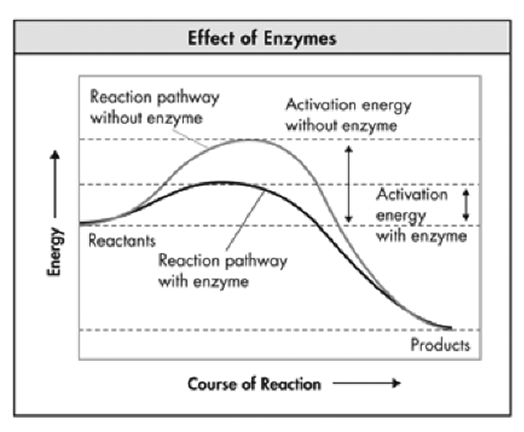
The graph shows how enzymes affect reactions in cells. Which statement best summarizes the information shown in the graph?
a)
Enzymes increase the energy of the reactants.
b)
Enzymes decrease the energy level of the products.
c)
Enzyme decrease the activation energy of the reaction.
d)
Enzymes reverse the direction of the reaction.
51.
Enzymes are...
a)
nucleic acids
b)
proteins
c)
lipids
d)
carbohydrates
52.
What happens when enzymes are heated to a high temperature?
a)
The enzymes die.
b)
The shapes of the enzyme are altered denature
c)
The enzymes' amino acid sequence changes.
d)
The enzymes remain the same
53.
Used for short term (quick) energy.
a)
carbohydrates
b)
lipids
c)
proteins
d)
nucleic acids
54.
Provides long term energy and insulation,
a)
lipids
b)
carbohydrates
c)
nucleic acids
d)
proteins
55.
Contains DNA and RNA
a)
lipids
b)
carbohydrates
c)
proteins
d)
nucleic acids
56.
Building blocks of the body, hair , muscles etc.
a)
protein
b)
nucleic acid
c)
lipids
d)
carbohydrates
57.
Is found in the cell membrane as a bilayer. 
a)
lipids
b)
protein
c)
nucleic acid
d)
carbohydrate
58.
Identify the macromolecule in the picture
*GLUCOSE
a)
lipid
b)
protein
c)
nucleic acid
d)
carbohydrate
59.
Identify the macromolecule in the picture
* cholesterol and triglycerides
a)
carbohydrate
b)
protein
c)
lipid
d)
nucleic acid
60.
Identify the macromolecule in the picture
a)
carbohydrate
b)
lipid
c)
protein
d)
nucleic acid
61.
What type of transport is this?
a)
facilitated diffusion
b)
active transport
c)
diffusion
d)
osmosis
62.
Special proteins help move particles, but NO energy is needed. This is..
a)
facilitated diffusion
b)
exocytosis
c)
active transport
d)
equilibrium
63.
This process is known as ________ transport.
a)
passive
b)
active
c)
protein
d)
temporary
64.
This is a picture of the......
a)
cell membrane
b)
phospholipid bilayer
c)
plasma membrane
d)
all of these
65.

The majority of the cell membrane is made of which macromolecule?

a)

Phospholipids

b)

Carbs

c)

Proteins

d)

Nucleic acids

66.
What are the monomers of DNA?
a)
glycerols
b)
amino acids
c)
fatty acids
d)
nucleotides
67.
What is a substance that is dissolved in another substance? 
a)
solution
b)
solute
c)
solvent
d)
compound
68.
Osmosis is the movement of _____ across a membrane.
a)
food
b)
energy
c)
oxygen
d)
water
69.

In which organelle are sugars converted into ATP energy?

a)

Cell Membrane

b)

Nucleus

c)

Mitochondria

d)

Vacuole

70.
An organism that has the ability to make its own food.
a)
Heterotroph
b)
Autotroph
c)
Cell
d)
Element
71.

A type of cell that is very complex and has many internal structures that perform different jobs, including a nucleus that holds DNA.

a)

Prokaryotic

b)

Eukaryotic

c)

Autotroph

d)

Heterotroph

72.
What is the gas we breath out that plants use for photosynthesis?
a)
sulfur
b)
carbon dioxide
c)
oxygen
d)
hydrogen
73.

A plant is placed in different wavelengths of light to observe the rate of photosynthesis. In which light will the plant have the LOWEST rate?

a)

green

b)

red

c)

blue-violet

d)

full spectrum

74.
Keeping your internal body temperature the same is an example of
a)
excretion
b)
homeostasis
c)
respiration
d)
metabolism
75.

What type of materials will be transported using the method shown in the picture?

a)

small, nonpolar

b)

large, complex

c)

small charged ions

76.

What are the products of cellular respiration?

a)

Energy (ATP) + Water + Carbon Dioxide.

b)

Water + Oxygen

c)

Oxygen + Carbon Dioxide

d)

Water + Energy (ATP)

77.

Which is a reactant of photosynthesis?

a)

oxygen gas

b)

water

c)

glucose

d)

ATP

78.
Polymers are made when monomers lose water in order to form a covalent bond - this process is known as:
a)
Hydrolysis
b)
Dehydration Synthesis
c)
Protein
79.
What energy transformation occurs during photosynthesis?
a)
Light --> Chemical
b)
Chemical --> Chemical
c)
Thermal --> Chemical
d)
Light --> Mechanical
80.

What are reactants of Photosynthesis?

a)

Carbon Dioxide + Water

b)

Glucose + Oxygen

c)

Sunlight + Oxygen

d)

ATP + Water

81.

Cellular Respiration is aerobic because _____ is a reactant.

a)

carbon dioxide

b)

oxygen

c)

glucose

d)

water

82.
What molecule helps plants absorb light energy?
a)
chloroplast
b)
pigments
c)
ATP
d)
glucose
83.

What helps organize data?

a)

Table

b)

Graph

c)

Bar

d)

Line

84.

How many push ups were done on Friday?

a)

0

b)

20

c)

5

d)

10

85.

How many more potatoes were grown in 2011 than in 2009?

a)

5

b)

10

c)

15

d)

20

86.
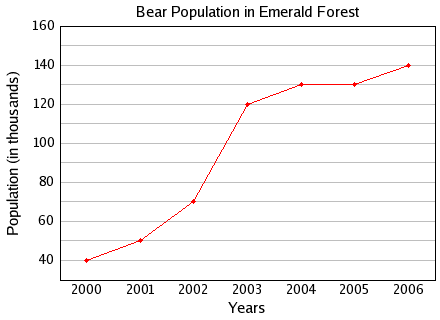
What was the bear population in 2001?
a)
40
b)
45
c)
50
d)
55
87.

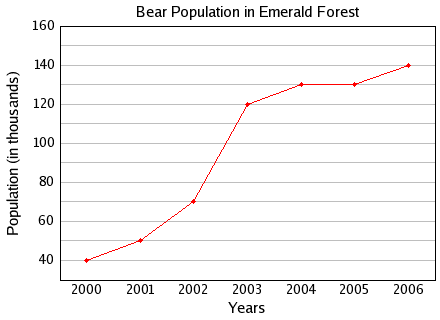
Between which two years did the bear population remain constant or the same?

a)

2004 and 2005

b)

2001 and 2002

c)

2005 and 2006

d)

2000 and 2001

88.
What is mean by homeostasis?
a)
Controls and coordinates body activities through chemical 
b)
controls and coordinates body activities through electrical impulses
c)
For maintenance of a steady state in the internal environment
d)
remove metabolic waste products from the cel
89.
What is a disease where sufferers cannot control their blood glucose levels?
a)
Diabetes
b)
Influenza
c)
Cholera
d)
Cystic fibrosis
90.
When you are cold, you shiver and your blood vessels contract, which warms you up. When you are hot, you sweat and your blood vessels expand, which cools you down.  
a)
Positive Feedback Response
b)
Negative Feedback Loop 
91.
Which system sends electrical messages that helps control the body's responses to internal and external changes?
a)
nervous
b)
endocrine
c)
reproductive
d)
integumentary
92.
These two body systems regulate feedback mechanisms.
a)
Skeletal & Muscular
b)
Skeletal & Endocrine
c)
Muscular & Nervous
d)
Endocrine & Nervous
93.
In which type of cells will mitosis occur?
a)
egg cells
b)
sperm cells
c)
jail cells
d)
Body cells except the sperm and egg cells
94.
What is the name of the process in which DNA (genetic information) is exchanged during meiosis?
a)
crossing under
b)
crossing over
c)
melding
d)
blending
95.
In meiosis, the haploid number of chromosomes in a human sex cell is:
a)
46
b)
92
c)
22
d)
23
96.
What is the diploid number of cells found in a human body cell?
a)
23
b)
46
c)
92
d)
47
97.
Why is sexual reproduction better than asexual reproduction?
a)
It gives an advantage to organisms to be different than the rest, if the environment changes.
b)
It is better for all organisms to be the same.
c)
It happens faster.
d)
It helps skin cells divide faster to heal wounds.
98.
After meiosis is complete, the new cells:
a)
are all identical
b)
are all different
c)
are half identical and half different
d)
are all stretched out
99.
A is:
B is:
C is:
a)
A: chromatid
B: centromere
C: chromosome
b)
A: chromosome
B: chromatid
C: centromere
c)
A: chromosome
B: centromere
C: chromatid
d)
A: centromere
B: chromosome
C: chromatid
100.
The process on the left is:
The process on the right is:
a)
Left: meiosis
Right: meiosis
b)
Left: meiosis
Right: cloning
c)
Left: mitosis
Right: meiosis
d)
Left: mitosis
Right: mitosis