wayground logo

Free Printable Worksheets

Font size

S
M
L
XL
Worksheets

Thermodynamics

Total questions: 36

Worksheet time: 29mins

Name
Class
Date
1.

I can't be created nor destroyed. What am I?

a)

energy

b)

air

c)

nothing

d)

a unicorn

2.
A(n) _____________ is a device for measuring temperature.
a)
thermometer
b)
barometer
c)
anemometer
d)
psychrometer 
3.
Temperature is a measure of the...
a)
total energy in a substance
b)
total kinetic energy in a substance
c)
average potential energy in a substance
d)
average kinetic energy of molecules in a substance
4.
What is absolute zero?
a)
0 K
b)
273 K
c)
0oC
5.

Heat is a measure of the...

a)

total energy in a substance

b)

total kinetic energy in a substance

c)

average potential energy in a substance

d)

average kinetic energy of molecules in a substance

6.
How does heat flow?
a)
Always from cold to warm
b)
Always from warm to cold
c)
Both warm to cold & cold to warm
d)
It depends on the temperature
7.
Warming hand over a radiator.
a)
Conduction
b)
Convection
c)
Radiation
8.
Snowman melting in the sun.
a)
Conduction
b)
Convection
c)
Radiation
9.
Water boiling in a kettle.
a)
Conduction
b)
Convection
c)
Radiation
10.
Eggs cooking in a frying pan.
a)
Conduction
b)
Convection
c)
Radiation
11.
When you touch something that feels cold, 
a)
heat from your hand moves into the cold substance.
b)
coldness moves from the cold substance into your hand.
c)
it melts.
d)
it freezes.
12.
The temperature of a glass of cold water will eventually...
a)
Match the temperature of the surrounding environment.
b)
Always be colder than the surrounding environment.
c)
Become warmer than the surrounding environment.
d)
Never change temperature.
13.
What is the symbol for Thermal Energy?
a)
Q
b)
t
c)
m
d)
C
14.
What is the symbol for Specific Heat
a)
Q
b)
t
c)
m
d)
C
15.
What is the equation to measure change in Thermal Energy?
a)
Q=mc∆t
b)
Q=mc
c)
Q= ∆mct
d)
m=QC
16.
The amount of energy required to raise the temperature 1ºC for every kilogram is called____?
a)
Thermal Energy
b)
Specific Heat
c)
Temperature
d)
Kinetic Energy
17.
Water has a specific heat of 4184 J/KgºC.  Wood has a specific heat of 1760 J/KgºC.  What material needs more energy to raise the temperature 1ºC
a)
Wood
b)
Water
c)
Both are the same
18.
Copper, Stainless Steel, Carbon Steel, and Zinc were all heated using the same thermal energy.  What material would be the coolest after being heated?
a)
Copper
b)
Carbon Steel
c)
Zinc
d)
Stainless Steel
19.

Calculate the energy absorbed by 30 g of 100 ⁰C water that is turned into steam at 100 ⁰C.

a)

67 800 J

b)

6 7800 J

c)

678 J

d)

67.8 J

20.

The heat absorbed by melting a solid is known as

a)

latent heat of fusion

b)

latent heat of solid

c)

latent heat of liquid

d)

latent heat of vaporisation

21.

specific latent heat of vaporisation is

a)

the amount of heat required to change 1 kg of the substance from the solid to liquid phase without change in temperature

b)

the amount of heat required to change 1 kg of the substance from the liquid to gaseous phase without change in temperature

c)

the amount of heat required to change the temperature 1 kg of the substance by 1 degree Celcius

22.

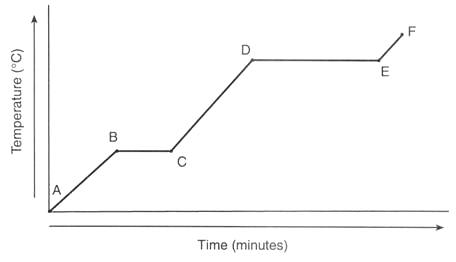
The graph shows the cooling curve of a substance. At which stages the specific latent heat released?

a)

AB and CD

b)

BC and DE

c)

AB and EF

d)

BC and CD

23.
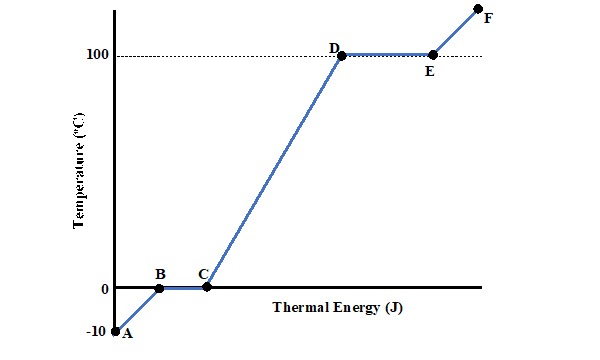
A substance's heating curve is shown in the graph.  What is its boiling point?
a)
100 C
b)
60 C
c)
80 C
d)
20 C
24.
What line segment represents only the solid state?
a)
A-B
b)
B-C
c)
C-D
d)
D-E
25.
Between which points is the temperature of the substance remaining constant?
a)
A-B only. 
b)
A-B, C-D, E-F
c)
B-C only. 
d)
B-C, D-E
26.

Which equation do you use to solve for the energy of segment D-E?

a)

q= mCΔT

b)

q= Hv*m

c)

PV=nRT

d)

q= Hf*m

27.

Which equation do you use to solve for segment B-C?

a)

q=mCΔT

b)

q= Hv*m

c)

q= Hf*m

d)

PV=nRT

28.

The energy of which segments can be found using the equation q=mCΔT?

a)

A-B, D-E, E-F

b)

B-C, D-E ,E-F

c)

B-C, C-D, E-F

d)

A-B, C-D, E-F

29.

Which equation do you use to solve for the energy of segment C-D?

a)

q=mCΔT

b)

q= Hv*m

c)

q= Hf*m

d)

PV=nRT

30.

Between which two points is Heat of Fusion?

a)

A <----> B

b)

B <----> C

c)

C <----> D

d)

D <----> E

e)

E <----> F

31.

Between which two points is Heat of Vaporization?

a)

A <----> B

b)

B <----> C

c)

C <----> D

d)

D <----> E

e)

E <----> F

32.
The graph shows a cooling curve for an unknown substance.  What is happening during segment DE?
a)
boiling
b)
condensation
c)
freezing
d)
melting
33.

Which equation would you use to solve the following: Calculate the heat necessary to change 10 g of ice(s) at 0°C to 10 g of water(l) at 0°C.

a)

q=mCΔT

b)

q= Hv*m

c)

q= Hf*m

d)

PV=nRT

34.

Which equation would you use to solve the following: Calculate the heat necessary to change 10 g of H2O(l) at 0 °C to 10 g of H2O(l) at 100°C.

a)

q=mCΔT

b)

q=Hv*m

c)

q= Hf*m

d)

PV=nRT

35.

What equation would you use to solve the following:

How much heat is absorbed by 20g granite boulder as energy from the sun causes its temperature to change from 10°C to 29°C?

a)

q=mCΔT

b)

q=Hv*m

c)

q= Hf*m

d)

PV=nRT

36.

What equation would you use to solve the following:

Calculate the heat necessary to change 10 g of H2O(l) at 100°C to 10 g of H2O(g) at 100°C.

a)

q=mCΔT

b)

q=Hv*m

c)

q=Hf*m

d)

PV=nRT