
 Worksheets
CNS quiz
Total questions: 42
Worksheet time: 29mins
main two-way conduction pathway to and from the brain
corpus callosum
spinal cord
cranial nerves
plexuses
In the spinal cord the white matter is ____________ to the grey matter
superficial (outside)
deep (inside)
anterior (in front)
lateral (to the side)
The bony protection for the skull is the ________ and the bony protection for the spinal cord is the _____________.
cranium; vertebra
cranium; meninges
meninges; vertebra
meninges; meninges


Makes decisions, plans for the future, reasons, and carries out behaviors
Frontal Lobe
Parietal Lobe
Occipital Lobe
Temporal Lobe
Stimulation at a point on which of the following may cause a person to report being touched on the knee?
Motor Cortex
Cerebellum
Somatosensory cortex
Temporal lobe
Damage to which of the following could interfere with the ability to plan for the future?
frontal lobe
temporal lobe
occipital lobe
parietal lobe
somatosensory cortex
Stimulation of which of the following may cause a person to involuntarily move his/her arm?
somatosensory cortex
motor cortex
glial cells
reticular activating systen
visual cortex

Name this structure.
Cerebrum
Cerebellum
Brain Stem
Basal Ganglia
The left cerebral hemisphere generally controls the right side of the body and vice versa. This is referred to as _____________________ organisation.
Unilateral
Contralateral
Ipsilateral
Bilateral
Which parts of the brain controls reflexes?
Cerebral cortex
Cerebellum
Medulla and Brain stem
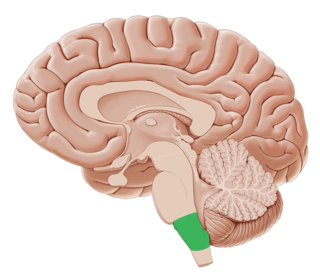
You watch your baby cousin try to put a round block into a square hole, but to no avail. Which part of his brain needs to develop more?
Parietal Lobe
Occipital Lobe
Temporal Lobe
Frontal Lobe
Jeff was a superior student and had a full scholarship, but following a head injury he can no longer plan, organize, or follow through with tasks necessary for school. In which lobe did Jeff's injury likely occur?
Temporal
Occipital
Parietal
Frontal
Tinnitus, which is ringing in the ears, can be a symptom of damage to which lobe?
Parietal
Frontal
Temporal
Occipital
Dr. Jill Bolte Taylor describes her stroke in her book, "My Stroke of Insight." She reported losing control over her right arm as it fell limp at her side. She also tried to call for help and after much effort dialed the numbers to both her workplace and her doctor’s office only to find that she could not articulate the words she had been practicing in her mind. What areas of the brain can you be certain her stroke impacted?
Right hemisphere, frontal lobe, Broca's area
Left hemisphere, frontal lobe, Broca's area
Right hemisphere, temporal lobe, Wernicke's area
Left hemisphere, temporal lobe, Wernicke's area
What contains the nucleus of the neuron?
Terminal Bouton
Cell Body
Axon Hillock
Myelin Sheath
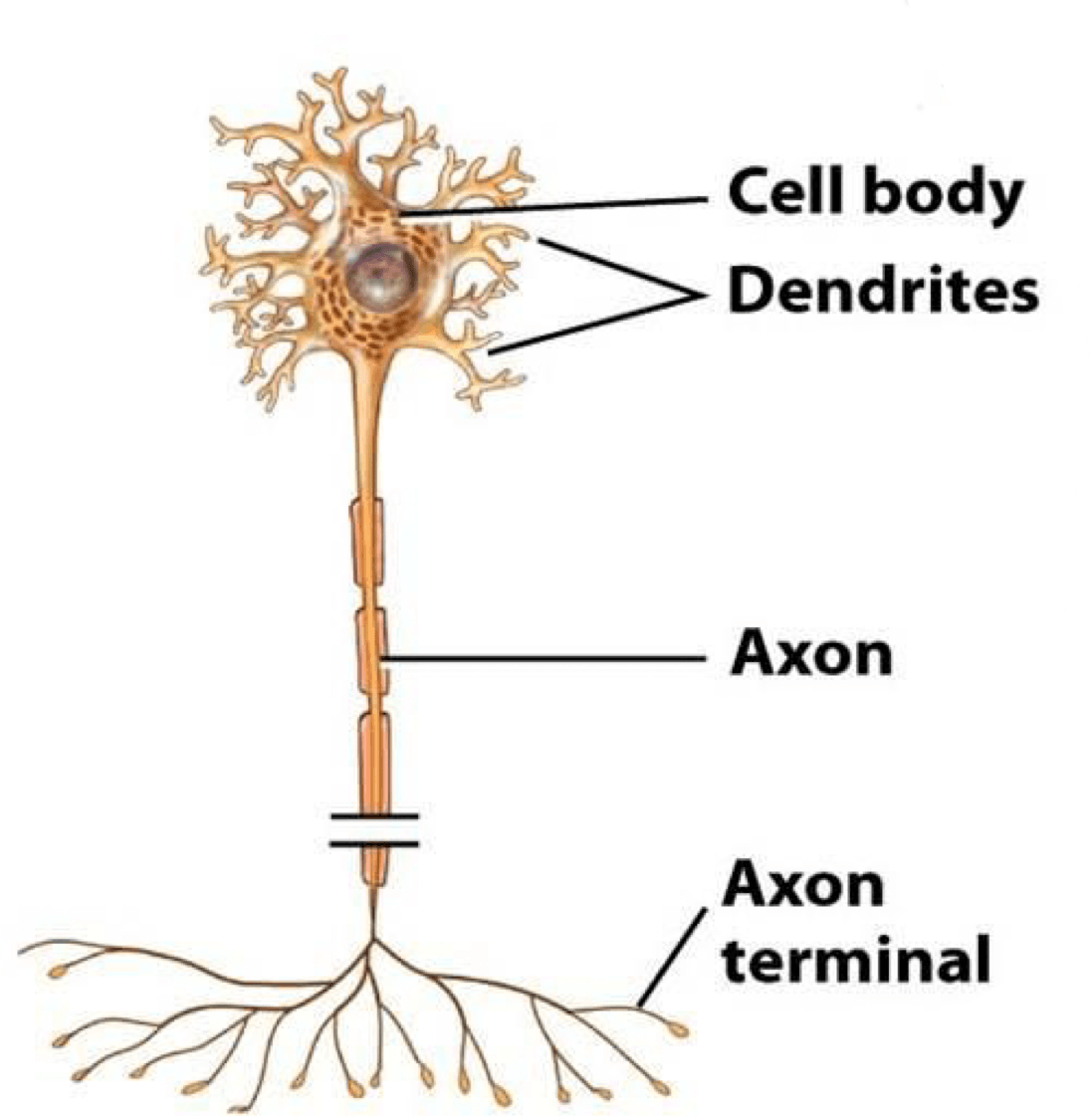
What type of neuron is represented on the image?
Motor Neuron
Interneuron
Sensory Neuron
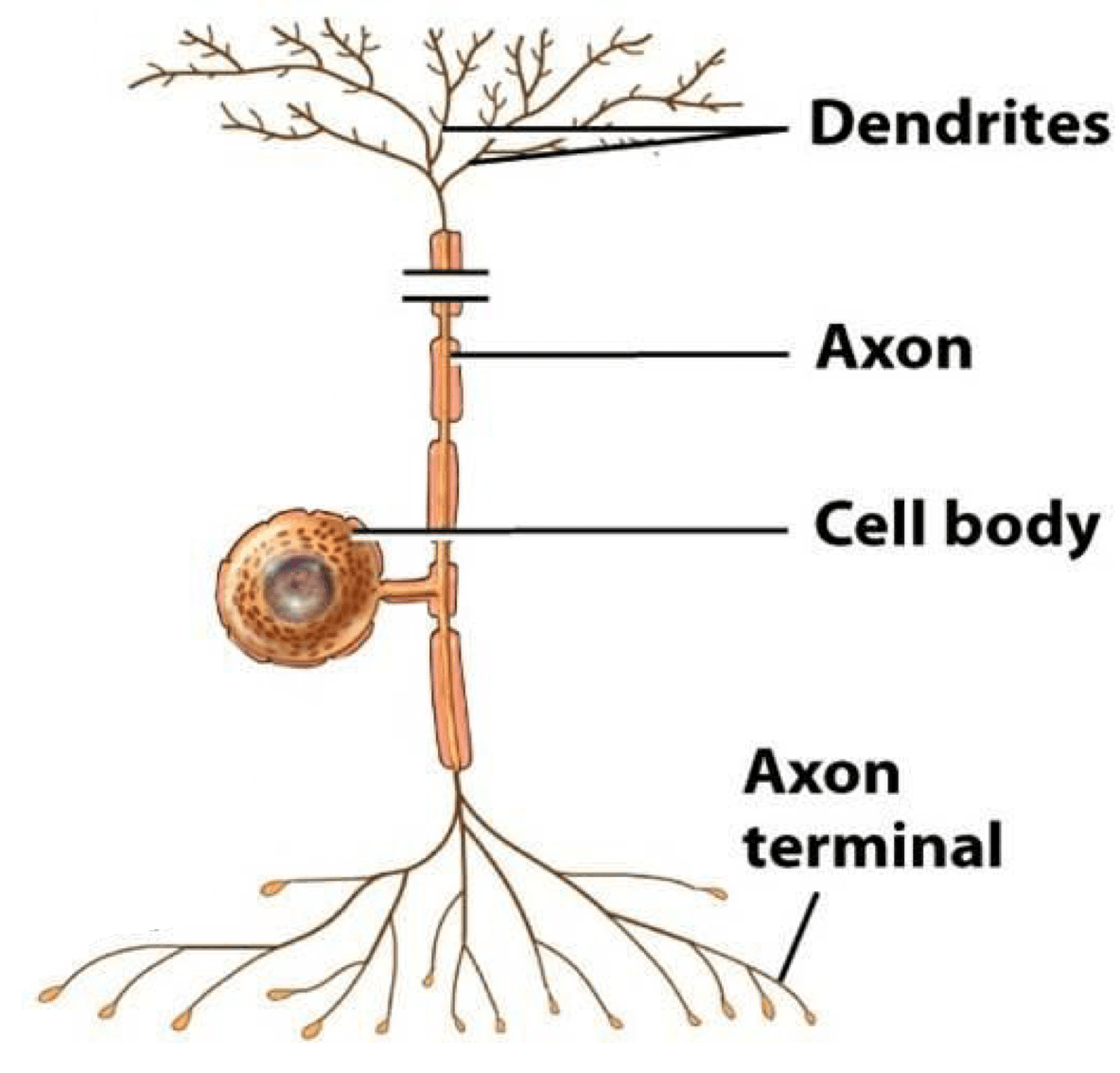
What type of neuron is represented on the image?
Motor Neuron
Interneuron
Sensory Neuron
Type of neuron that perceive information about your environment.
Motor Neuron
Interneuron
Sensory Neuron
Type of neuron located only in the brain and spinal cord that pass impulses from one neuron to another.
Motor Neuron
Interneuron
Sensory Neuron
Type of neuron that sends nerve impulses to muscles and gland, by the command of other neurons.
Motor Neurons
Interneurons
Sensory Neurons

when does the stimuli cause an action potential?
when it reaches threshold
just below the threshold
just above threshold

Depolarization is occuring at number
1
2
4
5

What maintains the resting membrane potential in a neuron?
sodium-potassium pumps
sodium channels
potassium channels
gravity


