Wayground logo

Free Printable Worksheets

Font size

S
M
L
XL
Worksheets

Space

Total questions: 41

Worksheet time: 41mins

Name
Class
Date
1.
Planets that are farther from the sun
a)
take more time to orbit
b)
take less time to orbit
2.
True or False
The Earth is the center of the solar system.
a)
True
b)
False
3.
The order of the planets is:
a)
Mars,Venus,Earth,
Mercury,Saturn
Jupiter, Uranus, Neptune
b)
Earth,Venus,Mars
Jupiter, Neptune,
Mercury,Saturn,
Uranus
c)
Mercury,Venus,Earth
Mars,Jupiter,
Saturn,Uranus
Neptune
4.
Which planet is the smallest?
a)
Mercury
b)
Venus
c)
Earth
d)
Mars
5.
What is in between the inner planets and the outer planets?
a)
Asteroid belt
b)
Kuiper belt
c)
Sun
d)
Moon
6.
Which planet has the biggest rings?
a)
Jupiter
b)
Saturn
c)
Uranus
d)
Neptune
7.
Which movement of Earth causes day and night?
a)
rotation
b)
revolution
8.
How long is a day on earth?
a)
22 hours
b)
365 days
c)
12 hours
d)
24 hours
9.
The earth orbits around the _________
a)
sun
b)
moon
c)
other planets
d)
solar system
10.
How long does it take earth to make one revolution around the sun?
a)
12 hours
b)
24 hours 
c)
365 days
d)
30 days
11.
The hemisphere where you live.
a)
equator
b)
southern
c)
northern
d)
eastern
12.
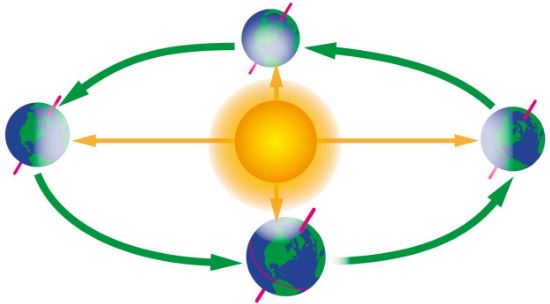
Why is it warmer in the summer?
a)
Closer to the sun
b)
More direct light from Earth's tilt
c)
Stronger light from the sun
d)
Earth spins slower
13.
What happens when the area in which you live tilts away from the sun?
a)
It is summer.
b)
It is spring.
c)
It is winter.
d)
It is fall.
14.
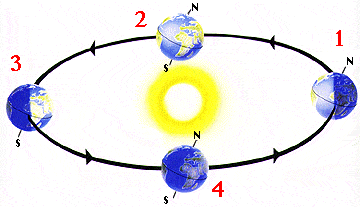
Which season is taking place in the Northern Hemisphere in Position 1?
a)
Winter
b)
Spring
c)
Summer
d)
Fall
15.
Which season is taking place in the Northern Hemisphere in Position 3?
a)
Winter
b)
Spring
c)
Summer
d)
Fall
16.
One rotation of Earth is equal to
a)
a day.
b)
a year.
17.

When the sun gets higher in the sky, shadows get ______.

a)

longer

b)

gone

c)

shorter

d)

darker

18.

When the sun gets lower in the sky, shadows get______.

a)

longer

b)

gone

c)

shorter

d)

darker

19.

Shadows are longest during _______.

a)

morning and evening

b)

noon

c)

night

20.

Shadows are shortest around______.

a)

morning and evening

b)

noon

c)

night

21.
Where does the sun rise? 
a)
North
b)
South
c)
East
d)
West
22.
Which light source causes shadows in the outdoor environment? 
a)
The Sun
b)
The Lightbulb
c)
The House
d)
The School
23.

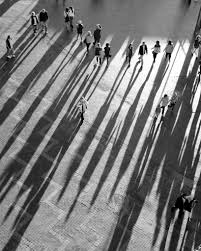
When was this picture most likely taken?

(Hint: think about the shadow's length)

a)

morning or evening

b)

night

c)

noon

d)

afternoon

24.
Look at the picture.  Would the sun be low or high in the sky in the afternoon picture?
a)
The sun would be directly above.
b)
You would not be able to see the sun at all.
c)
The sun would be low in the sky.
d)
The sun has nothing to do with shadows.
25.
When do we see a full moon?
a)
when half of the sun's light is shining on the half of the moon facing away from us
b)
when the sun goes down and there are no clouds in the night sky
c)
when none of the sun's light is shining on the half of the moon facing toward us
d)
when all the sun's light is shining on the half of the moon facing toward us
26.
How long does it take the moon to change from a new moon to a  full moon?
a)
about 1 month
b)
about 1 year
c)
about 1 week
d)
about 1 day
27.
What is causes a shadow?
a)
turning the lights off in a room
b)
standing still with your back to the sun
c)
the sun being blocked out by an object
d)
standing in a dark room
28.
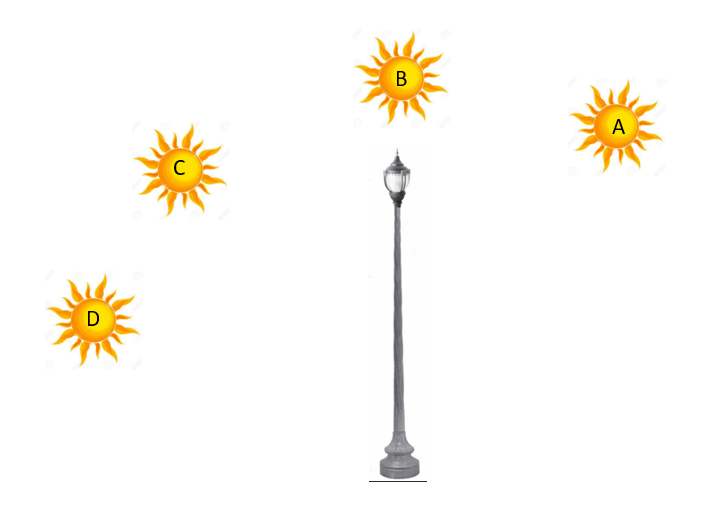
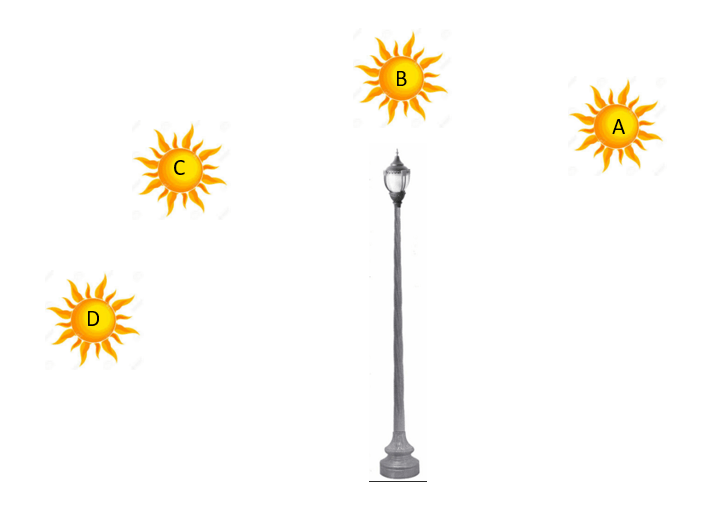
At which location of the sun would the shadow of the lamp post be the shortest?
a)
A
b)
B
c)
C
d)
D
29.
At which location of the sun would the shadow of the light pole be the longest?
a)
A  at 11 a.m
b)
B at noon
c)
C at 2 p.m.
d)
D at 6 p.m. 
30.
Which phase of the moon is represented by the letter E?
a)
New Moon
b)
Full Moon
c)
First Quarter
d)
Waning Crescent 
31.
Which phase of the moon is represented by the letter G?
a)
Waning Gibbous
b)
Waxing Gibbous 
c)
Last Quater
d)
Waning Crescent 
32.

Different faces of the moon are called

a)

full moon

b)

phases

c)

face

d)

crescent moon

33.

Which is the hottest planet?

a)

Mercury

b)

Venus

c)

Mars

d)

Jupiter

34.
The phase of the moon you see depends on
a)
where you are on Earth's surface
b)
how much of the sunlit side of the moon faces Earth
c)
if the moon is making its own light
d)
whether or not an eclipse is occurring.
35.

At which location in Earth's rotation is it summer in the Northern Hemisphere?

a)

SS

b)

VE

c)

WS

d)

AE

36.

What are the phases of the moon?

a)

The repeating pattern of night and day

b)

The monthly pattern of lunar and solar eclipses

c)

The sequence of seasons the moon causes on Earth

d)

The different shapes of the moon as seen from Earth
37.
Among the Earth, Sun, and Moon, what makes the Earth unique? Only the Earth –
a)
can generate energy
b)
lacks an atmosphere
c)
is made mostly of rock
d)
contains water in liquid form
38.
What characteristic do the Earth and Moon share that makes them different from the Sun?
a)
Spherical shape
b)
Rotate on an axis
c)
Rocky crust and surface
d)
Found in our Solar System
39.
Of the Earth, Sun, and Moon, which ones orbit another object?
a)
the Sun and the Earth
b)
the Sun and the Moon
c)
the Moon and the Sun
d)
the Moon and the Earth
40.
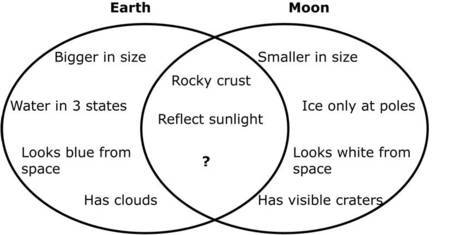
A student created a diagram to compare the characteristics of the Earth and the Moon.
Which of the following characteristics could be placed in the center part of the diagram?
a)
orbits another object
b)
strong gravitational pull
c)
rotates every 24 hours
d)
has an atmosphere
41.
What moon phase would be seen from Earth when the moon is at position 5? 
a)
new moon
b)
first quarter
c)
full moon
d)
third quarter