wayground logo

Free Printable Worksheets

NEW

Font size

S
M
L
XL
Worksheets

DoL Unit 1 Review

Total questions: 55

Worksheet time: 28mins

Name
Class
Date
1.

An example of Natural Selection

a)

Bacteria changing over time to survive hot springs

b)

Breeding dogs for the best traits

c)

Breeding humans for selected traits

d)

Viruses staying the same for long periods of time

2.

An example of artificial selection

a)

viruses changing from year to year

b)

bacteria gaining the ability to digest oil

c)

breeding dogs for specific traits

d)

bacteria becoming antibiotic resistant

3.

When you step out into the cold, your body shivers in order to keep its temperature at 98.6F. Which characteristic of life does this show?

a)

All living things use energy

b)

All living things contain cells

c)

All living things maintain homeostasis

d)

All living things grow

4.

A tulip opens in the morning at sunrise and closes in the evening at sunset. Which characteristic of life does this show?

a)

All living things have cells

b)

All living things use energy

c)

All living things respond to their environment

d)

All living things grow

5.

Reproduction that only involves one parent and all offspring are identical; for example, binary fission of bacteria or amoebas.

a)

Asexual

b)

Sexual

c)

Division

d)

Addition

6.

Reproduction that involves two cells from different parents unite to produce the first cell of a new organism.

a)

Asexual

b)

Sexual

c)

Budding

d)

Division

7.

Living things are based on a universal genetic

code. What molecule is responsible for that code?

a)

RNA

b)

Lipid

c)

Protein

d)

DNA

8.

A stimulus can be external or internal.

a)

False

b)

True

9.

Maintaining a stable internal

environment is called

a)

homeostasis

b)

equilibrium

c)

balance

d)

evenness

10.
Rocks are not living because
a)
they never move
b)
they aren't needed for humans
c)
they are not made of cells
d)
they don't break down
11.
A worm turns away from light is an example of a worm
a)
reproducing
b)
doing cellular respiration
c)
having cells
d)
responding to its environment
12.

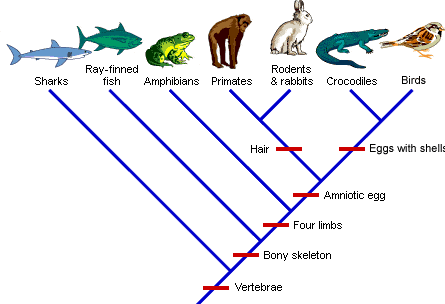
According to this cladogram, sharks are MOST closely related to which organism?

a)

Amphibians

b)

Ray finned fish

c)

Crocodiles

d)

Birds

13.

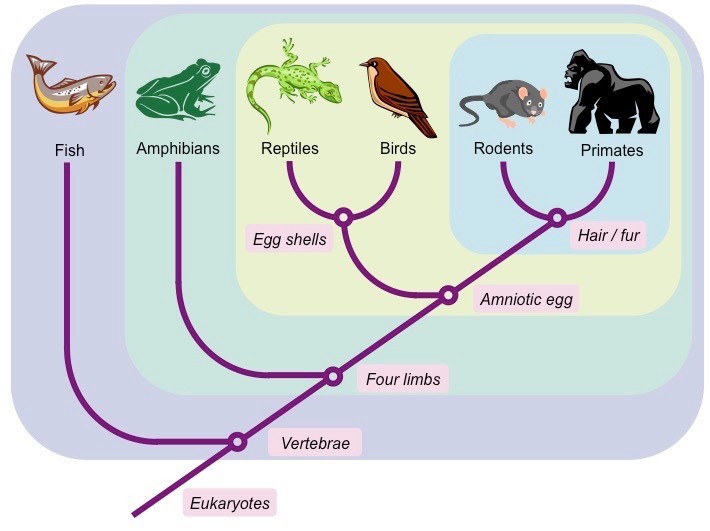
What characteristic distinguishes amphibians from birds and reptiles?

a)

Amniotic egg

b)

Egg shells

c)

Vertebrae

d)

Hair/fur

14.

What characteristic do all the organisms on this cladogram share?

a)

Being bi-pedal & having language

b)

Complex brains

c)

Fully binocular vision

d)

Partial binocular vision & opposable thumbs

15.

What distinguishes zebras from from giraffes?

a)

un-branching horns (in males)

b)

even number of toes

c)

fur

d)

carnivorous teeth

16.
Which kingdom do humans belong to?
a)
Plantae
b)
Fungi
c)
Animalia
d)
Protista
17.
The scientific name for an organism is made from the:
a)
class and family name
b)
genus and species name
c)
domain and kingdom name
d)
kingdom and phylum name
18.
Term given to describe the 2 name naming system is:
a)
dichotmous key
b)
binomial nomenclature
c)
2 scientific names
d)
binomial key
19.
The 8 levels of classification, most broad to most specific.
a)
Domain, Genus, Family, Order, Class, Phylum, Kingdom, Species
b)
Domain, Species, Kingdom, Genus, Phylum, Family, Class, Order
c)
Domain, Kingdom, Phylum, Class, Order, Family, Genus, Species
d)
Order, Kingdom, Species, Domain, Phylum, Family, Class, Genus
20.
What is the most specific level of classification?
a)
Family
b)
Domain
c)
Species
d)
Carolus Linnaeus
21.
A dichotomous key for trees is provided. Hikers found a tree that has large brown cones and single sharp needles. What species of tree have the hikers found?
a)
Juniper
b)
Pine
c)
Spruce
d)
Fir
22.
A dichotomous key for insects is given. To what order does an insect with two pairs of scaly wings belong?
a)
Coleoptera
b)
Heteroptera
c)
Diptera
d)
Lepidoptera
23.
An illustration and a dichotomous key are given. What is the correct classification for this organism?
a)
Class Insecta
b)
Order Amblygygi
c)
Order Araneae
d)
Order Scorpiones
24.
A labeled diagram of a fiddler crab is provided. Which of the following is an accurate observation of the structures of a fiddler crab? Fiddler crabs have -
a)
five pairs of walking legs on each side.
b)
an enlarged propodus on both front legs.
c)
a pair of eyes on stalks at the top of the body.
d)
two pairs or chelipeds for a total of four.
25.
What step do we always start with when using dichotomous keys?
a)
1
b)
2
c)
3
d)
4
26.
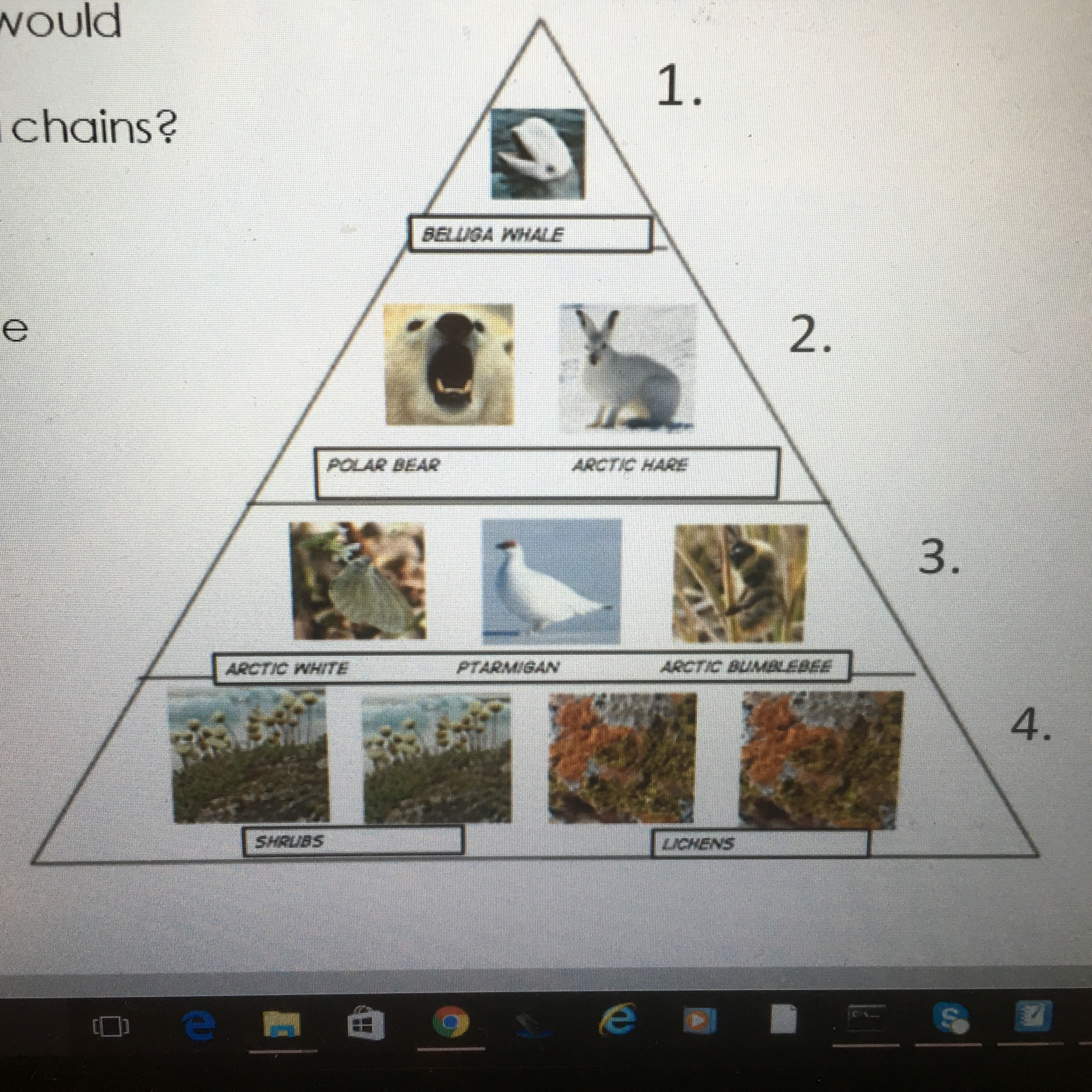
In the energy pyramid here, which organisms have the most energy available? 
a)
Producers
b)
Carnivores
c)
Herbivores
d)
Top Predator
27.
The method bacteria use to reproduce is
a)
asexual
b)
sexual
c)
artificial selection
d)
replication
28.
Which of the following is an example of an external Stimuli?
a)
Becoming dehydrated and then taking a drink of water
b)
Getting a headache and then taking Excedrin
c)
Having hunger pains and then eating a sandwich
d)
Smelling Pizza and then eating a piece
29.
Which of the following is an example of internal stimuli?
a)
Smelling pizza and then eating a piece of pizza
b)
Seeing ice cream on television and then eating a bowl of ice cream
c)
After working out feeling sore in your legs and then placing ice on the sore spot
d)
After working out seeing a bottle of water and drinking water
30.
Steven sets a brand new plant near the window. After several weeks Steven realizes the flower is starting to tilt towards the sunlight. What would be considered the stimuli in this scenario?
a)
Water
b)
The dirt in the flower pot
c)
The sunlight
d)
The window
31.
Many birds migrate long distances when the seasons change. Which of the following is an environmental stimulus that would signal to the birds the changing seasons?
a)
Changes in the length of daylight
b)
Increases in the population of edible plants
c)
Decreased number of offspring per hatching event
d)
Increase in annual precipitation levels
32.

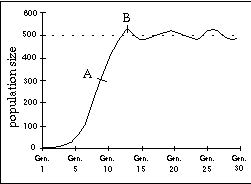
What is the carrying capacity of the graph?

a)

around 500

b)

around 550

c)

less than 400

d)

around 300

33.
Temperature, light, air, water, and soil are all ___________ parts of the environment.
a)
biotic
b)
abiotic
c)
dead
d)
scavenged
34.
All the organisms of a particular type living in the same place at the same time is called a _______.  An example is a herd of deer.
a)
population
b)
community
c)
resource
d)
ecosystem
35.

A nonliving thing in an ecosystem is a(n) _______.

a)

biotic factor

b)

population

c)

abiotic factor

d)

resource

36.

What is an example of a limiting factor

a)

food

b)

water

c)

shelter

d)

all of the above

37.

The picture to the right represents a sunny, dry desert.

Which factor most likely limits the desert’s carrying

capacity for plant life?

a)

the number of animals that eat plants

b)

the amount of sunlight

c)

the availability of space to grow

d)

the availability of water

38.
What is a consumer?
a)
Organism that makes its own energy
b)
Organism that breaks down dead organisms
c)
Organism that eats other organisms for food & energy
39.
If a disease destroying barley plants in a field swept through an ecosystem, what would happen to the barley eating bird population in the the field ?
a)
The bird population would stay the same
b)
The bird population would infinitely increase
c)
The bird population would decrease
40.

An inherited trait that helps those organisms that have it to survive

a)

niche

b)

structure

c)

characteristic

d)

adaptation

41.

What is the advantage to the finches in the Galapagos Islands having different shaped beaks?

a)

To look different from other species and attract mates.

b)

To be able to eat the food readily available in the environment.

c)

To protect itself against predators.

d)

To protect itself against prey.

42.

This process is when organisms with traits best suited to their environment are more likely to survive and reproduce.

a)

Variation

b)

Mutation

c)

Natural Selection

d)

Evolution

43.
The goal of every species on earth is...
a)
to survive and reproduce 
b)
divide and conquer 
c)
survive and conquer 
d)
reproduce and die 
44.

Occurs when humans produce a new breed of animal over a period of time by selecting animals that have certain desired traits and breeding them.

a)

Natural Selection

b)

Artificial Selection

c)

Adaptation

d)

Hibernation

45.

This is an inherited trait that makes an individual different from other members of its species.

a)

Variation

b)

Mutation

c)

Punctuated Equilibrium

d)

Embryology

46.

How do adaptations help animals?

a)

To escape animals

b)

to hunt for food

c)

to survive in their habitats

d)

All of these are correct

47.

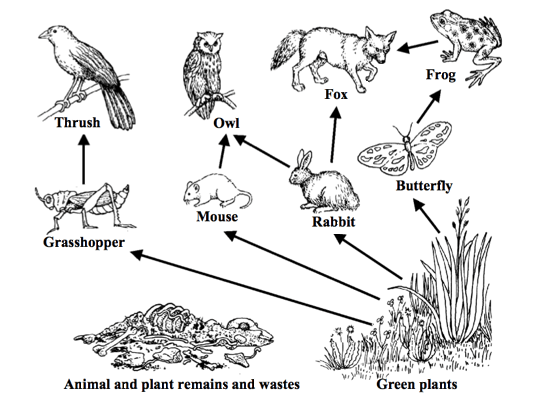
How many carnivores are shown in this food web?

a)

9

b)

4

c)

5

d)

1

48.
Which of the following is a herbivore?
a)
cricket
b)
frog
c)
hawk
d)
shrew
49.
The owl receives energy from which organisms?
a)
grasshopper and mouse
b)
mouse and rabbit
c)
rabbit and butterfly
d)
butterfly and frog
50.

Examine the graph below of two animal populations. Which animal must be the prey species?

a)

A

b)

B

51.
If there is 1000 Kcal available in the producers in trophic level 1, how much energy is available in the herbivores in trophic level 2?
a)
10 Kcal
b)
1 Kcal
c)
100 Kcal
d)
1000 Kcal
52.
Which trophic level is the Primary consumer? 
a)
1
b)
2
c)
3
d)
4
53.
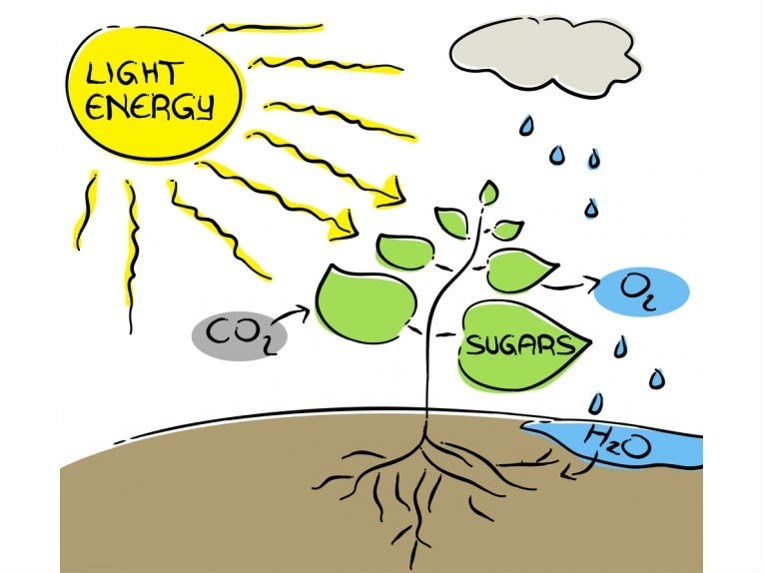
Where do producers get their energy? 
a)
soil
b)
decomposers
c)
sun
d)
garbage
54.

If there is an increase in prey, what will happen to the predator population?

a)

Decrease

b)

stay the same

c)

increase

55.

If there is an increase in the predator population, what will happen to the prey population?

a)

increase

b)

decrease

c)

stay the same