wayground logo

Free Printable Worksheets

Font size

S
M
L
XL
Worksheets

Climate Review

Total questions: 60

Worksheet time: 1hrs 6mins

Name
Class
Date
1.
What are the two main factors that determine the climate of an area?
a)
precipitation and humidity
b)
temperature and air pressure
c)
wind conditions and humidity
d)
temperature and precipitation
2.
What causes winds to form on Earth?
a)
solar energy
b)
ocean currents
c)
elevation differences
d)
uneven heating of the Earth by the sun
3.
What are the surface features of an area called?
a)
latitude
b)
longitude
c)
topography
d)
elevation
4.
What is the condition of the Earth's atmosphere at a certain time and place?
a)
climate
b)
temperature
c)
weather
d)
air pressure
5.
Which BEST describes why latitudes closest to the equator have warmer climates?
a)
they are at lower elevations
b)
they receive more solar energy
c)
they are nearer to ocean currents
d)
they get more winds that carry energy in the form of heat
6.
What is the measure of distance in degrees north and south from the equator?
a)
latitude
b)
longitude
c)
elevation
d)
topography
7.
What is the height of an area above sea level?
a)
elevation
b)
topography
c)
latitude
d)
longitude
8.
Which sentence best describes how latitude and temperature are related?
a)
LOWER latitude = COLDER air temperature
b)
HIGHER latitude = COLDER air temperature
c)
HIGHER latitude = WARMER temperatures
9.
What is the weather conditions in an area over a long period of time?
a)
climate
b)
temperature
c)
elevation
d)
precipitation
10.
What causes some areas of Earth to receive less intense solar energy than others?
a)
the mass of earth
b)
the curve of earth
c)
the density of earth
d)
the elevation of earth
11.
Which sentence best describes the relationship between elevation and air temperatures?
a)
LOWER elevation = COLDER temperatures
b)
HIGHER elevation = COLDER temperatures
c)
HIGHER elevations = WARMER temperatures
12.

Regions closest to ________________ tend to have warmer year-round climates.

a)

Forest Fires

b)

South Pole

c)

North Pole

d)

the Equator

13.

What causes seasons to change?

a)

Earth's rotation

b)

Earth's tilt

c)

Hot and Cold

d)

Santa Clause

14.

What does "latitude" refer to?

a)

the distance away from the Equator

b)

how much rain a place gets

c)

how high up a mountain a place is

d)

the number of seasons a place gets

15.

The higher the altitude of a city, the _______________ the temperatures are.

a)

hotter

b)

colder

c)

more consistent

d)

weirder

16.

Is the Earth heated evenly?

a)

Yes

b)

No

17.

Which of the following is NOT a factor that affects climate?

a)

latitude

b)

winds

c)

mountains

d)

weather forecast

18.

Which of the following is NOT a factor that affects climate?

a)

ocean currents

b)

mountains

c)

the amount of snow you get on Christmas

d)

latitude

19.

How do ocean currents affect climate?

a)

they cause hurricanes

b)

they spread temperatures around the Earth a little bit more evenly

c)

they make the Equator closer to Earth

d)

they cause the seasons

20.

Surface currents are driven by _____________.

a)

sea critters

b)

differences in temperature

c)

wind

d)

the Equator

21.

Deep ocean currents are driven by a difference in __________________.

a)

wind

b)

temperature

c)

climate

d)

tides

22.

Colder water _________________.

a)

rises

b)

sinks

23.

Warmer water _______________.

a)

Sinks

b)

Rises

24.

What is the name of the surface current that brings warmer temperatures to Europe?

a)

EAC

b)

Gulf Stream

c)

Big Current

d)

California Current

25.

The ________________ Effect is caused by Earth's rotation.

a)

Ocean Current

b)

Hurricane

c)

Climate

d)

Coriolis

26.

The Coriolis Effect causes which two things to curve sideways?

a)

weather and climate

b)

wind and ocean currents

c)

rain and snow

d)

temperatures

27.

Cities that are closer to large bodies of water tend to have _____________ temperatures

a)

more extreme temperature changes

b)

less extreme temperature changes

c)

4 distinct seasons

d)

more sunshine

28.

Surface currents are mainly driven by _________________.

a)

sun

b)

wind

c)

temperature

d)

narwhals

29.

The _______________ helps to more evenly spread out temperatures on earth.

a)

ocean

b)

equator

c)

altitude

d)

climate

30.
What is weather?
a)
What's happening in space at a time and place.
b)
What's happening in our atmosphere at a time and place.
c)
The average weather over many years
d)
The average temperature over many years.
31.
What climate does a desert have?
a)
Tropical
b)
Polar
c)
Arid/Dry
d)
Temperate
32.
Antarctica is cold all the time. What is it's climate?
a)
Tropical
b)
Polar
c)
Arid/Dry
d)
Temperate
33.
In which position is it Spring in the Northern Hemisphere?
a)
1
b)
2
c)
3
d)
4
34.
In which position is it summer in the Northern Hemisphere?
a)
1
b)
2
c)
3
d)
4
35.
Which of the following does NOT have an affect on a region's climate?
a)
Large bodies of water
b)
Latitude
c)
Mountains
d)
Longitude
36.
Which of the following is a greenhouse gas?
a)
carbon monoxide
b)
oxygen
c)
nitrogen
d)
carbon dioxide
37.
When the sun's rays pass through our atmosphere and then heat is trapped by the atmosphere it is called
a)
Global Warming
b)
Greenland Effect
c)
Greenhouse Effect
d)
Ice Age
38.
All of the following are causes of Global Warming except
a)
Rotation of the Earth
b)
Deforestation
c)
Increases in Greenhouse Gases
d)
Burning Fossil Fuels
39.
The gradual increase in the average temperature of our planet Earth is called
a)
Greenhouse Effect
b)
Global Warming
c)
Greenland Effect
d)
Ice Age
40.
Which of the following would help decrease Global Warming?
a)
drive hybrid/fuel efficient cars
b)
burn fossil fuels
c)
deforestation
d)
use aerosol cans
41.
All of the following are effects of Global Warming EXCEPT
a)
increase in hurricanes
b)
lower sea levels
c)
increase in disease
d)
melting polar ice caps
42.

During a(n) ____ event, trade winds are much stronger than usual.

a)

El Nino

b)

La Nina

c)

Normal

d)

Partly sunny

43.

Normally, atmospheric upwelling and rain occurs in the:

a)

FAR Western Pacific

b)

Central Pacific

c)

Western Pacific

44.

During an El Nino, it rains

a)

in the central Pacific

b)

in the FAR western Pacific

c)

in the western Pacific

d)

In all of the Pacific

45.

Both El Nino and La Nina have this in common

a)

Influence birds that migrate over the ocean

b)

Influence rainy / dry weather world wide

c)

The weather at the polar regions

d)

The directions that ships travel in the oceans

46.

During an El Nino, trade winds are typically...

a)

about average

b)

stronger

c)

weaker

47.

The picture below is of a(n) ____ event.

a)

Non-El Nino (Normal)

b)

El Nino

c)

La Nina

48.

The picture represents a(n) ___ event.

a)

El Nino

b)

La Nina

c)

Non-El Nino (normal conditions)

49.

In Florida, El Nino impacts our weather by:

a)

creating larger waves at the beach

b)

more thunderstorms and crows flying around

c)

dry and hot

d)

wetter and more flood-prone

50.

In Florida, La Nina impacts our weather by:

a)

dryer and warmer

b)

warmer and wetter

c)

wetter and colder

d)

more rain and crows flying around

51.

Without question, ENSO events:

a)

Are preventable

b)

Eliminate sources of rain

c)

Are really scary

d)

Impact everyone on the planet somehow

52.
Second layer of the atmosphere, extending about 17-48 kilometers above the earth’s surface. It contains a layer of gaseous ozone, which filters out about 95% of the incoming harmful ultraviolet radiation emitted by the sun
a)
Mesosphere
b)
Troposphere
c)
Stratosphere
d)
Ozone
53.
Layer of gaseous ozone in the stratosphere that protects life on earth by filtering out most harmful ultraviolet radiation from the sun
a)
Greenhouse Gases
b)
Troposphere
c)
Stratosphere
d)
Ozone Layer
54.
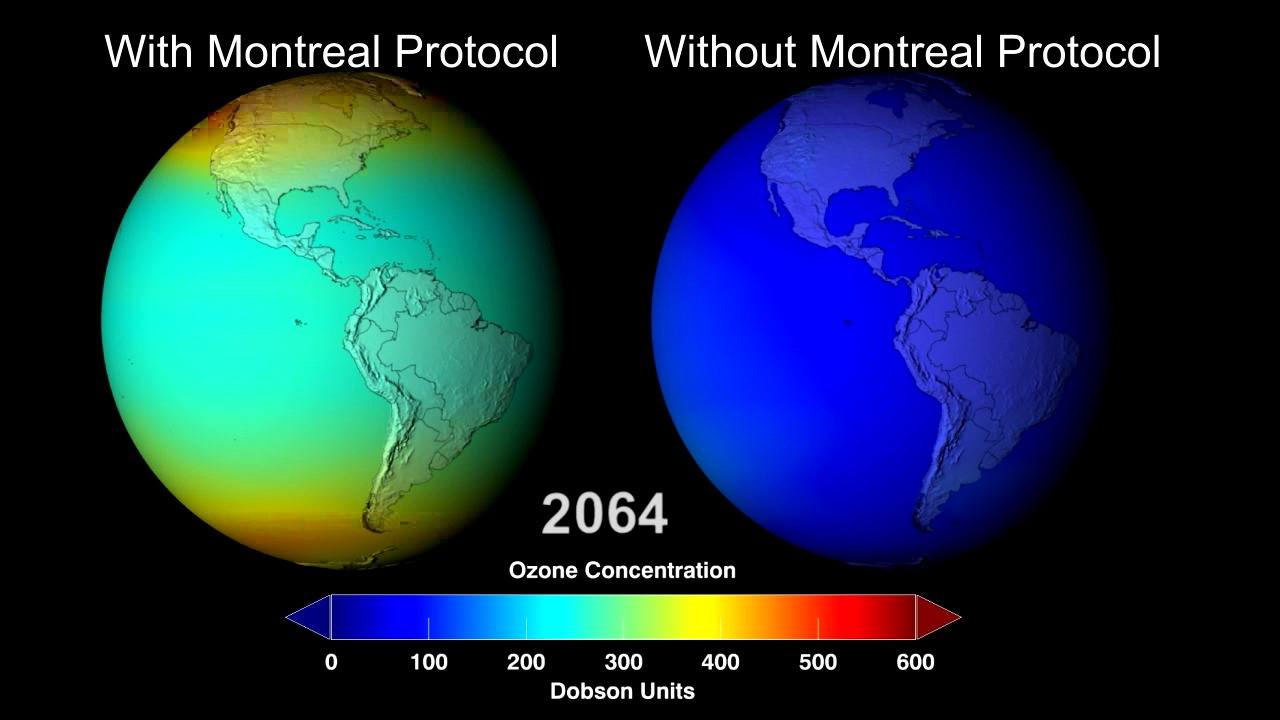
The breakdown of stratospheric ozone
I. can originate from the emission of chlorofluorocarbons (CFCs).
II. is catalyzed through a free chlorine (Cl) atom.
III. prevents UV rays from reaching the earth’s surface.
a)
I only
b)
III only
c)
I,&II
d)
I,II,& III
55.
Which agreement allowed for a reduction, and eventual elimination, of CFC production and use?
a)
Montreal Protoccol
b)
Kyoto Protoccol
c)
Paris Agreement
d)
Yo MaMa
56.
How do CFCs affect ozone production?
a)
UV radiation frees a chlorine atom, which breaks down ozone.
b)
Infrared radiation frees a chlorine atom, which breaks down ozone.
c)
UV radiation frees a fluorine atom, which breaks down ozone.
d)
Infrared radiation frees a chlorine atom, which breaks down ozone.
57.
Which of these sets of three items produce CFCs
a)
cars, factories, and cardboard
b)
spray cans, cardboard, insulation
c)
spray cans, refrigerant, cardboard
d)
spray cans, refrigerant, insulation
58.
Though CFC production has been curtailed, the threat to upper atmosphericozone continues because CFCs
a)
become harmless quickly.
b)
destroy ozone for only a short time.
c)
persist but stop destroying ozone.
d)
persist and continue to destroy ozone for decades.
59.

Which is NOT a result of the reduction in stratospheric ozone?

a)

reduced photosynthetic activity

b)

increased skin cancer

c)

increased likelihood of cataracts

d)

increased birth defects

60.

When is the ozone hole largest?

a)

early Antarctic spring

b)

late Antarctic summer

c)

early Antarctic winter

d)

late Antarctic fall