
 Worksheets
DNA Structure, Replication & Protein Synthesis Review A/B
Total questions: 40
Worksheet time: 13mins
Which of the following statements is true of RNA?
RNA is double Stranded
RNA contains Uracil
RNA contains deoxyribose sugar
RNA is made by replication
Which of the following do nucleic acids and proteins have in common?
They are both made of amino acids
Their structures consist of a sugar
They are macromolecules
They are made of 4 nitrogen bases
DNA and RNA both... (click all that apply)
are nucleic acids
can be found in the nucleus
consist of the nitrogen bases A, C, G and T
are required molecules for protein synthesis
Which statement best describes the process of transcription
DNA is used as a template and copied into mRNA inside the ribosome
mRNA codons are converted into amino acids inside the ribosome.
DNA is used as a template and copied into mRNA inside the nucleus
DNA is used as a template and copied into tRNA inside the nucleus
What is the name of the sugar in DNA?
Deoxyribose
Ribose
Glucose
Sucrose
What is the job of tRNA?
carries DNA's message from the nucleus to the ribosome
Matches its anti-codon to mRNA's codon in order to transfer/drop off an amino acid in the ribosome
Matches its codon to mRNA's anti- codon in order to transfer/drop off an amino acid
Replicate this strand of DNA: A T T G C A T
A T T G C A T
T A A C G T A
U A A C G U A
T U U C G T U

Which of the following statements describes what is happening in the process shown in the figure?
Molecules of RNA are forming chromosomes to ensure genetic variation in a species.
Transcription of DNA to mRNA to make proteins.
A molecule of mRNA is directly the production of tRNA.
Replication of a molecule of DNA creating two identical copies.
What is the correct sequence of molecules for protein synthesis?
DNA --> mRNA --> Amino Acids --> Protein
DNA --> tRNA --> Amino Acids --> Protein
DNA --> Amino Acids --> Protein
mRNA --> DNA --> Amino Acids --> Protein
The basic building block of DNA and RNA is
chromosomes
nucleic acids
gene
nucleotides
The 3 molecules that make up a nucleotide are...
ribose sugar, phosphate and a nitrogen base
deoxyribose sugar, phosphate and a nitrogen base
deoxyribose sugar, phosphate and a nucleic acid
ribose sugar, fatty acid and a nitrogen base
In DNA the nitrogen bases are as follows:
Adenine always bonds with Thymine; Cytosine always bonds with Guanine
Adenine always bonds with Cytosine; Cytosine always bonds with Thymine
Adenine always bonds with Uracil; Cytosine always bonds with Guanine
Adenine always bonds with Thymine; Cytosine always bonds with Uracil
During transcription, mRNA nitrogen bases will bond with DNA bases as followed:
Adenine always bonds with Thymine; Cytosine always bonds with Guanine
Adenine always bonds with Cytosine; Guanine always bonds with Thymine
Adenine always bonds with Uracil; Cytosine always bonds with Guanine
Adenine always bonds with Thymine; Cytosine always bonds with Uracil
During Replication the enzyme that unzips the DNA strand to be copied is
DNA Polymerase
Helicase
RNA Polymerase
Helix
Transcription occurs in what part of the cell?
Ribosome
Mitochondria
Chlorplast
Nucleus
Translation occurs in what part of the cell?
Ribosome
Mitochondria
Chlorplast
Nucleus

Use the codon wheel to convert the following DNA codons into amino acids:
TAC CGG TAA
Methionine, Alanine
Methionine, Alanine, STOP
Methionine, Arginine, STOP
Methionine, Aspartic Acid, STOP
Transcribe the following DNA strand into mRNA:
ATT CTA GAC
TAA GAT CTG
UTT GTU CUG
UAA GAU CUG

What is the letter A pointing to?
DNA
Nucleus
Ribosome
Mitochondria
What is the letter B pointing to?
mRNA
Nucleus
Ribosome
Mitochondria
What is the letter C pointing to?
DNA
Nucleus
Ribosome
Mitochondria
What is the letter G pointing to?
mRNA
Anti-codon
tRNA
Codon
What is the letter E pointing to?
mRNA
Anti-codon
tRNA
Codon
What is the letter D pointing to?
mRNA
protein
tRNA
amino acid
In RNA the base T is replaced with
U
G
C
A
What combines together to make a protein?
Amino Acid
RNA
Ribosome
DNA
Carries the amino acid used to make a protein
mRNA
rRNA
tRNA
What do we call the shape a DNA molecule takes?
double-stranded
double helix
sugar-phosphate backbone
pentagon
What will be the complementary DNA sequence resulting from the following:
GAT-TAC-AGA-TTA-CAT?
CTA-ATG-TCT-AAT-GTA
GAU-UAG-UGA-UUA-GUT
CUA-AUG-UCU-AAU-GUA
CAT-ACA-TAC-ATA-TAG
GAT-TAC-AGA-TTA-CAT?
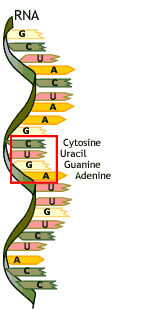
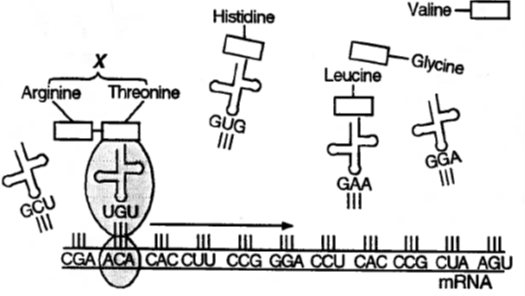

What process is happening in the diagram?
transcription
translation
dna replication
mitosis
What is the order for Protein Synthesis?
Transcription -> Translation -> Protein
Translation - > Transcription -> Protein
Protein -> Transcription -> Translation
Translation -> Protein -> Transcription

