Wayground logo

Free Printable Worksheets

Font size

S
M
L
XL
Worksheets

Unit 3 test Review

Total questions: 64

Worksheet time: 2hrs 32mins

Name
Class
Date
1.
a)
A push away
b)
A pull towards
c)
No Force
2.
Which statement is true?
a)
All Magnets have a North and South Pole
b)
All magnets can attract large objects
c)
Magnets can not pull through Solids.
d)
All Magnets have the Same shape and Size
3.
The South end of a Magnet will...
a)
Repel to a Copper Nail
b)
Repel to the North End of another Magnet
c)
Repel to the South end of another Magnet
4.
Which part of the Magnet is Strongest?
a)
Center
b)
Sides
c)
Poles
5.
When Magnets push away from each other they...
a)
Repel
b)
Attract
6.
What happens when two north poles of a magnet are placed together?
a)
they repel
b)
they attract
c)
they cancel each other out
d)
the strength of the magnet is doubled
7.
A north pole and a south pole will attract.
a)
True
b)
False
8.
Magnetism is a type of ____________
a)
force
b)
book
c)
plant
d)
animal
9.
When two magnets attract, they ______________
a)
push apart
b)
change color
c)
get colder
d)
pull together
10.
When two magnets repel, they ________________
a)
change color
b)
pull together
c)
push apart
d)
get colder
11.
The force of magnetism is stronger when magnets are ________________
a)
cold
b)
round
c)
closer together
d)
farther apart
12.

An Electromagnet is different from a permanent magnet. In order for an electromagnet to work, what must be true?

a)

It has to be touching another magnet.

b)

It must be heated until it is almost melting.

c)

It must have a complete electrical circuit.

d)

It must be lined up with Earth's magnetic field.

13.

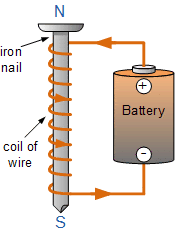
A complete electrical circuit made of wire coiled around an iron rod, a battery, and a switch are components of which of the following?

a)

A permanent magnet

b)

A natural magnet

c)

A magnetized paper clip

d)

An electromagnet

14.

Keisha made an electromagnet in class. She wound a wire over and over around a paper tube. Then she connected the ends of the wire to a battery. She tested the electromagnet, and it attracted some paper clips.


She is wondering if it really made the electromagnet stronger if the wire was wound more times around the tube. What is the best way to find out?

a)

Try lifting more paper clips and iron filings.

b)

Try winding the wire 20, 30, 40, then 50 times.

c)

Try adding 2, 3, 4, then 5 batteries.

d)

Try changing to a different kind of wire.

15.

What is our best evidence that Earth has a magnetic field?

a)

Earth's oceans all have currents.

b)

Winds blow from east to west.

c)

A compass needle lines up with earth.

d)

All things fall toward earth's center.

16.
What subatomic particle causes magnetism in an atom? 
a)
protons
b)
neutrons
c)
electrons
d)
nucleus
17.
Bob made an electromagnet but it was very weak.  How can he make it stronger?
a)
take away a d-cell
b)
wrap the wire loosely
c)
use thicker wire
d)
use less winds
18.
This large crane magnet functions only when the electrical current is ON.  The crane magnet is an example of what type of magnet?
a)
NIB Magnet
b)
Ceramic Magnet
c)
Electromagnet
d)
funnel magnet
19.

Cameron and Morgan are each holding a bar magnet with opposite poles facing each other. They walk in opposite directions until they stop feeling their magnet pull towards the other one. What can they conclude about the distance between them when they stop feeling their magnets pull?

a)

They are outside the magnetic field of their magnets.

b)

The distance made the magnets' force stronger.

c)

The magnetic fields are far enough apart to change direction.

d)

The magnetic field was weaker when they were close.

20.

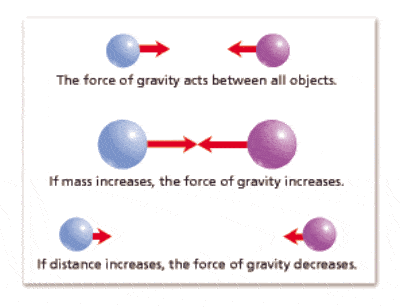
If Earth had twice the mass it has now, how would the gravitational force between it and the Sun change?

a)

The gravitational force would be twice as much as it is now.

b)

The gravitational force would be four times as much as it is now.

c)

The gravitational force would be half as much as it is now.

d)

The gravitational force would be the same as it is now.

21.

Which of the diagrams shows the least gravitational force?

a)

I

b)

II

c)

III

d)

IV

22.

Which of the diagrams shows the greatest gravitational force?

a)

I

b)

II

c)

III

d)

IV

23.

If two charges attract to each other, then which of the following is true?

a)

Both charges must be positive.

b)

Both charges must be negative

c)

Both charges must be different.

d)

Both charges must be equal in value.

24.

Two new planets are discovered, planet X and planet Y. The planets have identical volumes, but the mass of planet X is two times greater than the mass of planet Y. If two identical space ships land on each planet, which of the following will be true?

a)

The mass of the space ship on planet Y will be greater than the mass of the space ship on planet X.

b)

The weight of the space ship on planet Y will be greater than the weight of the space ship on planet X.

c)

The mass of the space ship on planet X will be greater than the mass of the space ship on planet Y.

d)

The weight of the space ship on planet X will be greater than the weight of the space ship on planet Y.

25.

A student claims that the gravitational force between two objects depends upon the mass of the objects and the distance between them. Which argument best supports the student's claim?

a)

If the distance between two objects increases, the gravitational force between the objects will decrease.

b)

If the distance between two objects decreases, the gravitational force between the objects will disappear.

c)

If the distance between two objects increases, the gravitational force between the objects will increase.

d)

If the distance between two objects decreases, the gravitational force between the objects will not change.

26.

Electrical current can produce which type of force?

a)

Chemical

b)

Gravitational

c)

Magnetic

d)

Nuclear

27.
Magnetic poles that are unlike ________and magnetic poles that are alike ___________.
a)
run; stay
b)
attract; repel
c)
stay; repel
d)
repel; attract
28.
What kind of magnet can be turned on and off?
a)
refridgerator magnet
b)
electromagnet
c)
ferromagnet
d)
semimagnet
29.

The earth is like a magnet because:

a)

It has a magnetic field due to its core

b)

it has a magnetic field do to its crust

c)

There is a magnetic pole in the earth's core

d)

Gravity generates a magnetic field

30.

You can increase the strength of an electromagnet by:

a)

Decreasing the battery charge

b)

Decreasing the amount of loops in the solenoid

c)

Winding the coils more closely

d)

Winding the coils more loosely

31.

you can inccrease the strength of an electromaget by

a)

Decreasing the current

b)

Decreasing the loops

c)

using a stronger iron (Ferro) material

d)

winding the coils more loosely

32.

DC Current stands for:

a)

Direct Current

b)

Alternating Current

c)

Diametric Current

d)

Induced Current

33.
Sally is creating a model to show what happens when electricity is used.  She decided to show the motor spinning below as her model. How could she best explain what is happening?
a)
Electric energy is transformed into energy of motion.
b)
Heat energy is transformed into energy of motion.
c)
Heat energy is transformed into electric energy.
d)
Electric energy is transformed into light energy.
34.
Jill finds that all of the electric cords in her school are covered in plastic. Why is it important to cover the electric cords with plastic?
a)
Plastic is an insulator.
b)
Plastic is a conductor.
c)
Plastic is strong.
d)
Plastic will melt.
35.
Tasha tested several items to see if they could conduct electricity.  Her data is shown below. What is the best claim she could make from her data?
a)
Wood is an insulator.
b)
Metal is an insulator.
c)
Keys are insulators.
d)
Toothpicks are conductors.
36.
A student built four electromagnets with different cores.  Everything else about the electromagnets was the same.    Which of the following cores would make her electromagnet the strongest?
a)
iron
b)
nickel
c)
wood
d)
plastic
37.
Identify the conductor below.
a)
cloth rag
b)
plastic bottle
c)
gold ring
38.
Identify the insulator below.
a)
aluminum foil
b)
paperclip
c)
rubber eraser
39.
An accumulation of electrons on an object is known as ___________.
a)
current
b)
AC
c)
static electricity
40.
Which type of current comes from a battery?
a)
alternating current (AC)
b)
direct current (DC)
41.
____________ stops the flow of electricity.
a)
A conductor
b)
An insulator
c)
A magnet
42.
Which property of wood makes it a good material for the handle on a cooking tool? 
a)
Wood is a natural material. 
b)
Wood is unaffected by metal. 
c)
Wood conducts heat well. 
d)
Wood does not conduct electricity well.
43.
Which material is the best conductor of heat? 
a)
aluminum 
b)
glass
c)
wood
d)
plastic
44.
How are electromagnets different from magnets?
a)
magnets can be turned on/off
b)
you can turn an electromagnet on/off
c)
magnets are more powerful
d)
magnets have a North and South pole
45.
What would increase the strength of an electromagnet?
a)
Increasing the amount of current flowing through the wire.
b)
Inserting a wooden core inside the coil
c)
Changing the direction of the current
d)
Decreasing the number of coils of wire
46.
In order for an electromagnet to be formed, an __________ current must pass through a coil of __________ wrapped around an ________ core.
a)
wire, iron, electric
b)
electric, wire, iron
c)
iron, electric, wire
d)
excited, hair, apple
47.
What are the ends of a magnet called?
a)
East and west poles
b)
Left and Right ends
c)
North and South ends
d)
North and South poles
48.
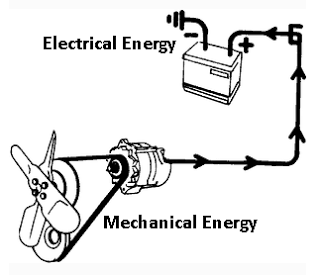
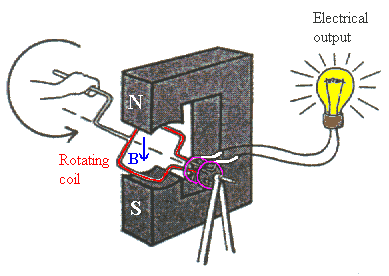
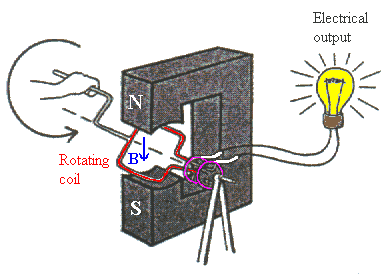
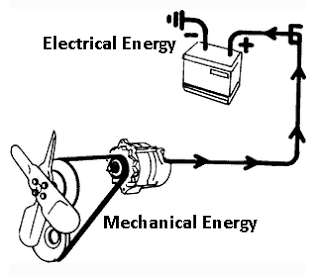
Generators are devices that convert _____ energy into _____ energy.
a)
chemical; mechanical
b)
mechanical; electrical
c)
electrical; mechanical
d)
potential; kinetic
49.

What is the transfer of energy in when you plug in a motor and it spins?

a)

chemical to mechanical

b)

electrical to mechanical

c)

mechanical to electrical

d)

physical to potential

50.
What energy do you put IN to a generator?
a)
Mechanical
b)
Electrical
c)
Thermal
d)
Potential
51.
What type of energy comes OUT of a generator?
a)
Mechanical
b)
Electrical
c)
Thermal
d)
Potential
52.
In an electric motor, the energy transformation begins as  ----
a)
electrical and becomes chemical
b)
mechanical and becomes electrical
c)
electrical and becomes mechanical
d)
mechanical and becomes chemical
53.

In an electric generator, the energy transformation begins as ----

a)

electrical and becomes chemical

b)

mechanical and becomes electrical

c)

electrical and becomes mechanical

d)

mechanical and becomes chemical

54.
True or False: A magnetic field is invisible.
a)
True
b)
False
55.

What two things determine the gravity of an object?

a)

mass & weight

b)

mass & distance

c)

density & mass

d)

volume & distance

56.

Which statement about gravity is true?

a)

gravity causes objects to pull towards one another

b)

gravity causes objects to push away from each other

c)

gravity only takes place between planets

d)

the moon doesn't have any gravity

57.
Any object with mass has gravity.
a)
True
b)
Sometimes
c)
False
d)
Never
58.
As mass increases, what happens to gravitational force?
a)
increases
b)
decreases
c)
stays the same
d)
i don't know
59.
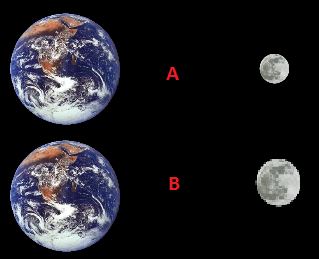
Which system has the greater gravitational attraction between the two objects (if any)?
a)
System A
b)
System B
c)
Same gravitational attraction fro System A and System B
60.
Which of the following will not change in different gravitational fields?
a)
wieght
b)
force
c)
mass
d)
pounds
61.
Which of the following never changes no matter where in the universe?
a)
weight
b)
force
c)
mass
d)
pounds
62.
A person would weigh less on on the Moon than on the Earth because . . .
a)
Moon has more mass, and therefore more gravity
b)
Moon has less mass, and therefore more gravity
c)
Moon has more mass, and therefore less gravity
d)
Moon has less mass and therefore less gravity
63.
The farther apart two objects are, the __ their gravity.
a)
weaker
b)
stronger
c)
more equal
64.

What causes the Earth's magnetic field?

a)

a permanent magnet in the inner core.

b)

the iron ore in the crust of the earth.

c)

the solar flares from the sun reaching earth.

d)

the movement of charged particles in the outer core.