

wayground logo

Free Printable Worksheets

Font size

S
M
L
XL
Worksheets

Q2 Benchmark

Total questions: 99

Worksheet time: 1hrs 14mins

Name
Class
Date
1.

The term laissez-faire roughly translates to mean

a)

hands-off

b)

resist

c)

freedom

d)

control

2.

The ability to have necessities of life, such as food, clothing, and shelter and wants like vacations, concerts, and other amusements is referred to as

a)

middle class

b)

upper class

c)

standard of living

d)

purchasing power

3.

The process of an area growing larger, with an increase in population, production of goods and services, and availability of a variety of options to fulfill one's wants and needs is called

a)

industrialization

b)

urbanization

c)

materialism

d)

commercialism

4.

Which of the following best describes industrialization?

a)

nations began to rely on one another for trade of various goods and resources after the beginning of the Industrial Revolution

b)

smaller nations needed assistance from their larger neighbors, so they formed trade alliances

c)

more and more people began to move to cities, away from rural areas

d)

advancement in technology to produce goods on a larger scale and a reliance on manufacturing of goods instead of individuals producing goods themselves

5.
How did railroads impact the prices of goods & services?
a)
Made goods and services more expensive & harder to ship
b)
Made goods and services cheaper & easier to ship
c)
Gave people safer transportation
d)
Opened new land for exploring and settlements
6.
These workers gather together to try and argue for better working conditions & higher pay. 
a)
abolitionists
b)
temperance movement
c)
organized labor
7.
How did the Industrial Revolution change the way we create goods?
a)
we made fewer products
b)
we made better quality products
c)
we made products from home
d)
mass production & cheaper goods
8.
How did the Industrial Revolution change the way we create goods?
a)
we made fewer products
b)
we made better quality products
c)
we made products from home
d)
mass production & cheaper goods
9.
Because children worked in factories 
a)
they had less education
b)
they became sick an injured
c)
they worked for less pay
d)
all of the above
10.
What was the purpose of labor unions?
a)
Negotiate as a group for bigger factories
b)
Negotiate as a group for better working conditions
c)
Negotiate as a group for a political revolution
d)
Negotiate as a group for a social revolution
11.
The cotton gin was invented by _____, which helped separate seeds from cotton fiber.
a)
Eli Whitney
b)
Henry Ford
c)
Robert Fulton
d)
Edmund Cartwright
12.
Why did people move to cities during the Industrial Revolution?
a)
People were looking for work.
b)
People were looking for farms.
c)
People wanted to buy a house.
d)
People wanted to sell their crops.
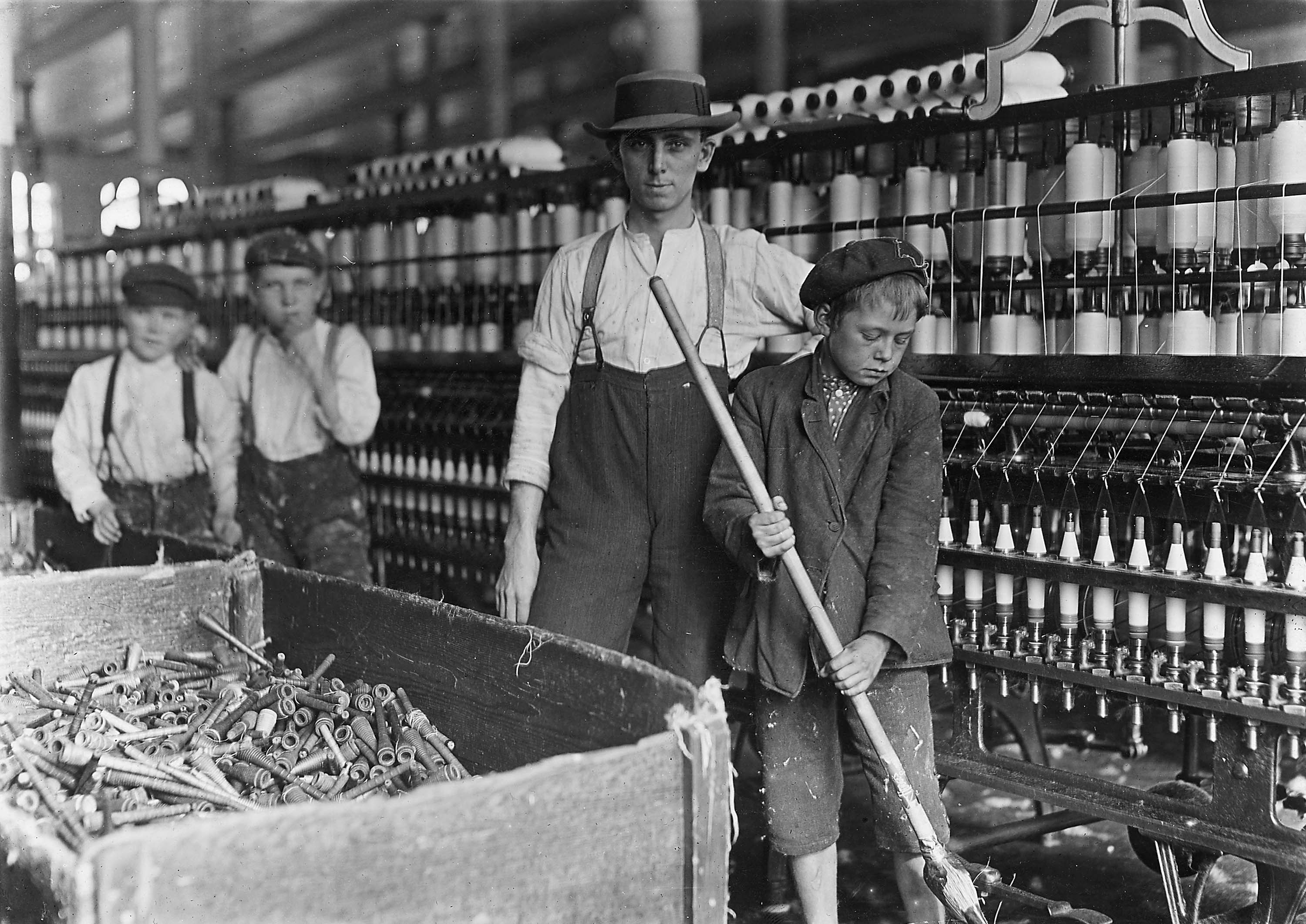
13.
This picture shows which problem of the factory system?
a)
unsafe working conditions
b)
urbanization
c)
unfair wages for women
d)
child labor
14.
What became a model for the manufacturing of American cars and consumer products?
a)
The assembly line
b)
Slavery
c)
Sharecropping
d)
Tenant Farming
15.
What technology revolutionized farming in the west? 
a)
Steel plows, mechanical reapers, and windmills
b)
Morse code
c)
Internet
d)
Hydroelectricity
16.
What did the Homestead Act of 1861 allow settlers to do?
a)
Go to war with Native Americans
b)
Own the land that they settled on after 5 years
c)
Establish the sharecropping system
d)
Make peace with the Native Americans
17.

How did the Transcontinental Railroad change the economy of the United States?

a)

It transported agricultural products to processing centers and helped major industries such as flour milling and meat processing develop in cities like Chicago.

b)

It transported people to the cities to work in factories.

c)

It transported Native Americans to the west.

d)

It transported raw materials to build factories in the west.

18.
Who cooperated to develop the cattle industry?
a)
Ranchers and cowboys
b)
Mexican Americans and Irish Americans
c)
Farmers and Townspeople
d)
Native Americans and pioneers
19.
What two ethnic groups helped to build the transcontinental railroad?
a)
Mexican Americans and Native Americans
b)
Irish immigrants and Chinese immigrants
c)
African Americans and European immigrants
d)
Scottish immigrants and Japanese immigrants 
20.
This act forced Native American tribes to give up their ancestral land holdings and move to reservation lands elsewhere. 
a)
Homestead Act 
b)
Morrill Act 
c)
Dawes Act 
d)
Fort Laramie Treaty, 1868
21.
Adopting the customs and practices of the dominant culture.
a)
Nativism
b)
Ethnic Enclaves
c)
Assimilation
22.
The Dawes Act...
a)
Allowed the Plains indians to continue their tribal traditions of following the buffalo herds
b)
divided the plains Indians tribal lands into family plots as a way to encourage assimilation
c)
provided 160 acres of free land to white settlers
d)
established the route for the Transcontinental railroad
23.
What act gave 160 acres to any family who would live on the land and farm it for 5 years?
a)
The Homestead Promise
b)
The Homestead Neighborhood
c)
The Homestead Act of 1862
d)
The Homestead farmland
24.

Poorly built overcrowded apartment buildings were

a)

settlement houses

b)

skyscrapers

c)

tenements

d)

benevolent societies

25.

What major trend occurred to the population of the United States during the industrial expansion of the late nineteenth century?

a)

farm population increased

b)

migration to rural areas increased

c)

immigration decreased

d)

urbanization increased

26.

Jacob Riis exposed the horrible conditions in New York City and wrote How the Other Half Lives

a)

tenements

b)

schools

c)

factories

d)

sweatshops

27.
People that permanently move to a new country to live.
a)
urbanization
b)
immigrants
c)
oppressive
28.
This inventor developed the first telephone.
a)
Alexander G. Bell
b)
Thomas Edison
c)
Boss Tweed
29.
Her poem encouraged immigrants to come to America and experience opportunity and freedom.
a)
Alexander G. Bell
b)
Jane Addams
c)
Emma Lazarus
30.

Identify the example(s) of ethnic neighborhoods we have discussed

a)

Chinatown

b)

New Mexico

c)

Little Italy

d)

Reservation Road

31.
Where did European immigrants enter when they came to America?
a)
Ellis Island
b)
Rhode Island
c)
Alcatraz
d)
Angel Island
32.
Where did Asian immigrants arrive when they came to America?
a)
Angel Island
b)
Rhode Island
c)
Ellis Island
d)
Fools Island
33.
Why did "Americans" discriminate against the Chinese?
a)
There owned all the businesses in California
b)
They had a lot of money when they came to U.S.
c)
They opened too many restaurants
d)
They held onto their culture (language, food, clothing) & they thought they would take their jobs
34.
Why were so few Chinese immigrants allowed to come to the United States?
a)
Very few tried to come
b)
The voyage was too far and expensive
c)
There were no jobs available
d)
The Chinese Exclusion Act of 1882
35.
Chinese immigrants were mainly employed by companies in which industry?
a)
auto building
b)
skyscraper building
c)
postage delivery
d)
railroad building
36.
Which statement about the “Trail of Tears” is accurate?
a)
President Andrew Jackson opposed the removal of the Cherokee Indians from Georgia.
b)
Large numbers of Cherokee were forced to relocate during the winter months.
c)
Chief Justice John Marshall ordered the Cherokee Indians to move westwards.
d)
The Cherokee were moved because they lacked a written alphabet.
37.
Which term is connected with a state quitting the United States?
a)
Nullification
b)
Annexation
c)
Manifest Destiny
d)
Secession
38.
Why were many more people allowed to vote during Andrew Jackson's presidency?
a)
A man didn't have to own property anymore to vote
b)
tariffs were lowered
c)
women gained the right to vote
d)
African Americans were allowed to vote
39.
What was the Southern economy based on?
a)
manufacturing
b)
livestock
c)
agriculture
d)
service industry
40.

The idea that America has the "God give" right to expand its territory west to the Pacific Ocean was known as --

a)

Nullification Crisis

b)

Trail of Tears

c)

Free Enterprise

d)

Manifest Destiny

41.

Americans relocated many Native Americans for the purpose to obtain more --

a)

Land

b)

Money

c)

Taxes

d)

Tariffs

42.

The act, or law, was created in order to remove Native Americans from their homelands and force them West.

a)

Alien and Sedition Acts

b)

No More Natives Act

c)

Citizens Only Act

d)

Indian Removal Act

43.

The rise of the plantation system in America was caused mostly be the successful crop, --

a)

Wheat

b)

Cotton

c)

Corn

d)

Tobacco

44.

"A state has the right to overrule an act passed by Congress." This ideology led to the --

a)

Nullification Crisis

b)

Free Enterprise

c)

Manifest Destiny

d)

Trail of Tears

45.

The U.S. annexation of ___________ led to disputes between the United States and Mexico. This was a major cause of the U.S. - Mexican War.

a)

Florida

b)

Louisiana

c)

Texas

d)

California

46.

President Andrew Jackson appealed (was liked) mostly by the --

a)

Richest Americans

b)

Poorest Americans

c)

The common man

47.
The Compromise of 1850 included all of the following except 
a)
California entered the Union as a free state
b)
All other states would enter under popular sovereignty
c)
US pays TX $10 million for land outside present day boundary
d)
Texas agreed to become a free state
48.
Slavery became a major issue in the 1840s and 1850s because:
a)
The northern states tried to abolish slavery in the southern states
b)
The nation was expanding to the West
c)
The southern states demanded the end of slavery
d)
None of these
49.
What controversial Law required U.S citizens to return runaway slaves back to their owner?
a)
Slave codes 
b)
Fugitive Slave Act
c)
Underground railroad 
d)
Slaves Law of 1852
50.
Washington crushed an uprising over whiskey taxes using the new federal army
a)
Judiciary Act of 1789
b)
Farewell Address
c)
Whiskey Rebellion
d)
Battle of Fallen Timbers
51.

This law created lower federal courts beneath the Supreme Court to help process court cases.

a)

Whiskey Rebellion

b)

Alien and Sedition Act

c)

Quartering Act

d)

Judiciary Act of 1789

52.
How many terms did George Washington serve as President?
a)
0
b)
1
c)
2
d)
3
53.

This party wanted a national bank

a)

Federalist

b)

Democratic-Republican

54.

This party was led by Thomas Jefferson

a)

Federalist

b)

Democratic-Republican

55.

What was the purpose of Jay's Treaty?

a)

Remove British forts from the Northwest Territory

b)

Make peace with the French

c)

Pay back money owed to America by France

d)

Prevent French ships from attacking American merchant ships

56.

The XYZ Affair controversy happened because....

a)

the French attacked American ships

b)

the British refused to meet American diplomats

c)

French diplomats demanded a bribe to meet with American diplomats

d)

the British were forcing Americans to join their navy

57.

What was the purpose of the Sedition Act?

a)

To prevent people from criticizing the government

b)

To get Americans to support a war with France

c)

To get Americans to support a war with Britain

d)

To stop immigrants from entering the country illegally

58.

What was the purpose of the Kentucky and Virginia resolutions?

a)

Argued for a separation of Church and state

b)

Argued for a stricter interpretation of the Constitution and the ability of states to ignore a federal law that was tyrannical

c)

Argued for a peace treaty with France to end the continuing hostilities

d)

Argued for a higher tariff on goods shipped to America from Europe

59.

The result of Marbury v. Madison was...

a)

the Supreme Court did not have the power to strike down laws that violate the Constitution

b)

the Supreme Court ruled that the president can no longer appoint judges

c)

the Supreme Court ruled that they have the power to strike down laws that violate the Constitution

d)

no president could appoint people within the last three months of their presidency

60.

The decision in McCullough v. Maryland defined which clause that shaped Congress’s power?

a)

Necessary & Proper

b)

The clause to collect taxes

c)

The right of states to control interstate commerce

d)

The River Clause

61.

Which power did the U. S. Supreme Court establish in Marbury v. Madison?

a)

Judicial Review

b)

Hearing appeals from lower federal courts

c)

Deciding cases involving two or more states

d)

Judicial independence through lifetime tenure

62.
Showing loyalty to a state or section rather than the whole country is known as
a)
states' rights
b)
secede
c)
sharecropper
d)
sectionalism
63.

Which statement BEST explains President Abraham Lincoln's original reason for fighting the Civil War?

a)

President Lincoln wanted to end all slavery everywhere in the US

b)

President Lincoln wanted to preserve the Union

c)

President Lincoln wanted to punish the South for their rebellion

64.
What was the South's MAIN argument in support of slavery?
a)
They were an agricultural (farming) based economy that relied on free workers
b)
They had the right to limit the power of the federal government (states' rights)
c)
A workplace made up slave labor would work harder
65.

When was the Civil War?

a)

1861-176

b)

1861-1865

c)

1870-1876

d)

2015-2019

66.

Which was a cause of the Civil War? (Check all that apply).

a)

Tariffs (taxes)

b)

States' rights

c)

Sectionalism

d)

Slavery

e)

Economy

67.

After Abraham Lincoln won the election, which states seceded (left)?

a)

Indian Territories

b)

Western Territories

c)

Southern States

d)

Northern States

68.

What's important about Fort Sumter?

a)

This is where Lee surrender and it ended the Civil War.

b)

The Confederates open fired on the fort, which began the Civil War.

c)

Lincoln gave the Gettysburg Address here.

69.

The Emancipation Proclamation truly freed slaves in ALL parts of the United States.

a)

True

b)

False

70.

Which social change was brought about by the 13th Amendment?

a)

formerly enslaved African Americans were granted land

b)

enslaved African Americans were made United States citizens

c)

African Americans living in the South were given the right to vote

d)

the practice of enslaving people was outlawed in the United States

71.
The US government created what organization to help former slaves and poor whites?
a)
Bureau of Parks and Recreation
b)
Free Food Bureau
c)
Jobs and Education Bureau
d)
Freedman's Bureau
72.
Which is the best description of Reconstruction?
a)
rebuilding the US after a big earthquake
b)
a period of rebuilding in the US after the Revolutionary War
c)
a period of rebuilding in the US after the Civil War
d)
unfair treatment of African Americans after the Civil War
73.
The 14th Amendment granted...
a)
freedom of speech
b)
citizenship and equal protection
c)
the right to vote
d)
the right to a speedy and fair trial
74.
Which of these amendments gives citizens the right to vote regardless of race, color or previous condition of servitude?
a)
13th Amendment
b)
14th Amendment
c)
15th Amendment
d)
18th Amendment
75.
Southern states created the Black Codes to do what?
a)
limit African Americans rights
b)
expand Confederate rights
c)
give women voting rights
d)
jail Carpetbaggers
76.
Who could hold public office in the south during Reconstruction?
a)
African Americans
b)
Confederate Leaders
c)
Southern Women
d)
American Indians
77.
Carpetbaggers were...
a)
Newly freed slaves
b)
Southern Republicans
c)
Confederate Soldiers
d)
Northerners who took advantage of southern economic hardships 
78.
Who pushed Madison into declaring war against Great Britain? 
a)
The War Hawks 
b)
The Native Americans
c)
His own party 
d)
All of these
79.
Which is NOT a cause of the War of 1812?
a)
British impressment of American sailors
b)
British searching and seizing American ships
c)
British giving guns and ammunition to Native Americans
d)
British burning down Washington D.C.
80.
One way the War of 1812 effected industry in the Northeastern US was - 
a)
Americans bought more American-made goods as a result of the embargo
b)
The US relied heavily on goods made in other countries
c)
The war caused a decline in American made goods
d)
The war caused Americans to ration their products
81.
What is the practice of kidnapping sailors and forcing them to serve?
a)
Impressment
b)
Isolationism
c)
Sedition
d)
Embargo
82.
What ended the War of 1812?
a)
Treaty of Paris
b)
The Document of Termination
c)
Quang
d)
Treaty of Ghent
83.

What was the last battle fought in the War of 1812?

a)

The Battle of Lake Erie

b)

The Battle of Toronto

c)

The Battle of Quebec

d)

The Battle of New Orleans

84.

Nationalism is:

a)

Not wanting to declare war

b)

Pride in ones country

c)

Revenge against another nation

d)

Upset with ones country

85.
Who were the War Hawks?
a)
Men from the Northeast who want to go to war
b)
Women who fought in the War of 1812
c)
Men from the South and West who want to go to war
d)
Men from the South and North who do NOT want to go to war
86.
What was the main objective of the Lewis and Clark expedition?
a)
Discover a waterway across America
b)
Map the uncharted territory
c)
Document wildlife and plants in the area
d)
Get a Christmas tree for the White House
87.
The United States bought the Louisiana Territory from which foreign country?
a)
Spain
b)
France
c)
England
d)
Germany
88.
What did Jefferson do to punish the British for Impressing American sailors?
a)
The Embargo Act
b)
The Stamp Act
c)
The Sugar Act
89.
Why is the Election of 1800 so significant?
a)
It was the transfer of power from Federalist to Democratic-Republican
b)
It was the transfer of power between Democratic-Republican to Federalist
90.
What was the name of the first women's rights convention? 
a)
The Seneca Falls Convention
b)
The Rochester Convention
c)
The Niagara Falls Convention
d)
The Ithaca Convention
91.
People who fought for women's suffrage were fighting for:
a)
Women having the right to vote
b)
Women having the right to work outside the home
c)
women's right to own property
d)
women's right to be in the army
92.
Abolitionists wanted what practice to end immediately? 
a)
The Civil War
b)
Women's voting
c)
Unclean meat processing
d)
Slavery
93.
Who led hundreds to freedom through a system called the Underground Railroad?
a)
Frederick Douglass
b)
Sojourner Truth
c)
Nat Turner
d)
Harriet Tubman
94.
Which abolitionists was a founder of the newspaper "The Liberator"?
a)
Garrison
b)
Wright
c)
Douglass
d)
Anthony
95.
Who published a newspaper called "The North Star", and worked for the rights of African Americans and Women?
a)
Wright
b)
Douglass
c)
Garrison
d)
Anthony
96.

What was the effect of the novel by Harriet Beecher Stowe?

a)

Increased support for women's rights.

b)

Industries implemented labor unions for worker's rights.

c)

Resulted in the outlawing the Fugitive Slave Act

d)

Caused abolitionist movement to grow.

97.
Many felt Jackson acted as a____________________ during his presidency
a)
Gambler
b)
Monarch
c)
Corrupt bargain
d)
Politician
98.
Jackson's practice of rewarding political supporters with government jobs became known as
a)
the spoils system.
b)
Jacksonian democracy.
c)
mudslinging.
d)
a corrupt bargain.
99.

What allowed the President to imprison aliens and deport-send out of the country-those thought to be dangerous?

a)

XYZ Affair

b)

Jay's Treaty

c)

Alien Act

d)

Whiskey Rebellion
