
 Worksheets
SLT Science Practice
Total questions: 70
Worksheet time: 4hrs 30mins


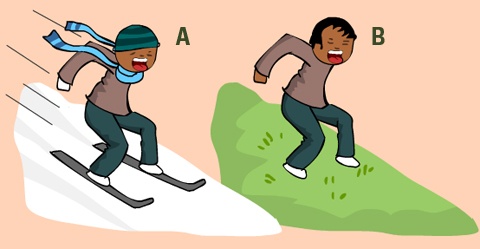


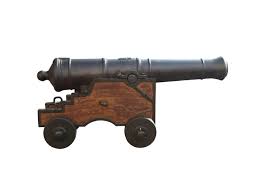
? = mass x acceleration
or
? = m x a
is used to find
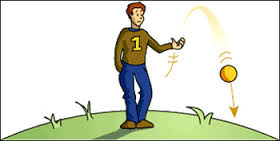
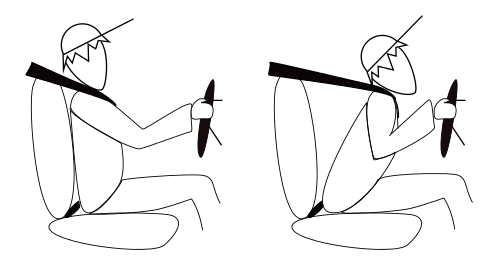

What force is acting on the cat at the end?
Gravity
Friction
Momentum

A 10 kg, 15 kg, and 20 kg rock are rolling down a hill. Which rock will require the most force to stop?
10 kg rock
15 kg rock
20 kg rock
All 3 rocks will require the same force
What does Newton's Third Law state?
For every action there is an equal and opposite reaction.
When masses are the same, the exert the same amount of force.
An object will not move unless acted on by an unbalanced force.
F = m x a

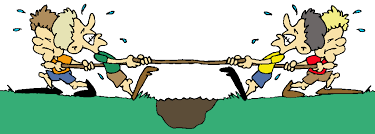
In which direction would this object move and by how much?
10 newtons to the left
10 newtons to the right.
5 newtons to the right
The object would not move

Which dog would be easier to pick up?
The larger dog due to the larger mass.
The smaller dog due to the smaller mass.
Smaller mass = less inertia
The larger dog because it takes up more space.
Neither. You would exert the same amount of energy picking up both dogs.
When are forces considered to be unbalanced?
Forces are always balanced
Forces are considered to be unbalanced when the net force acting on the object is greater than zero.
When the net force is zero
When friction is applied.
What is inertia?
An object’s tendency to resist a change in motion.
The friction that acts on an object after it is in motion.
An object that has an equal reaction force.
A force pair
Which activity would BEST demonstrate the Law of Action/Reaction?
A car traveling down the road.
A rocket launching to space.
A soccer ball sitting on the ground.
A lady pushing a grocery cart.
Which activity would BEST demonstrate Newton's law of Inertia?
A plate sits on a table top.
A lady pushes a grocery cart.
A child jumps on a trampoline.
A boy swings a baseball bat.
Which activity would BEST demonstrate the Law of Force and Acceleration?
A lady pushes a grocery cart.
A boy swings a baseball bat.
A soccer ball sits on the ground.
A rocket launches into space.

Which law is this picture an example of?
Law of Inertia
Law of Force and Acceleration
Law of Action / Reaction

Which law is this picture an example of?
Law of Inertia
Law of Action / Reaction
Law of Force and Acceleration

Which law is this picture an example of?
Law of Inertia
Law of Force and Acceleration
Law of Action / Reaction

Regular eclipses of the Sun and the Moon are best explained by which of the following?
Th relative masses of the Sun, Earth and the Moon
The different compositions of the Sun and the Moon
The rotation of Earth and Moon on their axes
The movement of Earth and the Moon around the Sun


Which of the following is most responsible for the changing of seasons on Earth?
Orbit of the Earth around the Sun
Tilt of the axis of Earth
Rotation of the Sun
Rotation of the Earth

If Katherine wanted to represent a solar eclipse, at what position should she place the Moon?
A
B
C
D

Name the eclipse.
solar eclipse
lunar eclipse

Based on the diagram, where is the sun located
On the left of the diagram
On the right of the diagram
Above the diagram
Below the diagram

Based on the diagram above, what phase is observed from Earth at location D?
waxing crescent
first quarter
waning crescent
new moon

How would the moon appear from point B?


True or False? The Sun has a greater influence on Earth's tides than the moon.
False
True

Tides are caused by _________________
the gravitational pull of the moon only.
large storms over the ocean.
the action of Earth's tectonic plates.
the combined gravitational forces of the sun and moon.
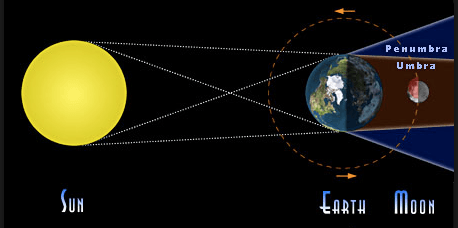
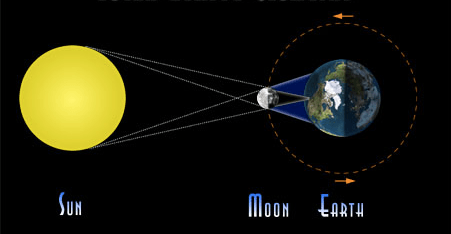

What happens during a solar eclipse?
The sun blocks the moon from Earth.
The moon blocks the light from the sun from Earth.
The Earth blocks the moon from the sun.
The Earth blocks the light from the sun on the moon.

Lunar eclipses last for a longer period of time.
C.E.R. stands for
Claim Evidence Reasoning
Cause Effect Results
Conclusion Endnotes Reference
What is a claim?
Answers a question or problem
long and detailed paragraph
Explains why something happened
What is an example of a claim?
Mrs. Hoselle likes coffee.
In the fall, because of changes in the length of daylight and changes in temperature, the leaves stop their food-making process.
The data shows that when leaves are taken away from sunlight, they change colors.
What is an example of evidence?
Football players are 33% more likely to get injured than baseball players.
Football is more dangerous than baseball.
Baseball is a fun sport.
Why do we need evidence?
To answer a question
To show how and why
To prove our claim is true
Evidence is your __________________
Proof
Question
Reasoning
What is a Claim?
Living things need water.
Data that supports
tThe how and why the evidence supports
A statement or stance that answers a scientific question or problem
A framework for writing scientific explanations is called
(a)
What is EVIDENCE ?
Answers a question
Data, observations, facts
Long and detailed paragraph
What is REASONING?
Answers a question
Explaining how evidence supports a claim
Used to prove something true or false
What is a CLAIM?
Answers a question or problem
long and detailed paragraph
Explains why something happened
What is the purpose of writing a CER?
To ignore evidence and make up science explanations
To support your science argument or explanation with evidence
There is no purpose of writing a CER.
What does the R in CER stand for?
Red
Read
Reasoning
Real
What does the E in CER stand for?
(a)
What does the C in CER stand for?
Claim
Cat
Career
Clap

