
 Worksheets
LIthosphere Review
Total questions: 55
Worksheet time: 56mins
Name
Class
Date
1.
Where do most earthquakes and volcanoes occur?
a)
in the ocean
b)
along the coast
c)
along fault lines
d)
in the Arctic
2.
At an oceanic-oceanic divergent boundary, ____.
a)
new crust is created
b)
old crust is deformed or fractured
c)
plates side past one another
d)
old crust is recycled by subduction
3.
Continental-continental plate collisions produce ____.
a)
very tall mountain ranges
b)
deep-sea trenches
c)
rift valleys
d)
island arcs
4.
Crust is neither destroyed nor formed along which of the following boundaries?
a)
convergent
b)
magnetic
c)
divergent
d)
transform
5.
The driving forces of tectonic plates are related to convection currents in Earth’s ____.
a)
crust
b)
inner core
c)
mantle
d)
outer core
6.
Volcanism that occurs around the Pacific Ocean is referred to as ____.
a)
the Mediterranean Belt
b)
the Ring of Fire
c)
a hot spot
d)
rift volcanism
7.
A tsunami is generated after an underwater _________.
a)
volcano
b)
earthquake
c)
hurricane
d)
pressure change
8.
The type of plate boundary where plates moves apart?
a)
Divergent
b)
Convergent
c)
Transform
9.
Type of plate boundary where plates moves together (towards each other)?
a)
Divergent
b)
Convergent
c)
Transform
10.
Continuous changing and remaking of rocks is the
a)
water cycle
b)
earth cycle
c)
rock cycle
d)
lithosphere cycle
11.
This family of rocks results as one rock changes into another due to increased heat and pressure on the rock and the rock does not melt.
a)
Igneous
b)
Sedimentary
c)
Metamorphic
12.
Which of these structures form when materials are deposited, buried, and cemented?
a)
intrusive structures
b)
volcanic mountains
c)
igneous rock
d)
sedimentary rock
13.
The primary force responsible for plate tectonics is ___________ in the mantle.
a)
Conduction
b)
Convection
c)
Radiation
14.
2. Melted rock inside a volcano or near a volcano is known as....
a)
Magma
b)
Lava
c)
Pyroclastic Material
15.
The theory that says Earth's continents once made up an ancient supercontinent, and have been drifting apart ever since, is called the theory of...
a)
Pangea
b)
Plate Tectonics
c)
Natural Selection
d)
Gravity
16.
A type of rock that forms from the cooling of molten rock at or below the surface of the earth
a)
Igneous Rock
b)
Metamorphic Rock
c)
Sedimentary Rock
d)
chemical Rock
17.
What process is used to form sedimentary rocks?
a)
Lava cools and hardens to form a rock.
b)
Bits of sand and gravel form layers that turn into rock from pressure.
c)
Extreme heat and pressure from inside the Earth turn rocks into new rocks.
d)
Magma trapped under the Earth's surface cools and solidifies.
18.
Which type of rock would you expect to find by a volcano?
a)
Ingenious
b)
Igneous
c)
Indigenous
d)
Indigo
19.
The process by which igneous rocks are formed...
a)
heat and pressure
b)
melting and cooling
c)
compaction and cementation
20.
The process by which metamorphic rocks are formed...
a)
heat and pressure
b)
compaction and cementation
c)
melting and cooling
21.
Wind, water, and ice breaking down rock is called
a)
Erosion
b)
Deposition
c)
Compaction
d)
Weathering
22.
A metamorphic rock changes into an igneous rock by what two processes?
a)
Melting and cooling
b)
Extreme heat and pressure
c)
Compaction and cementation
d)
Weathering and erosion
23.
What type of rock forms when lava cools?
a)
Igneous
b)
Metamorphic
c)
Sedimentary
d)
Magma
24.
This type of weathering occurs when rocks weaken then break down due to chemical changes in the composition of the rock.
a)
mechanical weathering
b)
chemical weathering
c)
erosion weathering
d)
deposition
25.
This type of weathering occurs when rock is physically broken down into smaller pieces of rock.
a)
mechanical weathering
b)
chemical weathering
c)
erosion weathering
d)
deposition
26.
How is mechanical weathering different from chemical weathering?
a)
Chemical weathering happens over much shorter time frame than mechanical weathering.
b)
Chemical weathering changes the chemical composition of rocks; mechanical weathering does not.
c)
Chemical weathering occurs only in tropical climates; mechanical weathering occurs only in cool climates.
d)
Chemical weathering occurs only in the mountains; mechanical weathering occurs only on flat land.
27.
Weeds growing into the cracks in a sidewalk and the sidewalk begins to crumble is an example of:
a)
mechanical weathering
b)
chemical weathering
28.
A metal statue slowly turning green after years of being outside is an example of:
a)
mechanical weathering
b)
chemical weathering
29.
Massive pieces of land that are part of the Earth's crust and upper mantle
a)
Tectonic plates
b)
Trenches
c)
Divergent boundary
d)
Continental shelves
30.
The zone where one plate slides under another is called the
a)
Convergent zone
b)
Subduction zone
c)
Transform zone
d)
Mantle zone
31.
Which type of crust is more dense and thinner?
a)
Continental
b)
Asthenosphere
c)
Oceanic
d)
Byers
32.
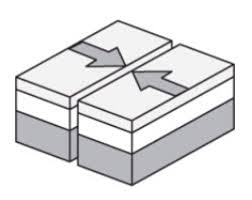
Name the boundary
a)
convergent boundary
b)
divergent boundary
c)
transform boundary
d)
sergent boundary
33.

Name the boundary
a)
convergent boundary
b)
divergent boundary
c)
transform boundary
d)
sergent boundary
34.
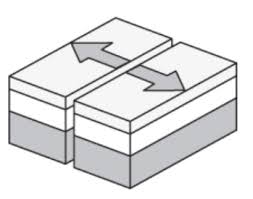
Name the boundary
a)
convergent boundary
b)
divergent boundary
c)
transform boundary
d)
sergent boundary
35.
Where are most volcanoes found?
a)
Southern Hemisphere
b)
Ring of Fire
c)
Mid-Atlantic Ridge
d)
Hot Spots
36.
Where do volcanoes come from?
a)
Places where plates move apart
b)
Places where plates are moving together
c)
Hot Spots
d)
All of these options
37.
What geologic feature/event you be most likely to find at a transform boundary?
a)
Earthquakes
b)
Volcanoes
c)
Mountains
d)
Rift Valleys
38.

Acid mine drainage is the result of
a)
ash and air debris creating acid rain
b)
boulders and debris blocking the flow of rivers/streams
c)
toxins in tailings leaching into the soil
d)
minerals from mining being left behind creating pollution
39.

Which regulation requires miners to clean up after themselves?
a)
General Mining Act of 1872
b)
Mineral Leasing Act of 1920
c)
Surface Mining Control and Reclamation Act
40.
Which type of mining is associated with disturbing more land?
a)
Surface mining
b)
Sub-surface mining
c)
Mining in the oceans
41.

What is the name of solid waste that was produced during mining?
a)
Tailings
b)
Rocks
c)
Minerals
d)
Deposits
42.
Reclamation is.....
a)
not required in the US.
b)
a process that causes significant environmental damage.
c)
returning the land back to its original condition after mining
d)
required for every country and every type of mine in the world.
43.
How are coal and minerals distributed across the globe?
a)
Randomly all across Earth
b)
Located primarily in mountains
c)
Found mostly in streams
d)
Found mostly on islands
44.

Ore is
a)
any type of rock
b)
a rock with metals
c)
a rock with metals worth something to someone
d)
a rock with minerals
45.

The _____ sets standards to minimize the surface effects of coal mining on the environment.
a)
Clean Water Act
b)
Comprehensive Response Compensation and Liability Act (1980)
c)
Surface Mining Control and Reclamation Act of 1977
d)
Safe Drinking Water Act
46.

Which of the one of the following is and effect of land being disturbed by mining?
a)
Better water quality
b)
Loss of Habitat for animals
c)
New habitat for animals
d)
No negative effects
47.

Mining accidents have occurred as far back as 1907.
a)
True
b)
False
48.

Deep deposits of minerals being removed from underground though tunnels and shafts is the definition of:
a)
Strip Mining
b)
Mountaintop Removal
c)
Subsurface Mining
d)
Surface Mining
49.

When machines dig very deep large holes with machines is the definition of:
a)
Open Pit Mining
b)
Strip Mining
c)
Surface Mining
d)
Subsurface Mining
50.

Mineral deposits being removed from near the surface is the definition of:
a)
Subsurface mining
b)
Open Pit Mining
c)
Strip Mining
d)
Surface Mining
51.
Huge bulldozers are used to clear away the top layers of the Earth’s surface to reach minerals close to the surface.
a)
shaft mining
b)
shaft mining
c)
open-pit mining
d)
strip mining
52.

Air pollution, water pollution, and noise pollution are associated mostly with ______.
a)
subsurface mining
b)
surface mining
c)
shaft mining
d)
room and pillar mining
53.
When machines dig very deep large holes from the surface hundreds of meters down to remove minerals is called:
a)
Open Pit Mining
b)
Strip Mining
c)
Room and Pillar Mining
d)
Shaft Mining
54.
Minerals are considered...
a)
renewable
b)
non-renewable
c)
unnecessary for day to day living
d)
too expensive to be extracted
55.
Which type of mining is probably the most dangerous?
a)
strip mining
b)
surface mining
c)
open pit mining
d)
subsurface mining
100 %

