wayground logo

Free Printable Worksheets

Font size

S
M
L
XL
Worksheets

Unit 5 Exam

Total questions: 92

Worksheet time: 1hrs 3mins

Name
Class
Date
1.

Sexual reproduction results in

a)

Genetically unique offspring

b)

Genetically identical offspring

2.

Sexual reproduction results in

a)

No variation

b)

Large amounts of variation

3.

Which of the following is the female animal gamete?

a)

Sperm

b)

Egg

c)

Pollen

d)

Teste

4.

Which of the following describes the main advantages of sexual reproduction?

a)

requires lots of time/energy

b)

no new gene combos can arise

c)

genetic diversity

d)

looks identical to the parent

5.
The cells produced via meiosis are called:
a)
sex cells
b)
somatic cells
c)
body cells
d)
skin cells
6.
A human zygote should have _____ chromosomes inside.
a)
46
b)
23
c)
92
d)
64
7.
Human eggs and sperm are _____, and each has ____ chromosomes.
a)
diploid, 23
b)
diploid, 46
c)
haploid, 23
d)
haploid, 46
8.
How are your chromosomes inherited?
a)
most of your chromosomes from your mother
b)
most of your chromosomes from your father
c)
a random number of chromosomes from each parent
d)
half your chromosomes from your mother and half from your father.
9.

Crossing-over is an efficient way to produce _________ ____________which increases genetic diversity

a)

genetic variation

b)

genetic recombination

c)

genetic elements

10.

What process creates reproductive cells used in sexual production?

a)

meiosis

b)

mitosis

c)

cellular respiration

d)

photosynthesis

11.

A zygote is formed by ___________ of a male and female gamete.

a)

fertilization

b)

division

c)

reduction

d)

addition

12.

Which describes a zygote cell?

a)

diploid

b)

haploid

c)

monoploid

d)

triploid

13.

When a single-celled organism splits into 2 new organisms it is called _________________.

a)

fragmentation

b)

fission

c)

budding

d)

sporulation

14.

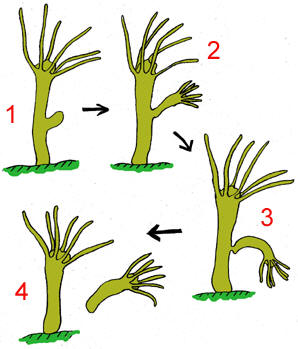
When an offspring grows off from the body of a parent organism it is called __________________.

a)

budding

b)

fission

c)

fragmentation

d)

sporulation

15.

Some advantages of sexual reproduction include: (select all that apply)

a)

genetic variation

b)

improves chances of adapting to the environment

c)

helps species survive catastrophes

d)

it doesn't take as much energy as asexual reproduction

16.

What are some disadvantages to sexual reproduction? (select all that apply)

a)

it takes a lot of energy to find a mate

b)

you don't need another mate

c)

it requires a male and a female

d)

more genetic errors can occur

17.

What are some advantages of asexual reproduction are: (select all that apply)

a)

it only requires one organism

b)

it takes less energy than sexual reproduction

c)

offspring are already well-adapted for the environment

d)

there is a lot of genetic variety

18.

Genetically identical offspring are _____________ the parent organism.

a)

opposite of

b)

clones of

c)

superior to

d)

inferior to

19.

In fission, how does the DNA of the daughter cells compare to the DNA of the parent cell?

a)

it is exactly the same

b)

it is different due to meiosis

c)

it is mostly the same with slight changes

d)

it is better than the parent DNA

20.

If a sex cell has 10 chromosomes, how many chromosomes will there be after fertilization?

a)

5

b)

10

c)

15

d)

20

21.
All of the offspring of an organism have the same genetic material, which is identical to the parent organism. From this, we can conclude that this organism -
a)
makes its own food
b)
is unicellular
c)
live in a marine habitat
d)
reproduces asexually
22.
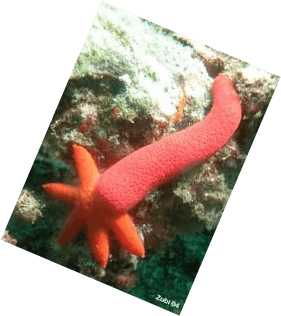
When a starfish grows a new body off a broken arm, what kind of reproduction is this?
a)
Sexual
b)
Differentiation
c)
Asexual 
d)
Specialization
23.
What type of asexual reproduction is taking place?
Fishermen work hard to catch and remove all the starfish that get into their favorite shell fishing beds and the “underwater farms” where they raise clams and oysters. In the past, they put the starfish into their boats, cut them up with knives, and then throw the pieces of starfish overboard. They thought this would kill the starfish. What they did not know was that each piece of starfish will grow into a whole new animal.
a)
Regeneration
b)
Vegetative propagation
c)
Budding
d)
Fission
24.
If two organisms reproduce sexually, then their offspring will exhibit a genetic makeup that is -
a)
identical to only one parent
b)
identical to all of its siblings
c)
a unique combination of traits
d)
the recessive traits of each parent
25.

In sexual reproduction the female produces ___ cells.

a)

Femalex

b)

Quack

c)

Egg

d)

Sperm

26.

New PLANTS are reproduced from roots, stems, or leaves of the parent plant (Ex: Strawberries, Potatoes)

a)

Sexual Reproduction

b)

Vegetative Reproduction

c)

Budding

d)

Regeneration

27.

Which type of organisms have both internal fertilization & development?

a)

Plants

b)

Mammals & Humans

c)

Fish & Amphibians

d)

Reptiles

28.

Which is a benefit of internal fertilization & development?

a)

Rapid rate of reproduction

b)

Easiest way to reproduce

c)

Safer & provides protection for the offspring

d)

Produces more offspring

29.

Which is an disadvantage of external fertilization?

a)

Too many eggs to fertilize

b)

Only one offspring is produced

c)

Decreased chance that any get fertilized

d)

Predators can eat the eggs & sperm may be swept away by the current

30.
When an egg is first fertilized it is known as 
a)
a nucleus
b)
an embryo
c)
a zygote
d)
a fetus
31.
When a fertilized egg divides and forms a ball of cells, it is known as...
a)
a nucleus
b)
a fetus
c)
a zygote
d)
an embryo
32.
Where does the implantation occur and the zygote develop?
a)
in the uterus
b)
in the ovary
c)
in the vagina
d)
in the fallopian tube
33.
The developing embryo is fed by its mother’s blood through a tissue called the
a)
placenta
b)
vagina
c)
amnion
d)
uterus
34.
The developing embryo is connected to the placenta by
a)
the spinal cord
b)
the umbilical cord
c)
the amniotic fluid
d)
the developing nerves
35.
A baby comes out of what part of a mother’s body?
a)
vagina
b)
placenta
c)
uterus
d)
fallopian tube
36.
Ordinarily, how many sperm fertilize a female’s egg?
a)
several million
b)
a few hundred
c)
one
d)
six to ten
37.
An egg is fertilized after the union of the egg’s and sperm’s
a)
membranes
b)
semen
c)
nucleus
d)
zygote
38.
After the egg is fertilised, where does the fertilized egg develops?
a)
A
b)
B
c)
C
d)
D
39.

Where do the egg and sperm meet?

a)

The ovary

b)

The fallopian tube / oviduct

c)

The vas deferens

d)

The uterus

40.
The fluid that forms around the baby in the mother's uterus is called ____________ fluid.
a)
tissue
b)
placental
c)
amniotic
d)
lymphatic
41.
In mitosis, the two resulting cells are
a)
different from the starting cell and identical to each other.
b)
different from the starting cell and different from each other.
c)
identical to the starting cell and different from each other.
d)
identical to the starting cell and identical to each other.
42.
In which type of cells will mitosis occur?
a)
egg cells
b)
sperm cells
c)
jail cells
d)
Body cells except the sperm and egg cells
43.
After meiosis is complete, the new cells:
a)
are all identical
b)
are all different
c)
are half identical and half different
d)
are all stretched out
44.
How many daughter cells are produced from meiosis ?
a)
10
b)
6
c)
4
d)
2
45.
Humans have how may chromosomes ?
a)
112
b)
46
c)
8
d)
67
46.
Most of the cells in the human body are produced by
a)
mitosis
b)
meiosis
47.
Why do we need meiosis?
a)
To double the number of chromosomes going into sex cells
b)
To halve the number of chromosomes going into sex cells
c)
To triple the number of chromosomes going into sex cells
d)
To not change the number of chromosomes going into sex cells
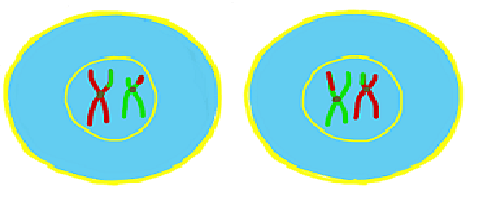
48.
Name that process
a)
Mitosis
b)
Meiosis
c)
Mutation
d)
Cell Cycle
49.
During which phase of the meiotic cell cycle does DNA Replication occur?
a)
Interphase 
b)
Prophase 
c)
Metaphase 
d)
Telophase
50.
In Meiosis if the parent cells has 40 chromosomes, then how many will the daughter cells have 
a)
40
b)
10
c)
20
d)
18
51.
The stages of mitosis in order
a)
Metaphase, Anaphase, Prophase, Telophase
b)
Prophase, Anaphase, Metaphase, Telophase
c)
Prophase, Metaphase, Anaphase, Telophase
d)
Anaphase, Prophase, Telophase, Metaphase
52.
A cat has a total of 38 chromosomes in its body cells.  How many in its gametes?
a)
38
b)
19
c)
76
d)
10
53.
When a cell is not actively dividing, it is in what phase?
a)
interphase
b)
anaphase
c)
prophase
d)
telophase
54.
What portion of the cell cycle involves the actual dividing?
a)
interphase
b)
mitosis
c)
Gap 1
d)
Gap 2
55.
Before a cell can divide, what must happen?
a)
Nothing, it is always ready to divide
b)
The number of chromosomes must be cut in half
c)
The number of chromosomes must double
d)
The number of chromosomes must triple.
56.
What is the name of the process in which DNA (genetic information) is exchanged during meiosis?
a)
crossing under
b)
crossing over
c)
melding
d)
blending
57.
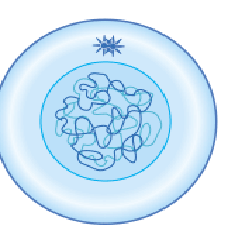
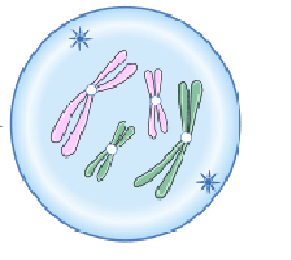
The process on the left is:
The process on the right is:
a)
Left: meiosis
Right: meiosis
b)
Left: meiosis
Right: cloning
c)
Left: mitosis
Right: meiosis
d)
Left: mitosis
Right: mitosis
58.
Place these cells in order of mitosis.
a)
A, B, C, D, E
b)
B, E, D, A, C
c)
C, E, A, D, B
d)
B, D, A, E, C
59.

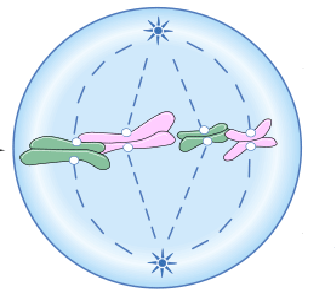
What phase am I?

a)

Interphase

b)

Prophase

c)

Metaphase

d)

Anaphase

e)

Telophase

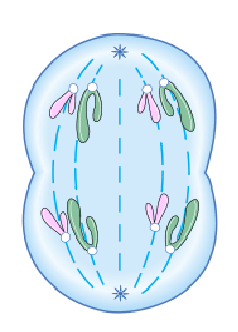
60.

What phase am I?

a)

Interphase

b)

Prophase

c)

Metaphase

d)

Anaphase

e)

Telophase

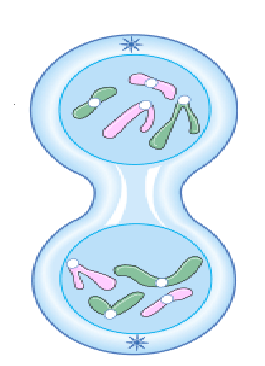
61.

What phase am I?

a)

Interphase

b)

Prophase

c)

Metaphase

d)

Anaphase

e)

Telophase

62.

What phase am I?

a)

Interphase

b)

Prophase

c)

Metaphase

d)

Anaphase

e)

Telophase

63.

What phase am I?

a)

Interphase

b)

Prophase

c)

Metaphase

d)

Anaphase

e)

Telophase

64.

When the cells completely split it is call what?

a)

Telophase

b)

Cytokinesis

c)

Anaphase

65.

what phase am I?

a)

Prophase 1

b)

Metaphase 1

c)

Anaphase 1

d)

Telophase 1

e)

Cytokinesis

66.
The diagram shows the female reproductive system. The part labelled B is called  
a)
sperm 
b)
the egg  
c)
the womb  
d)
the ovary 
67.
After fertilisation the zygote increases in size and travels down the Fallopian tube to become embedded in the walls of the womb. This process is known as
a)
implantation
b)
ovulation
c)
menstruation
d)
conception
68.
This carries the egg to the uterus. 
a)
Fallopian tube
b)
Vagina
c)
cervix
d)
 Ovary
69.

This occurs on days 1 to 4 of the menstrual cycle.

a)

The lining of the uterus remains in place in preparation for the possible arrival of an early embryo.

b)

Shedding of the lining of the uterus

c)

An egg is released from the ovaries

d)

The lining of the uterus builds up

70.

The human male reproductive system is adapted for the production of

a)

sperm and the delivery of these cells for internal fertilization

b)

gametes that transport food to the egg

c)

zygotes and the development of these cells into a fetus

d)

hormones that stimulate placenta formation in the male

71.

A reproductive system is represented in the diagram

given. Which structure is correctly paired with its

reproductive function?

a)

A – pathway of gametes

b)

B – synthesis of progesterone

c)

C – production of sperm

d)

D – regulation of homeostasis

72.

A diagram of the human male reproductive system is given. Which structure produces cells that have the potential to become gametes?

a)

A

b)

B

c)

C

d)

D

73.

Which structure is correctly paired with its function?

a)

ovary — provides milk for newborns

b)

testis — development of sperm

c)

placenta — storage of released eggs

d)

uterus — produces estrogen

74.

Base your answer to the following question on the diagram given and on your knowledge of biology. The letters in the diagram indicate structures present in a human male.

What change would occur immediately if both

structures labeled B were damaged or blocked?

a)

Structure A would decrease in size.

b)

The blood supply to structure E would decrease.

c)

Gametes would no longer be transported to

structure C.

d)

Structure D would be able to deliver more

gametes.

75.

Base your answers to questions 10 on

the picture given which represents systems in a

human male and on your knowledge of biology.

Which structure has both reproductive and

excretory functions?

a)

A

b)

G

c)

C

d)

D

76.

Base your answer to question 12 on the picture given which represents systems in a human male and on your knowledge of biology.

Which sequence represents the path of sperm leaving the body?

a)

A-C-G

b)

A-C-B

c)

E-F-H

d)

D-F-G

77.
What is structure #3
a)
Ovary
b)
Fundus
c)
Fallopian Tube
d)
I don't know
78.

The two hormones that maintain the lining of the uterus are:

a)

FSH and estrogen

b)

LH and estrogen

c)

estrogen

d)

Progesterone and estrogen

79.
What is the main role of FSH?
a)
Stimulates follicle to burst and release the ovum
b)
Stimulates rebuilding of the uterus wall
c)
Stimulates one egg cell to develop (become follicle)
d)
Completes development of uterus wall, promotes glycogen storage
80.
What hormone needs to spike to signal ovulation?
a)
FSH
b)
LH
c)
Estrogen
d)
Progesterone
81.

What is the first cloned mammal?

a)

goat

b)

cat

c)

sheep

d)

cow

82.
A clone can be BEST thought of as a(n)  _____ created in the lab. 
a)
identical twin
b)
GMO
c)
science fiction experiment
83.
Why might people be against cloning? 
a)
It's creepy
b)
It can cause unknown defects
c)
It is detrimental to genetic diversity
d)
All of the above
84.
In cloning, what is the purpose of the surrogate mother? 
a)
Donate her DNA
b)
Donate her egg cell
c)
Incubate and carry the baby until birth
d)
Nothing.  She's useless.
85.

Which technology below would probably be the most important to a person who had diabetes and had to take insulin every day?

a)

using recombinant DNA to produce human hormones from bacteria

b)

testing parents for genetic disorders before they have children

c)

engineering fruits and vegetables that resist insects and other pests

d)

C. developing ways to identify criminals through DNA fingerprinting

86.

In which ways can genetic engineering can improve crops

a)

Make them pest or drought resistant

b)

Make them more nutritious

c)

Make them larger

d)

All answers are correct

87.
Making changes in the DNA of an organism is
a)
selective breeding
b)
artificial selection
c)
genetic engineering
d)
genetic transformation
88.
What term is used to express creating an identical copy of a gene or organism?
a)
hybridization
b)
inbreeding 
c)
cloning 
d)
gene splicing 
89.
What process is shown in the picture?
a)
Gene therapy
b)
Cloning
c)
DNA Fingerprinting
d)
Gene Splicing
90.
Rice modified to have more Vitamin A
a)
Genetic engineering
b)
Cloning
91.
Dolly the sheep 
a)
Genetic engineering
b)
Cloning
92.
Pets to be like the original one.
a)
Genetic engineering
b)
Cloning