Wayground logo

Free Printable Worksheets

Font size

S
M
L
XL
Worksheets

Year 13 Coastal Environments Class Competition Quizizz

Total questions: 75

Worksheet time: 46mins

Name
Class
Date
1.
What is the name of the salt marsh succession 
a)
Halosere
b)
Hydrosere
c)
Lithosere
d)
Psammosere
2.
What is the name of the sand dune succession 
a)
Halosere
b)
Hyrdosere
c)
Lithosere
d)
Psammosere
3.
What is the colour change in a sand dune succession?
a)
green, grey , brown,
b)
yellow, green, grey
c)
yellow, green, brown
d)
yellow, grey, brown
4.
What is the name of organic matter?
a)
homous
b)
rhizones
c)
humus
d)
houses
5.
Where does the water table intersect with succession
a)
Fore dune
b)
Grey Dune
c)
Dune Slack
d)
Climax community
6.
What type of plant is this?
a)
Marram Grass
b)
Sea Rocket
c)
Heather
d)
Sandwort
7.
What is the dominant species of plant in the Yellow Dunes?
a)
Beach Trees
b)
Lichens
c)
Heather
d)
Marram Grass
8.
Where are Salt marshes located?
a)
High energy coastlines
b)
Estuaries and behind spits
c)
In bays and coves
d)
Lagoons
9.
What are pioneer species?
a)
Species introduced by humans changing the succession.
b)
Species that like water
c)
Species at the end of the sucession
d)
The first species to colonise that usually have a specific adaptation
10.
The process of breaking up Earth's surface into sediment is called...
a)
sediment
b)
erosion
c)
weathering
d)
deposition 
11.
What is sediment?
a)
the process of rocks being broken down and carried away
b)
bits of rock, sand, and silt caused by the weathering of rocks
c)
the top layer of the soil
d)
decaying plant or animal material 
12.
Which of these is an example of erosion
a)
Light Shinning onto a mountain
b)
Rain breaking down rock 
c)
Wind blowing away sediment
d)
All of the above
13.
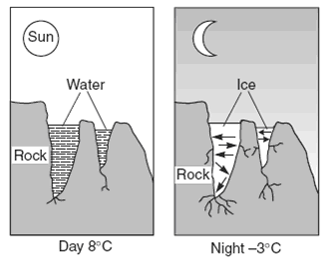
The diagrams  shows a natural process that weathers rock.
 Which statement best explains why this process results in weathering?
a)
frozen water acts as a solute
b)
water expands when it freezes
c)
the mass of water increases when it freezes
d)
frozen water dissolves most types of rock
14.

The process where materials being carried by waves that are bumping into eachother and are smoothed and broken down into smaller pieces is referred to as

a)

Abrasion

b)

Attrition

c)

Hydraulic Action

d)

Weathering

15.

The chemical action of seawater weathering away the coast is referred to as:

a)

Corrosion

b)

Chemical Engineering

c)

Compression

d)

Hydraulic acid action

16.
This is a
a)
Barrier
b)
Bayside beach
c)
Spit
d)
Tombolo
17.
This is a
a)
Bayhead beach
b)
Bayside beach
c)
Spit
d)
Tombolo
18.

Wha type of tide would this arrangement of earth-moon-sun create?

a)

full moon tide

b)

new moon tide

c)

neap tide

d)

spring tide

19.

What type of tides would this arrangement of earth-moon-sun create?

a)

neap tide

b)

spring tide

c)

new moon tide

d)

full moon tide

20.
What is the erosional process in which rocks are pushed by waves up against the headland, eroding the cliff face further?
a)
Hydraulic action.
b)
Abrasion.
c)
Attrition.
d)
Solution.
21.
What is this landform?
a)
mountain
b)
glacier
c)
bay
d)
canyon
22.

What erosion process am I explaining? When waves force air and water into cracks in the rock widening and weakening them breaking parts off over time.

a)

Abrasion

b)

Attrition

c)

Hydraulic Action

d)

Solution

23.

What erosion process is referred to as the 'sandpaper effect'

a)

Attrition

b)

Abrasion

c)

Hydraulic Action

d)

Solution

24.

What feature can you identify in the image?

a)

Bay

b)

Headland

c)

Wavecut platform

d)

Stack

25.

Select the correct sequence for explaining the formation of a stack

a)

Weakness, cave, arch, stump

b)

Weakness, cave, arch, stack

c)

arches, stacks, cave

d)

caves, arches, stacks

26.

Which erodes quicker?

a)

Hard rock (clay)

b)

Soft rock (sandstone)

c)

Hard Rock (Sandstone)

d)

Soft Rock (Clay)

27.
What is this landform?
a)
Arch
b)
Cave
c)
Headland
d)
Wave-cut Platform
28.
I transport material along a beach. What am I.
a)
Longshore Drift
b)
Longshape Drift
c)
Longnose Drift
d)
Longway drift
29.

Which of the following is NOT a process of erosion?

a)

Deposition

b)

Hydraulic Action

c)

Attrition

d)

Abrasion

30.
Constructive waves...
a)
Are tall in relation to width
b)
have a stronger swash than backwash
c)
have a stronger backwash than swash
d)
occur most often in winter
31.
How to headlands form? 
a)
Headlands form when there are alternating bands of rock (hard and soft). The soft rock is eroded more quickly leaving the hard rock sticking out.
b)
Headlands form when there are alternating bands of rock (hard and soft). The hard rock is eroded more quickly leaving the soft rock sticking out.
32.
What are the 2 main erosional processes that act on headlands ?
a)
Abrasion and hydraulic action
b)
Action and knocking
c)
Deposition and transportation 
33.
What forms when soft rock is eroded? 
a)
Bay 
b)
Beach 
c)
Stack 
d)
Stump 
34.
How is a wave-cut platform formed?
a)
Wavs cut at the rock 
b)
Waves cause most erosion at the foot of the cliff. This forms a wave-cut notch. The rock above the notch becomes unstable and collapses
c)
Waves cause most deposition at the foot of the cliff. This forms a wave-cut notch. The rock above the notch becomes unstable and collapses
35.
What is swash?
a)
Movement of water down a beach
b)
Movement of water up a beach
c)
Movement of water across a beach
d)
Movement of water in general
36.
What is the prevailing wind?
a)
The dominant wind direction
b)
The subservient wind direction
c)
Wind from the West
d)
Wind from the East
37.
Which is a landform of coastal erosion?
a)
Stack
b)
Spit
c)
Sand Dune
d)
Bar
38.
What is the name for the coastline which has alternating bands of hard and soft rock in the same direction as the coastline?
a)
Discordant
b)
Concordant
39.
When waves cause rocks and pebbles to smash into each other, which breaks them down into smaller and smaller pieces it is called
a)
Attrition
b)
Corrasion
c)
Corrosion
d)
Hydraulic Action
40.

Identify this landform

a)

Ria

b)

Fjord

c)

Rio

d)

Fiord

41.

Identify this landform

a)

Ria

b)

Fjord

c)

Rio

d)

Fiyord

42.

Identify this landform

a)

Raised beach

b)

Tombolo

c)

Ria

d)

Barrier beach

43.
The maximum distance a wave can have travelled from is called the….
a)
Fetch
b)
Drift
c)
Draft
d)
Swell
44.

Identify this type of sea defence

a)

Gabion

b)

Revetment

c)

Groyne

d)

Seawall

45.

Identify this type of sea defence

a)

Gabion

b)

Revetment

c)

Groyne

d)

Seawall

46.

Identify this type of sea defence

a)

Gabion

b)

Revetment

c)

Groyne

d)

Seawall

47.

Identify this type of sea defence

a)

Gabion

b)

Revetment

c)

Groyne

d)

Seawall

48.
When sea-level ACTUALLY changes, say by glaciers melting, this is called….
a)
Eustatic sea-level change
b)
Isostatic sea-level change
c)
Isotonic sea-level change
d)
Eugenic sea-level change
49.
When sea-level changes because the land moves up or down, this is called….
a)
Eustatic sea-level change
b)
Isostatic sea-level change
c)
Isotonic sea-level change
d)
Eugenic sea-level change
50.

Name the largest source of sediment to sediment cells

a)

Rivers

b)

Cliffs

c)

Offshore

d)

Aeolian sources

51.

Name the second largest source of sediment to sediment cells

a)

Rivers

b)

Cliffs

c)

Offshore

d)

Aeolian sources

52.

Which human feature/activity will reduce the amount of sediment entering the cell?

a)

The Groyne

b)

The Spit

c)

The Dam

d)

Dredging

53.

What process is causing the formation of the spit

a)

Erosion

b)

Transportation

c)

Deposition

d)

Dredging

54.

Which human feature/activity will increase the amount sediment in the cell

a)

The Groyne

b)

The Spit

c)

The marina

d)

Dredging

55.

What is the name of the area between England and the Netherlands that was colonized but has sunk below the waves.

a)

Atlantis

b)

Pompeii

c)

Maui Nui

d)

Doggerland

e)

Sodom and Gomorrah

56.

What emergent feature can be seen in the beach

a)

Ria

b)

Fjord

c)

Raised Beach

d)

Relic Cliffs

57.

Is this feature a result of

a)

Sea level rise

b)

Sea level fall

58.

Is this a feature of:

a)

Sea level rise

b)

Sea level fall

59.

What is the name of this feature

a)

Old Cliffs

b)

Ancient Cliffs

c)

Cliffs of Moher

d)

Relic Cliffs

60.

Coral polyps secrete _____________ that creates the structure of the coral reef.

a)

sediments

b)

staghorn

c)

calcium carbonate

d)

camouflage

61.

A _______ reef forms offshore and has a lagoon between it and the main coast.

a)

fringing

b)

barrier

c)

atoll

d)

sinking

62.

Clear, well-lit water is needed

a)

to prevent sediments from accumulating

b)

to keep parrotfish away

c)

for photosynthesis to occur

d)

for coral bleaching

63.

Which is the correct number order for the steps to atoll formation?


(2)VOLCANO BECOMES EXTINCT AND SINKS

(3)REEF GROWS AS LAND SLIPS BENEATH SURFACE

(1)CORALS KEEP BUILDING; LAGOON FORMS WHERE ISLAND ONCE WAS

a)

1, 2, 3

b)

2, 3, 1

c)

3, 1, 2

d)

3, 2, 1

64.

The type of reef shown here is

a)

a fringing reef

b)

a barrier reef

c)

an atoll

d)

a bleached reef

65.

The body form of corals is

a)

medusa

b)

polyp

c)

staghorn

d)

both polyp & medusa

66.

A medical use of coral

a)

toothpaste

b)

bone grafts

c)

pain relief

d)

sedative

67.

How is a barrier reef different from a fringe reef?

a)

A barrier reef is home to many different types of sea life.

b)

A barrier reef is shaped like a circle and forms outside of a sinking island.

c)

A barrier reef follows the natural shoreline of the land.

d)

A barrier reef has a large, deep area of water between it and the shore.

68.
What is the hard structure that provides the foundation for the reef?
a)
limestone
b)
sandstone
c)
concrete
d)
granite
69.
A ringed shaped reef
a)
fringing reef
b)
barrier reef
c)
atoll
d)
archipelago 
70.
What is the largest reef in the world?
a)
Belize Barrier Reef
b)
Great Barrier Reef
c)
Aldabra Atoll
d)
The Palancar Reef
71.

What percentage of the ocean's sea life lives in coral reefs?

a)

10 -15%

b)

20%

c)

45%

d)

25%

72.

What are coral reefs often compared to?

a)

forests

b)

gardens

c)

rainforests

d)

deserts

73.

What is the algae called that live in the polyps?

a)

Zooxanthellae

b)

Zoozanthelay

c)

Zooxantheylae

d)

Zooxanthellea

74.

What is the optimum temperature for coral growth?

a)

23-25 oC

b)

20-23 oC

c)

25-27 oC

d)

27-29 oC

75.

True or False? There is coral in the water around Bahrain.

a)

True

b)

False