wayground logo

Free Printable Worksheets

NEW

Font size

S
M
L
XL
Worksheets

Earth Science Camp

Total questions: 46

Worksheet time: 40mins

Name
Class
Date
1.
The rock at the Grand Canyon National Park is made from layers of minerals, sand and shells.  What type of rock is this?
a)
Igneous
b)
Sedimentary
c)
Metamorphic
d)
Magma
2.
Comparing the fossil layers, you find -
a)
Fossils in layer A are younger than layer D
b)
Fossils in layer A and C are the same age
c)
Fossils in layer A are older than layer C
d)
Fossils in layer A and C are younger than layer B
3.
Which of the following is an example of renewable energy?
a)
Coal
b)
Petroleum
c)
Biomass
d)
Natural gas
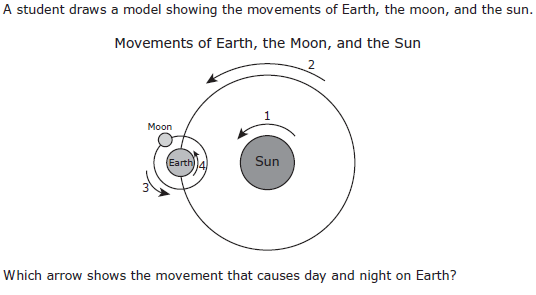
4.
a)
Arrow 1, because it shows the rotation of the sun
b)
Arrow 2, because it shows the orbit of Earth around the sun
c)
Arrow 3, because it shows the orbit of the moon around Earth
d)
Arrow 4, because it shows the rotation of Earth
5.
A student is looking for evidence that Earth is always rotating on its axis. Which of the following would provide the best evidence?
a)
The different amounts of rain that falls each day
b)
The appearance of shadows changing throughout the day
c)
The presence of other planets in the night sky
d)
The different phases of the moon in a month
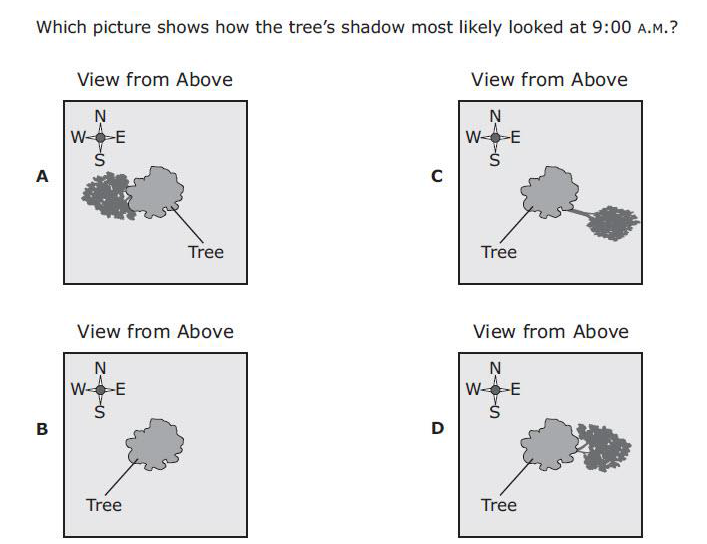
6.
a)
A
b)
B
c)
C
d)
D
7.
On which side of a house in Texas should a window be placed so that the people inside the house can see the sunrise each day through the window?
a)
North
b)
South
c)
East
d)
West
8.
a)
Day and Night
b)
Moon Phases
c)
Rainfall and evaporation
d)
Seasons
9.
Erosion is one of the processes involved in the formation of sedimentary rock. Which of these best describes the process of erosion?
a)
Rocks are broken into smaller pieces that remain in the same location.
b)
Pressure compacts layers of sediment and turns them into rock.
c)
Pieces of rock or soil are carried from one place to another.
d)
Sediment grains fall to the bottom of a lake to form sedimentary layers.
10.

Non-renewable flammable material (coal, oil, natural gas) made from the remains of plants and animals buried in Earth's crust that is burned to produce heat and power

a)

Sedimentary Rock

b)

Fossil Fuels

c)

Igneous Rock

d)

Metamorphic Rock

11.

A solid fossil fuel that is formed from the concentrated remains of mostly swamp plants over a very long period of time.

a)

Oil

b)

Coal

c)

Natural Gas

12.

Fossil fuels formed from the remains of tiny, ancient marine organisms.

a)

Oil

b)

Coal

c)

Natural Gas

d)

Both Oil and Natural Gas

13.
All of these are related to the formation of oil or natural gas EXCEPT
a)
Decomposed Animals
b)
Decayed Plants
c)
Sedimentary Rocks
d)
Active Volcanoes
14.
Coal often forms where once there was swamps.  What characteristic of swamps is important to the formation of coal?
a)
High Temperature
b)
Abundant Plant Life
c)
Frequent Rains
d)
Reptile Predators
15.
Which of these is an example of erosion
a)

Light Shining onto a mountain

b)
Rain breaking down rock 
c)
Wind blowing away sediment
d)
All of the above
16.
The process that breaks down rocks and other materials on Earth's surface is called
a)
Weathering
b)
Erosion
c)
Deposition
d)
Decomposition
17.
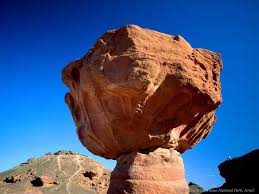
What is this landform?
a)
mountain
b)
canyon
c)
coast
d)
cliff
18.
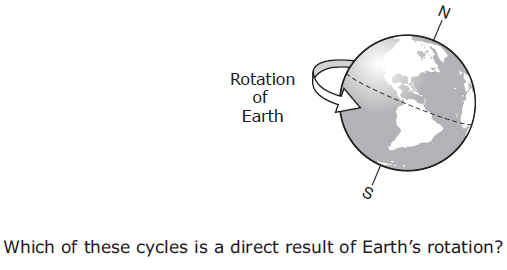
Which of these cycles is a direct result of Earth's rotation?
a)
Day and Night
b)
Moon phases
c)
Rainfall and evaporation
d)
Seasons
19.
Which of the following events in the water cycle is an example of solar energy being absorbed?
a)
Water vapor condensing into clouds
b)
Water evaporating from ocean surface
c)
Rain freezing as it falls toward the ground
d)
Clouds releasing precipitation 
20.
Which of these best describes climate rather than weather?
a)
Wind speed is changing as a storm moves through
b)
The temperature is decreasing due to a cold front
c)

Annual high temperatures in the summer have increased over many decades

d)
It is a cold cloudy day outside
21.
Look at the diagram of our solar system.  What is Earth's position from the sun?
a)
first
b)
third
c)
fifth
d)
seventh
22.

Which type of rough, gritty soil is made up of very, very tiny grains of rock?

a)

humus

b)

sandy soil

c)

loam

d)

clay

23.
Weathering occurs when rock
a)
get wet in the rain or snow
b)
is worn away or broken down into smaller and smaller pieces.
c)
melts
24.
Renewable resources are
a)
resources that cannot be reused or replaced
b)
resources that will never run out
c)
resources that can be replaced to be used over and over again
d)
resources such as fossil fuels
25.
What process changes liquid water into vapor?
a)
1 - sun's radiation
b)
2 - condensation
c)
3 - evaporation
d)
4 - precipitation
26.

Which process is most responsible for the formation of the Grand Canyon?

a)

scraping by glaciers

b)

erosion by the Colorado river

c)

explosive volcanic eruptions

d)

cracking of Earth's crust by earthquakes

27.
This landform is a sea arch. What is responsible for shaping this arch?
a)
plate tectonics
b)
earthquakes
c)
deposition
d)

wave erosion

28.
This rock formed when bits of other rocks became pressed into a solid. What type of rock is it?
a)
Sedimentary Rock
b)
Metamorphic Rock
c)
Igneous Rock
29.

What forms a delta?

a)

sediments deposited in the ocean

b)

sediments deposited in a lake

c)

sediments deposited at the mouth of a river

d)

sediments deposited at the base of a hill

30.

Looking at this picture, we can see wind, water, and ice. These elements can move sediment during what process?

a)

weathering

b)

erosion

c)

deposition

d)

hurricane

31.
Which of the following best identifies Non-Renewable Energy?
a)
Resources found above ground and underground
b)
Resources that produce clean energy (less pollution)
c)
Resources that can be made again
d)

Resources that cannot be replaced in your life time.

32.
Choose the Non-Renewable energy source below:
a)
HydroPower
b)
Wind
c)
Solar
d)
Oil
33.

Which process would probably create the most rapid change in Earth's surface?

a)

Erosion

b)

Heating

c)

Volcanic eruption

d)

Weathering

34.

Which of the following is NOT a characteristic of sedimentary rocks?

a)

Sedimentary rocks often contain fossils.

b)

Layers or bands are often visible in sedimentary rocks.

c)

Sedimentary rocks formed as a result of volcanic eruptions.

d)

Sedimentary rocks usually scrape easily and often crumble.

35.

Large cities use hydroelectric power to produce electricity. Hydroelectric power is energy created from....

a)

the heat from the Sun

b)

the movement of wind

c)

moving or falling water

d)

materials that were once alive

36.

What is the source of all energy on Earth?

a)

Coal

b)

Wind

c)

Water

d)

Sun

37.

Which is NOT a fossil fuel

a)

solar energy

b)

Natural gas

c)

Petroleum

d)

Coal

38.

Which best describes fossil fuels?

a)

Organic matter trapped in the Earth's crust

b)

Organic matter trapped in igneous rock

c)

Organic matter buried under sediments

d)

Non-organic matter trapped in metamorphic rock

39.

Which of the following causes the greatest change in the Earth's surface over a long period of time?

a)

Heat from the Sun

b)

Hurricanes and tornadoes

c)

Volcanoes and earthquakes

d)

Erosion by wind and water

40.

Which causes the formation of sand dunes?

a)

erosion

b)

gravity

c)

water

d)

wind

41.

Picture a glacier moving down a mountain....Which statement about glaciers is correct?

a)

Glaciers are the main force in the creation of mountains

b)

Glaciers move too slowly to change Earth's landscape

c)

Glaciers create both U-shaped valleys and mountain lakes

d)

Glaciers carved all of the rivers that currently exist on Earth.

42.

Nathan checks the outside temperature every morning before he gets ready for school. Nathan is checking....

a)

climate

b)

weather

c)

forecast

d)

pattern

43.

What is the source of energy that begins the water cycle?

a)

electricity

b)

gravity

c)

moon

d)

sun

44.

Which of the following correctly describes the Sun

a)

A gaseous satellite Earth

b)

The largest star in the universe

c)

A star at the center of the solar system

d)

A gaseous planet at the center of the solar system

45.

The Sun appears to move across the sky from morning until nightfall because....

a)

Earth rotates on its axis

b)

the Sun rotates on its axis

c)

Earth is tilted toward the Sun

d)

Earth revolves around the Sun

46.

How many times does Earth revolve around the Sun in one year?

a)

1

b)

7

c)

24

d)

365