
 Worksheets
5. Great Depression mhs
Total questions: 70
Worksheet time: 2hrs 4mins

Which of the following best completes this graphic organizer?
Increase in consumer spending
Overspeculation in the stock market
Decrease in military spending
Government subsidization of agriculture
The Federal Housing Administration is a New Deal agency that continues to assist many Americans primarily by —
providing them with money to pay for moving expenses
helping them obtain mortgage loans from banks
helping them choose a reputable home builder
offering incentives for them to invest in rental properties

How did the legislation excerpted above affect the relationship between the U.S. government and its citizens?
It allowed the government to tax investment income.
It allowed people to have more direct input in government decisions.
It made most people distrust the power of the government.
It made the government more responsible for the people’s economic welfare.

Many members of Congress disagreed with President Roosevelt’s proposed solution to the problem described above because —
the Constitution required hearings to confirm judicial appointments
Supreme Court justices were subject to term limits
the power of the executive branch would increase
the time required for judicial proceedings would increase

This satirical cartoon expresses a sentiment that eventually contributed to —
the passage of a federal statute prohibiting foreign companies from contributing to presidential campaigns
the issuance of a Supreme Court ruling declaring it unconstitutional for members of the same political party to serve consecutive terms as president
the establishment of a congressional committee to investigate private presidential conduct
the ratification of a constitutional amendment establishing term limits for presidents
President Franklin D. Roosevelt sought to reassure the American public during uncertain economic times by —
publishing a weekly news editorial titled “The Road to Prosperity and Peace”
holding weekly town-hall meetings with average citizens
making short appearances in a variety of Hollywood films
delivering a series of evening radio speeches known as fireside chats
Which of the following was a defining characteristic of the United States during the 1930s?
A sharp increase in the power given to state governments
An extended period of economic depression
The adoption of an interventionist foreign policy
The formation of a national Civil Rights movement

Which of the following best completes this diagram?
Led to a decrease in U.S. international trade
Helped stabilize the U.S. economy
Strengthened U.S. relationships overseas
Led to a decline in U.S. unemployment

The creator of this political cartoon was expressing his concerns about —
the Senate confirmation hearings of Supreme Court nominee Clarence Thomas
the U.S. declaration of war on Japan after the bombing of Pearl Harbor
the expansion of executive power during the Great Depression
the involvement of U.S. government officials in the Iran-Contra scandal

The Reconstruction Finance Corporation is similar to later New Deal legislation in that both —
protected the economy through government intervention in private business
gave direct relief payments to unemployed citizens
provided more efficient services through public utility regulation
borrowed money from foreign banks to reduce the national debt

What does the sticker in this illustration represent to patrons of this bank?
Restrictions on the federal government’s ability to set prime interest rates
The power of the federal government to privatize the bank in order to stimulate economic growth
Limitations on the role of the federal government in providing home loans
The federal government’s assurance of protection on individual bank deposits
What is one ongoing result of the New Deal?
The federal government funds a space-exploration program.
State governments deny residency to persons working in other states.
State governments use property taxes to fund social security programs.
People can rely more on the federal government during times of economic distress.

Which constitutional amendment did the Supreme Court use as a basis of this ruling?
First
Tenth
Fourteenth
Twenty-sixth
Which of these factors contributed most to the Dust Bowl?
Flash flooding and intense deforestation
Prolonged drought and poor farming practices
High winds and railroad construction
Severe heat and rapid suburban development

What was the main reason the federal government built this dam?
To provide resources for a growing population
To facilitate the transportation of goods in the region
To increase tourism in the region
To prevent the Colorado River from drying up

Lines like the one shown above were partially the result of —
growing demand for payment of military pensions
a sudden increase in agricultural exports
the passage of the Selective Service Act
widespread business failures


The farmer’s criticisms are similar to those found in —
Warren Harding’s advocacy of a “return to normalcy”
Huey Long’s proposal to “share our wealth”
Charles Coughlin’s rhetoric of “Christianized democracy”
Herbert Hoover’s emphasis on “rugged individualism”
In response to the national crisis posed by the Great Depression, the U.S. government —
abandoned deficit spending as a remedy for economic downturns
dismantled financial regulatory agencies
assumed a principal role in protecting economic stability
decreased the number of federal entitlement programs

Which speaker expresses the main argument against President Franklin D. Roosevelt's plan to increase the number of justices on the Supreme Court?
Speaker 1
Speaker 2
Speaker 3
Speaker 4
Which of the following directly contributed to the economic instability of the United States in 1929?
The implementation of a personal income tax
Overspeculation in the stock market
New regulations on banking
The elimination of import tariffs
Which headline describes the primary issue faced by the federal government at the onset of the Great Depression?


What is the main function of the Federal Deposit Insurance Corporation?
Assisting banks in recovering unpaid loans
Providing monetary aid to struggling banks
Guaranteeing job security for bank employees
Protecting personal savings in the event of bank failure
The Social Security Act affected the role of the federal government by —
authorizing the government to impose a flat tax
creating a government-administered benefits program
implementing new regulations on interstate travel
establishing an agency to monitor immigration

The economic conditions described in this excerpt contributed to —
a global economic depression
an increase in foreign investments in the U.S. market
the adoption of the gold standard
an increase in free market activity

Which of the following contributed most to the situation described in this excerpt?
The rise of corporate monopolies
Strict banking regulations and high income tax rates
The influx of immigrants into urban areas
High unemployment and widespread home foreclosures
How did the creation of the Federal Deposit Insurance Corporation change the nature of banking in the United States?
The government began to guarantee bank deposits.
Depositors could transfer investments without penalties.
Depositors were guaranteed minimum interest rates on savings accounts.
The government required taxpayers to open savings accounts.

The goals of these New Deal agencies support the conclusion that the New Deal —
gave the federal government a larger role in the day-to-day welfare of its citizens
forced citizens to participate in federal programs
gave preference to state-run agencies over federally run agencies
forced the federal government to adopt isolationist foreign policies
Some of President Franklin D. Roosevelt’s New Deal programs were declared unconstitutional when the Supreme Court held that they —
required U.S. cooperation with foreign nations
prevented equal access to the judicial system
granted privileges to religious organizations
infringed on powers reserved to the states

Who is described in the obituary above?
Jacqueline Kennedy
Mamie Eisenhower
Eleanor Roosevelt
Claudia “Lady Bird” Johnson
What was one factor that helped turn the Great Plains into the Dust Bowl in the 1930s?
Paying farmers to plant native grasses
Increased demand for tobacco after World War I
Numerous tornadoes occurring in the region
Intense drought in the region

What was the goal of the actions on this time line?
To ensure deposits into customer savings accounts
To increase government regulation of business
To end speculation in the stock market
To stabilize the national economy
Which statement best explains how bank failures contributed to the Great Depression?
People lost their savings because the government did not insure bank deposits
Business could not be done when President Franklin Roosevelt declared a bank holiday.
The interest rates on bank loans were too high.
Foreign investors did not invest enough in U.S. banks.
Which of the following was a significant effect of New Deal legislation?
Income tax rates fell to historic lows.
The federal government took on new roles.
The regulation of intrastate trade was transferred to the states.
States became the sole enforcers of immigration law.

Which action completes this cause-and-effect diagram?
Banks lower interest rates
Elected leaders lower tariff rates
Companies lay off employees
Labor unions demand higher wages

Which New Deal agency was created to specifically serve this population?
Federal Housing Administration
Securities and Exchange Commission
Federal Deposit Insurance Corporation
Social Security Administration

Why were country-and-western performers such as Gene Autry popular with U.S. radio audiences during the 1930s?
Their art related to the struggles of the period.
They shared stories of individuals who became wealthy.
They promoted work programs for rural communities.
Their art brought attention to global human rights issues.
Which statement best describes how investment in the stock market during the mid-to-late 1920s contributed to the Great Depression?
People were unable to repay the loans used to purchase stocks.
Government taxes on stock transactions made it difficult to repay investors.
Financial institutions were not required to report earnings to stock investors.
Foreign countries were not required to immediately pay stockholder earnings.
Which New Deal program still in existence today provides an income for retired people?
Social Security Administration
Securities and Exchange Commission
Federal Deposit Insurance Corporation
Farm Credit Administration
President Franklin D. Roosevelt proposed an increase in the number of Supreme Court justices because the Court ruled against —
the gold standard
some New Deal programs
internment camps
some rationing programs
Which statement best explains one effect of the New Deal?
The federal government took control of public education and universities.
Corporations had to obtain permission from state governments before hiring workers.
Labor unions had to provide justification to state governments before conducting strikes.
People relied more on the federal government for assistance.
Great Depression-Demand for goods declined -> businesses failed -> Unemployment grew -> economic Depression -> homeless


Over speculation-In stock market lead to Great Depression
True
False

Dust Bowl
played every New Years in college football
caused the Southwest to become mostly desert
caused by drought and poor farming practices.
caused by the stock market crash of 1929

Federal Government would take on a new role by playing a larger role in helping the welfare of Americans, protecting economy, and helping provide jobs and mortgage loans. Relief, Recover, Reform
Return to Normalcy
New Deal
Square Deal
Roosevelt Corollary

Government guaranteed bank deposits, protects people’s savings. Created by the Banking Act of 1933.
Federal Deposit Insurance Corporations
Social Security Act
22nd Amendment
Agriculture Adjustment Act

created a government benefits program to help elderly/disabled/retired; increased government’s responsibility.
Federal Deposit Insurance Corporations
Social Security Act
22nd Amendment
Agriculture Adjustment Act

Unconstitutional Programs-Supreme Court used 10th Amendment to approve some New Deal programs.
True
False

response to rejection of some New Deal programs, many disliked because it increased power of president.
22nd Amendment
over speculation
Roosevelt's Court Packing Plan
Unconstitutional Programs

Limited president to serve only two terms, passed in response to FDR serving four terms.
22nd Amendment
over speculation
Roosevelt's Court Packing Plan
Unconstitutional Programs

Why did the federal government create this program in 1933?
To establish industrial centers in the region
To promote organic farming practices
To offset the effects of urbanization and rapid population growth
To provide jobs and improve the regional standard of living

Which reason correctly replaces the question mark on this list?
Decrease in interest rates
Failure of banks
Outsourcing of manufacturing jobs
Outbreak of a global war

Which phrase correctly replaces the question mark in this diagram?
Increase in minimum wage
Growth of immigration
Increase in unemployment
Growth in consumer spending
How does the Federal Deposit Insurance Corporation (FDIC) continue to affect U.S. citizens?
By regulating loans made to investors who buy stocks on margin
By changing interest rates to prevent people from playing higher prices of goods
By providing financial assistance to elderly people who are retired
By protecting the savings of bank customers during an economic crisis
What was one result of the creation of the Civilian Conservation Corps (CCC) during the 1930s?
State governments took over the responsibility of protecting minority rights.
The federal government was no longer responsible for protecting natural resources.
State governments could no longer control their budgets.
The federal government provided suffering from unemployment.

Why was the bill in this cartoon important to President Franklin D. Roosevelt?
He wanted to strengthen the congressional power of impeachment.
He wanted to strengthen federal judicial authority over state governments.
He wanted to remove congressional leaders from office.
He wanted to weaken the power of the judicial branch over the executive.
The Twenty-second Amendment was passed in response to which event?
The election of Franklin D. Roosevelt to a fourth presidential term
Herbert Hoover's reelection defeat
Bill Clinton's impeachment trail
The resignation of Richard Nixon after Watergate
Which action by the federal government was one cause of the Great Depression?
Failing to decrease the reserve requirement
Refusing to regulate the stock market
Abolishing the use of the gold standard
Eliminating tariffs on foreign trade
How did the Great Depression affect American society?
The price of agricultural goods decreased, causing an increase in demand for farm labor.
Manufacturing wages increased, causing businesses to concede to labor union demands.
Demand for luxury goods increased, causing overproduction in manufacturing.
Businesses were forced to close, causing widespread unemployment.

How did this response to the Great Depression differ from the ideas of Franklin D. Roosevelt?
Hoover wanted to implement social welfare programs to provide for the poor.
Roosevelt wanted private charities to take responsibility for relief efforts.
Hoover wanted to limit the role of the federal government in managing the crisis.
Roosevelt wanted state governments to regulate private business activity.
What is the purpose of the Securities and Exchange Commission?
To encourage business practices that promote minority employment
To maintain fair markets and increase investor confidence in financial institutions
To encourage business policies that protect the environment
To ensure worker safety and protect the public from hazardous products.

How did the new program described in the poster affect the role of the federal government?
It provided the federal government with a role in administering a retirement fund for workers.
It limited the federal government's power to enforce minimum wage requirements.
It provided the federal government with a role in managing workers' bank accounts.
It limited the federal governments' power to assist workers in manufacturing plants.

What is the MOST LIKELY reason the Public Works of Art Project commissioned this painting?
To promote optimism for U.S. economic progress during the Great Depression
To demand federal worker safety laws during the Great Depression
To encourage competition for U.S. technological superiority during the Great Depression
To question the success of nationalizing industries during the Great Depression

What was one effect of this new style of "musical Western" on the United States in the 1930s?
Country music became more popular than rock and roll music.
Country music prompted people to move to farms on the Great Plains.
Country music transitioned from a regional genre to a national sensation.
Country music encouraged Exodusters to migrate from southern states
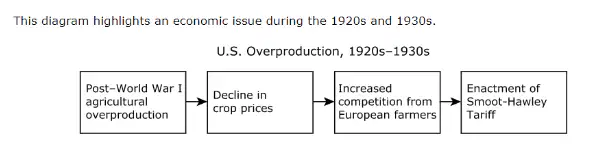
How did this trend contribute to the Great Depression?
By leading to a rise in consumer demand
By discouraging stock market speculation
By stabilizing unemployment and inflation rates
By causing drops in profits and employment
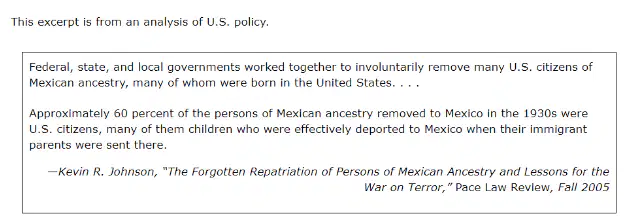
Why did the U.S. government take this action during the Great Depression?
Some thought people of Mexican ancestry were buying too much property.
Some thought people of Mexican ancestry were taking jobs from U.S. workers.
Some feared that people of Mexican ancestry would force U.S. schools to teach foreign languages.
Some feared that people of Mexican ancestry would force their religious beliefs to become the law of the land.

How did the American Liberty League's mission differ from New Deal policies?
The League focused more on personal responsibility than government responsibility.
The League placed greater importance on the needs of the lower classes than the needs of the upper classes.
The league focused more on government intervention than free enterprise.
The League placed greater importance on the needs of rural farm workers than the needs of urban factory workers.

How did the states work to lessen the effects of the Great Depression shown in this diagram?
By refusing to accept federal money for relief programs and demanding more laissez-faire policies
By agreeing to let the federal government nationalize industries to bring stability to the national economy
By stopping the federal government from collecting federal income taxes to give people more money to spend in the states
By accepting federal money for relief programs but maintaining control over the administration of the programs

Based on the excerpt and your knowledge of U.S. history, what did President Roosevelt want Congress to do?
He wanted Congress to replace progressive Supreme Court justices with conservative ones.
He wanted Congress to rewrite legislation to make it agreeable to the Supreme Court justices.
He wanted Congress to increase the number of Supreme Court justices from nine to fifteen.
He wanted Congress to increase the number of clerks assigned to the Supreme Court justices.
Which situation motivated the repeal of the Eighteenth Amendment prohibiting the manufacture and sale of alcohol?
The need to generate revenue after removing protective tariffs in the 1920s
The need to ration the consumption of agricultural goods in the 1940s
The need to reduce the federal deficit after the Cold War
Thee need to promote economic recovery during the Great Depression

