Wayground logo

Free Printable Worksheets

Font size

S
M
L
XL
Worksheets

DNA, Protein Synthesis and Mutations

Total questions: 58

Worksheet time: 2hrs 39mins

Name
Class
Date
1.
Which sequence of DNA bases would pair with this partial strand
ATG TGA CAG
a)
ATG TGA CAG
b)
TAC ACT GTC
c)
GTA AGT GAC
d)
CAT TCA CTG
2.
Which of the following best describes a DNA molecule?
a)
double helix
b)
contains ribose
c)
made of amino acids
d)
contains Uracil
3.
Which of the following units are repeatedly joined together to form a strand of DNA?
a)
amino acids
b)
nucleotides
c)
fatty acids
d)
polysaccharides
4.
In a molecule of double-stranded DNA, the amount of Adenine present is always equal to the amount of
a)
cytosine
b)
guanine
c)
thymine
d)
uracil
5.
Which 2 molecules form the sides (backbone) of the DNA ladder?
a)
deoxyribose sugar and adenine
b)
deoxyribose sugar and a hydrogen bond
c)
deoxyribose sugar and the nucleus
d)
deoxyribose sugar and phosphate
6.
What are the three components of a nucleotide?
a)
sugar, hydrogen, nitrogen base
b)
sugar, oxygen, nitrogen base
c)
sugar, phosphate, nitrogen base
d)
sugar, phosphate, protein
7.
What mutation has occurred here? 
T-G-A-C-C-A
T-G-A-G-C-A
a)
Substitution
b)
Deletion
c)
Insertion
d)
Frameshift 
8.
Are all mutations bad?
a)
Yes
b)
No
9.
ATTTGAGCC- Original
ATTGAGCC - Mutated
The example above is an example of a 
a)
Insertion- Frameshift
b)
Deletion- Substitution
c)
Deletion -Frameshift
d)
All of the above
10.
Would a mutation in the DNA of a skin cell be passed on to an organism's offspring?
a)
Yes, because any change to the DNA is passed on to the offspring
b)
Maybe. Sex cells only use half of the body's genetic code. It might get the copy of a gene that wasn't mutated.
c)
No. Only mutations that occur in the gametes (sex cells) are passed on to the offspring
d)
Without knowing the animal, it would be hard to tell whether or not the mutation would be passed on.
11.
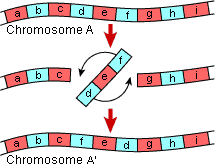
What type of chromosomal mutation is this?
a)
Translocation
b)
Inversion
c)
Deletion
d)
Duplication
12.
Transcription is a process that in eukaryotic cells takes place in the:
a)
Nucleus
b)
Cytoplasm
c)
Golgi Apparatus
d)
Rough E.R.
13.
Translation is a process in eurkaryotic cells takes place in the:
a)
Cytoplasm
b)
Nucleus
c)
Nucleolus
d)
Golgi Bodies
14.
The main function of tRNA is to...
a)
carry a message that, when translated, forms proteins
b)
form a portion of ribosomes
c)
string together complementary RNA and DNA strands
d)
bring amino acids from the cytoplasm to the ribosomes
15.
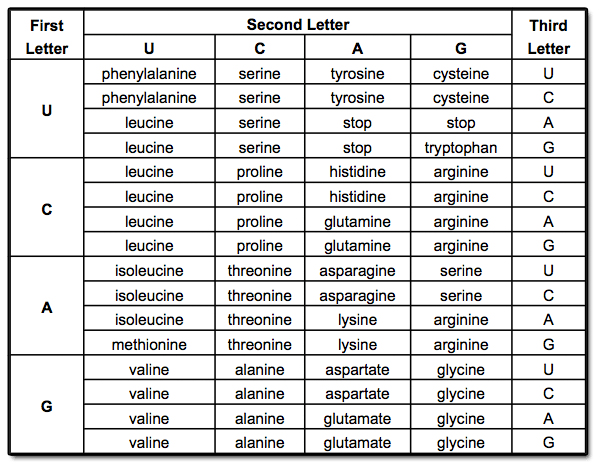
What amino acid is represented by the codon UUA?
a)
Phenylalanine
b)
Tyrosine
c)
Leucine
d)
Stop codon
16.
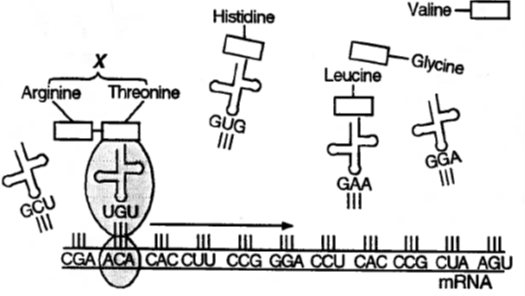
What process is going on in this photo? 
a)
Transcription 
b)
Translation 
c)
Replication 
d)
All the above 
17.

What term describes when mRNA is read 3 consecutive letters (bases) at a time and it codes for a single amino acid?

a)

Codon

b)

Anticodon

c)

Polypeptide

d)

Gene

18.

What is the mRNA sequence that complements the following DNA sequence: TATAAACGCTAGGCAG

a)

ATATTTGCGATCCGTC

b)

AUAUUUGCGAUCCGUC

c)

TATAAACGCTAGGCAG

d)

UTUTTTGCGUTCCGTC

19.

If mRNA reads UUU-AGC-UCG-CGC-GUG-CUC, the complimentary tRNA would read?

a)

AAA-TCG-AGC-GCG-CAC-GAG

b)

TTT-UCG-AGC-GCG-CAC-GTG

c)

UUU-AGC-UCG-CGC-GUG-CUC

d)

AAA-UCG-AGC-GCG-CAC-GAG

20.

If the mRNA codon reads UUU, it would translate into which amino acid?

a)

Phenylalanine

b)

Stop

c)

Leucine

d)

Lysine

21.

If the mRNA codons read ACA-GUA-GAA-UUG-AUC, what amino acids make up the protein sequence?

a)

Cys-Val-Gly-Ser-Stop

b)

Cys-His-Leu-Asn-Stop

c)

Thre-Val-Glu-Leu-Iso

d)

None of the above

22.

A sequence of DNA codes for part of a gene and is listed below. How many amino acids are coded for by this segment. 5' ATCAGCGCTGGC 3'

a)

4

b)

8

c)

12

d)

20

23.

What is a mutation?

a)

The specific sequence of bases in a molecule of DNA

b)

A change in the genetic material of a cell

c)

The process by which a molecule of DNA make a copy of itself

d)

The perfect replication of DNA molecule

24.

A mutation that occurs in the gametes of an organism will most likely be transferred to ?

a)

The siblings of the organism

b)

The organism itself

c)

The offspring of the organism

d)

The mating partner of the organism

25.

What codon is required for a protein to begin to be synthesized?

a)

UAG

b)

UGG

c)

AUG

d)

UAA

26.

Translation is the process of _____ ?

a)

Converting codons to anticodons

b)

Reading mRNA and finding the tRNA complement

c)

Reading mRNA and building a protein by attaching the coded amino acids

d)

Making the complementary strand of mRNA from the DNA sequence

27.

Which of the following bases replaces thymine in RNA?

a)

Uracil

b)

Adenine

c)

Cytosine

d)

Guanine

28.

Mutations result in which of the following?

a)

Changes in DNA sequence

b)

Genetic variation in a species

c)

Differing amino acid sequence

d)

All of the above

29.
Which of the following statements is true?
a)
DNA is single-stranded
b)
RNA is single-stranded
c)
DNA contains uracil
d)
RNA contains deoxyribose
30.
Why are insertion and deletion (frameshift) mutations so harmful?
a)
They change all of the codons from the mutation on down the line, which changes the amino acid sequence
b)
They insert things that an organism doesn't need.
c)
They often delete things that organisms need.
d)
Insertion and deletions are not any more harmful than substitution mutations.
31.

Why must transcription occur where DNA can be found?

a)

because DNA can't leave

b)

because ribosomes are in the nucleus

c)

because DNA polymerase is found there

d)

because helicase unzips the DNA

32.

The important enzyme related with transcription is;

a)

gyrase

b)

DNA polymerase

c)

RNA polymerase

d)

ligase

33.

Genetic info flows in one direction. Which best represents this flow according to the central dogma?

a)

DNA-protein-RNA

b)

Protein-RNA-DNA

c)

RNA-protein-DNA

d)

DNA-RNA-protein

34.

What is the location in the cell for translation?

a)

nucleus

b)

mitochondria in cytoplasm

c)

ribosome in cytoplasm

d)

chloroplast in cytoplasm

35.

What are the 3 kinds of RNA?

a)

mRNA, rRNA, tRNA

b)

messenger RNA, ribosomal RNA, transfer RNA

c)

metamorphosis RNA, rock star RNA, templated RNA

36.
a change in one DNA triplet that may result in a new triplet that codes for a stop codon instead of an amino acid is known as
a)
missense
b)
nonsense
c)
frameshift
d)
silent
37.
A type of substitution in which no  amino acids change is called 
a)
Missense
b)
Nonsense
c)
Silent
d)
Deletion
38.
An example of a mutation where a piece of chromosome breaks off and attaches to another chromosome is called ___.
a)
trisomy
b)
translocation
c)
inversion
d)
deletion
39.
What process occurs during meiosis that can result in chromosomal disorders?
a)
crossing over
b)
non-disjunction
c)
anaphase I
d)
prophase II
40.

The karyotype shows an individual with Edward's Syndrome. What is the name of the specific disorder?

a)

monomy 18

b)

trisomy 18

c)

deletion

d)

translocation

41.
Which enzyme has the job of unzipping the double helix?
a)
Helicase
b)
Polymerase
c)
Ligase
d)
Primerase
42.
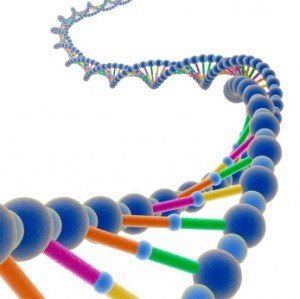
This picture is illustrating the ____ nature of DNA.
a)
anti-parallel
b)
deoxyribosic
c)
helical
d)
radioactive
43.
The enzyme that splits open the DNA creates what's called a fork - where the DNA separates into the lagging strand and the ______ strand.
a)
leading
b)
leveraging
c)
Okazaki
d)
ligase
44.
Polymerase is able to replicate the new DNA ______ along the leading strand.
a)
continuously
b)
only in short fragments
c)
very slowly
d)
prokaryotically
45.
In what phase of the cell cycle does DNA replication take place?
a)
G1
b)
S
c)
G2
d)
M
46.
The process of DNA replication is called semi conservative because it results in
a)
none of these
b)
Two DNA molecules.  One original molecule and one with two new strands
c)
two exact copies with new strands
d)
two identical molecules, each with 1 original strand and one new.
47.

The fragments on the lagging strand that are made up of repeating segments of DNA and RNA Primers

a)

okazaki fragments

b)

Primase

c)

Polymerase

d)

unused DNA

48.

DNA polymerase moves in the _________ to ____________ direction

a)

3' to 5'

b)

easiest

c)

5" to 3"

d)

9 to 5

49.

Proteins that DNA winds itself around to for Chromosomes

a)

Histone

b)

Double Helix

c)

Chromatin

d)

Chromatin

50.
During replication, what enzyme adds complimentary bases?
a)
helicase
b)
synthesase
c)
ligase
d)
polymerase
51.
Which of the following cells is a gamete?
a)
egg
b)
bone
c)
heart
d)
muscle
52.
In mitosis cells are genetically _______, but in meiosis cells are genetically ______.
a)
diverse, identical
b)
identical, diverse/different
53.

Is the following cell diploid or haploid?

a)

Diploid

b)

Haploid

54.

Is this karyotype for a male or female?

a)

MALE

b)

FEMALE

55.

Mitosis makes sure that all daughter cells are _____.

a)

genetically identical, diploid

b)

genetically identical, haploid

c)

genetically diverse, diploid

d)

genetically diverse, haploid

56.
If the Diploid number of Carrots is 18, the haploid number is
a)
18
b)
9
c)
27
d)
36
57.
Meiosis makes sperm and egg cells. In humans, sperm and egg cells each have _____ chromosomes. Therefore a fertilized human egg cell (sperm and egg cell combined) would create a cell with _____ chromosomes.
a)
23, 46
b)
46, 23
c)
2, 4
d)
50, 100
58.
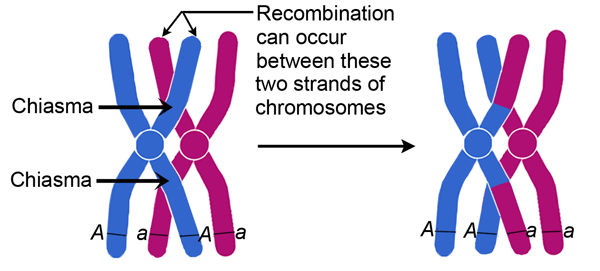
This image shows chromosomes during Prophase 1. Which of the following correctly describes the process shown?
a)
segregation of sister chromatids
b)
condensation and segregation of alleles
c)
mutationin which the DNA content of the gene is altered
d)
crossing - over in which alleles are exchanged