wayground logo

Free Printable Worksheets

Font size

S
M
L
XL
Worksheets

Ch. 14 Heredity and Ch. 15 DNA Technologies Review

Total questions: 40

Worksheet time: 47mins

Name
Class
Date
1.
What percentage of human sperm cells carry an X chromosome?
a)
0%
b)
25%
c)
50%
d)
100%
2.
A human female inherits
a)
twice as many sex chromosomes as a human male inherits
b)
one copy of every gene located on the Y chromosome
c)
two copies of every gene located on the X chromosome
d)
all of the same genes that a human male inherits
3.
Sex-linked genes are located
a)
the Y chromosome only
b)
the autosomal chromosomes
c)
the X chromosome only
d)
both the X chromosome and the Y chromosome
4.
The failure of chromosomes to separate during meiosis is called
a)
Down syndrome
b)
X-chromosome inactivation
c)
nondisjunction
d)
Turner's syndrome
5.
Colorblindness is more common in males than females because the allele for colorblindness is
a)
recessive and located on the Y chromosome
b)
recessive and located on the X chromosome
c)
dominant and located on the Y chromosome
d)
dominant and located on the X chromosome
6.
This is a picture of chromosomes arranged in homologous pairs---what is it called? 
a)
Genome
b)
Punnett Square 
c)
Karyotype
d)
Autosomal cells 
7.
Looking at the karyotype, is this person male or female?
a)
There is no way to tell from a karyotype.
b)
Male 
c)
Female 
d)
This person has a genetic disorder
8.
Looking at this karyotype, is this individual male or female?
a)
Male
b)
Female
c)
There is no way to tell from this picture
d)
This person has a genetic disorder 
9.
What is the genotype for a normal female? 
a)
XX
b)
XY
c)
XXY
d)
XXX
10.
What is the genotype of a normal male? 
a)
XX
b)
XXY
c)
XY
d)
X
11.
What is the % chance that a human offspring will be female or male?  
a)
20%
b)
80%
c)
50%
d)
30%
12.
This is a chart used to analyze and show the relationships within a family---what is it called? 
a)
Pedigree
b)
Punnett Square
c)
Genome
d)
Karyotype
13.
This is a full set of all the genetic information that an organism carries in its DNA.
a)
Genome
b)
Karyotype
c)
DNA
d)
Pedigree 
14.
On a pedigree, squares represent...
a)
Males
b)
Females
15.
If a circle or a square is shaded in on a pedigree, it means that family member is: 
a)
Affected
b)
Unaffected
16.
If a circle or square is half shaded in it means that family member is:
a)
A carrier or heterozygous
b)
Always affected 
c)
Never affected 
d)
No longer living 
17.
Which condition is caused by nondisjunction and results in an extra chromosome on pair 21? 
a)
Down Syndrome
b)
Kleinfelter's Syndrome
c)
Turner's Syndrome
d)
Colorblindness 
18.
These cut DNA into smaller pieces.
a)
Restriction enzymes
b)
Gel electrophoresis
c)
Ozaki fragments
d)
Scissors
19.
The technique used to separate DNA strands of different lengths is_______
a)
gel electrophoresis 
b)
restriction enzyme digestion
c)
shotgun sequencing
d)
bioinfomatics
20.
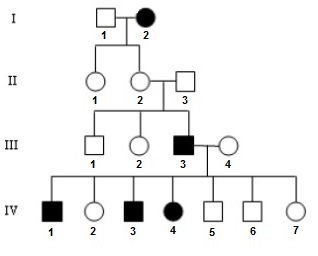
If this pedigree shows an autosomal recessive disorder, what MUST the genotype of individual II-3 be?
a)
HH
b)
Hh
c)
hh
d)
None of the above
21.
How are individuals III-2 and II-4 related?
a)
Cousins
b)
Dad and Daughter
c)
Uncle and Niece
d)
Grandpa and Granddaughter
22.
What type of heredity is shown in the pedigree?
(hint: check your notes - "modes of inheritance")
a)
Sex-Linked Dominant
b)
Sex-Linked Recessive
c)
Autosomal Dominant
d)
Autosomal Recessive 
23.

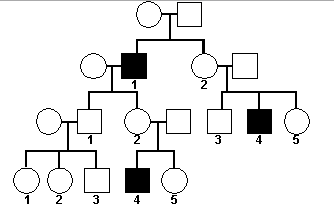
If this pedigree shows a recessive disorder, what MUST the genotype of individual 4 be?

a)

HH

b)

Hh

c)

hh

24.
How many generations are shown in this pedigree?
a)
1
b)
2
c)
3
d)
4
25.
How many kids did the mother and father from the first generation have?
a)
2
b)
4
c)
5
d)
6
26.
This pedigree represents the inheritance of hemophilia in this family. How many of the females have the hemophilia trait?
a)
8
b)
5
c)
2
d)
3
27.

Breeding desired traits of some plants and animals.

a)

Selective breeding

b)

Recombinant DNA

c)

Hybridization

d)

Gene therapy

28.

Involves inserting DNA of one organism into the DNA of another organism using gene splicing.

a)

Selective breeding

b)

Hybridization

c)

Recombinant DNA

d)

PCR

29.

Chemical scissors used to splice DNA into fragments for various DNA Technology procedures.

a)

restriction enzymes

b)

DNA fingerprint

c)

gel elecrophoresis

d)

transgene

30.

Organisms that have DNA from other organisms are called

a)

hybrids

b)

transgenic

c)

clones

d)

fingerprints

31.

Technique used for manipulating DNA that have potential medical uses due to the altering of a sick person's DNA.

a)

cloning

b)

gene therapy

c)

PCR

d)

genome projects

32.

Process of producing offspring from a single parent cell.

a)

cloning

b)

gene therapy

c)

PCR

d)

recombinant DNA

33.

Name of first cloned mammal.

a)

Dolly

b)

Gene

c)

Margie

d)

Daina

34.

Uses the process of gel electrophoresis to separate fragments of DNA to identify individuals.

a)

PCR

b)

Genome projects

c)

DNA fingerprinting

d)

Gene therapy

35.

Mapped the physical and genetic aspects of chromosomes.

a)

Human Genome Project

b)

Gene Therapy Endeavor

c)

Polymerase Chain Reaction

d)

Recombinant DNA

36.

Which fragments in a DNA Fingerprint are the biggest?

a)

The ones farthest from the well.

b)

The ones closest to the well.

c)

The ones in the middle.

d)

There is no way to know this by looking at a fingerprint.

37.

Which child(ren) are the child(ren) of BOTH Mom AND Dad?

a)

Child 1

b)

Child 2

c)

Child 3

d)

Child 4

38.

Which child(ren) are the child(ren) of Mom, but NOT Dad?

a)

Child 1

b)

Child 2

c)

Child 3

d)

Child 4

39.

Which child(ren) are the child(ren) of NEITHER Mom NOR Dad?

a)

Child 1

b)

Child 2

c)

Child 3

d)

Child 4

40.

Where did the blood come from?

a)

Satheesh

b)

Dheva

c)

John

d)

Ramalingam