
Font size
 Worksheets
Unit 3 Review (Gas Laws)
Total questions: 46
Worksheet time: 2hrs 15mins
The freezing point of water is
0 Kelvin
0 Celsius
212 Farenheit
-273 Kelvin
100 Celsius
How many moecules are in one mole of water, H2O?
22.4 molecules
6.02 x 10²³ molecules
273 molecules
1.00 molecule
If 6.00L of gas at 293K is compressed to 4.00L, what is the new temperature?
195K
439K
0.0820K
12.2K
The temperature at which all molecular motion stops is
-460 .C
-273 Kelvin
0 Kelvin
0.C
Which phase of matter is the MOST dense?
liquid
gas
solid
The kinetic molecular theory states that all of the particles that make up matter are constantly
growing
shrinking
crying
moving

According to the Kinetic Molecular Theory of gases at higher temperatures...
particles in an object have less energy
particles in an object move faster
a gas contracts
If you place a fully blown balloon into a freezer, what will happen to the overall size of the balloon?
Hint: balloon has been tied off, keeping volume constant.
Doubles
increases
decreases
stays still
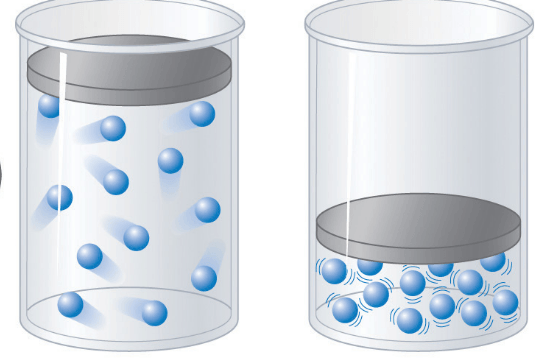
Which container will have a lower pressure? Why?
left; Increased volume, lower pressure
right; decreased volume, lower pressure
they both have the same pressure
left; decreased volume, lower pressure
right; Increased volume, lower pressure
If amount of gas and volume remain constant, how are pressure and temperature related?
Directly
Indirectly
They aren't related
A gas has a volume of 3.50L at 200K. If the volume changes to 7 Liters, what is the new temperature?
100K
300K
350K
400K
If I have 2.00 moles of a gas at a temperature of 250.0 K and a volume of 8.50 liters, what is the pressure?
0.673atm
1.41atm
2.91atm
4.83atm
Which of the following would increase the (gas) pressure in a container?
Decreasing the temperature
Increasing the Volume
Increasing the number of the particles
Removing gas particles
You collect 85.0mL of ice. When melted down, what volume of water would result?
78.2mL
92.4mL
85.0mL
170.mL
The number of eggs you have is proportional to the number of cartons of eggs you have. A carton of eggs holds a dozen eggs. How many cartons do you have if you have 36 eggs?
1 carton
3 cartons
6 cartons
2 cartons
How many atoms of iodine are in one mole of iodine?
22.4
63.55g
126.9
6.02 x 10²³
What is the Molar volume of any gas at STP?
22.4 L
2.24 L
6.02 x 10²³ L
224 L
Which gas variable is associated with the STP 22.4 Liters?
Pressure
Temperature
Amount of gas
Volume
Which are the correct units for the universal gas constant, R?
atm x L/mol x K
L x atm/Celsius x mols
mmHg x L/mol x K
mol x K/TORR x L
What pressure, in atm, is exerted by 2.50 L of gas containing 1.35 mol at 47.0 oC?
14.2 atm
16.5 atm
18.4 atm
22.5 atm
A gas is under 750 mm Hg of pressure. What is the pressure in Atmospheres?
1.013 atm
0.987 atm
760 atm
0.0013 atm
A sample of H2 (g) and a sample of N2 (g) at the same temperature and pressure contain the same number of molecules. Each sample must have
the same volume, but a different mass
the same mass, but a different volume
both the same volume and the same mass
neither the same volume nor the same mass
What formula would you use to solve the following: If a cylinder has a volume of 5.4 x 10⁶ L of air at a pressure of 840 Torr and it is determined that there are 3.0 x 10⁵ moles of CO2 present, calculate the temperature inside the cylinder.


A weather balloon has a volume of 105L at 0.97 atm when the temperature is 318K. What is the volume at 293K and 1.05 atm?
89.4 L
0.32 L
93.8 L
3.13 L
STP conditions for temperature, pressure and volume are:
1 atm, 0 K, 22.4 L
1 atm, 273 K, 22.4 L
0 atm, 273 K, 6.02 x 10²³ Liters
1 atm, 273 K, 6.02 x 10²³ Liters
You build a snowy snowman to a volume 323 mL of snow with a density of 0.670 g/mL. How much liquid water will result when the snowman melts down?
482 mL
0.00207 mL
216 mL
245 mL
Place equally massed samples of rain, ice, and snow (0.50 g/mL) in order of decreasing volume (separate each with a comma in your answer).
(a)
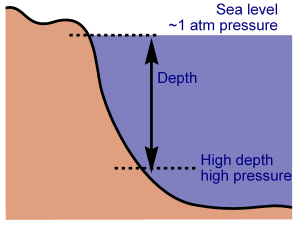
When you increase your depth under water, the water pressure on your body and the items around you
increases
decreases
stays the same
Given equal masses, which of these substances occupies the GREATEST volume?
Aluminum
(2.70 g/mL)
Cobalt (8.86 g/mL)
Plutonium
(19.7 g/mL)
Managanese
(7.33 g/mL)
If the volume of a gas is halved while the pressure remains constant, what change (if any) would be observed in the temperature?
Temperature would double
Temperature would be halved
Temperature would remain constant
Not enough information to determine
When sublimation occurs, what is the change in the state of matter?
Gas to liquid
Gas to solid
Solid to gas
Solid to liquid
You fill your 40.0 ounce Stanley with ice. If the ice in the Stanley completly melts down, how much liquid water would result?
1,740 ounces
40.0 ounces
43.5 ounces
36.8 ounces
Which has more particles, a balloon filled with 20 Liters of Hydrogen gas, H2, or balloon filled with 15 Liters of Nitrogen gas, N2
(assume STP)?
20 Liters if H2 has more particles.
15 Liters if H2 has more particles
They have an equal amount of particles
Not enough information to determine
If 33.00 moles of krypton gas occupies a volume of 288.0 Liters, what volume will 71.00 moles of krypton occupy at the same temperature and pressure?
133.8 Liters
619.6 Liters
8.135 Liters
314.5 Liters
One mole of an ideal gas is held at standard conditions. At what Kelvin temperature would the pressure be doubled?
6.02 x 10²³ Kelvin
22.4 Kelvin
546 Kelvin
273 Kelvin
According to Avogadros Law, 22.4 Liters of 02(g) and 22.4 Liters of F2(g) at the same temperature and pressure __________.
have unequal volumes
have the same density
contain 1 mol of gas each
have the same mass
Calculate the molar mass of Oxygen gas.
16.0 g/mol
32.0 g/mol
8.00 g/mol
64.0 g/mol
Of the 3 temperature scales used in class, which has the smallest degree change?
Celsius
Kelvin
Fahrenheit
Arsenic has a density of 5.7g/ml. The mass of Arsenic was 7.8g and it was found at the crime scene. Determine the volume of Arsenic.
1.4 mL
.73 mL
44 mL
2.1 mL
A 185 pound male must drink at least 2,809 mL of fluid per day. How many liters of fluid is this?
28.09 Liters
2.809 Liters
0.2809 Liters
280,900 Liters
You have a 1.00 mole sample of Fluorine gas at STP. Calculate the number density (n/V) of this gas sample.
0.0446 mol/L
6.02 x 10²³ mol/L
22.4 mol/L
0.992 mol/L

