wayground logo

Free Printable Worksheets

Font size

S
M
L
XL
Worksheets

Biology B Exam Review

Total questions: 69

Worksheet time: 5hrs 24mins
Name
Class
Date
1.

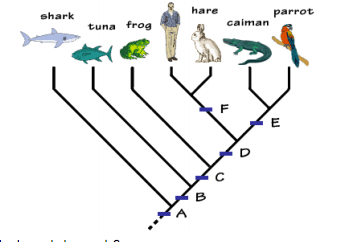
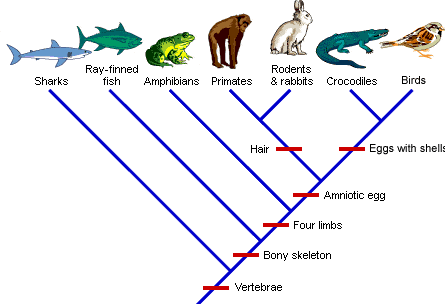
According to this cladogram, primates are most closely related to....

a)

Amphibians

b)

Rodents & rabbits

c)

Crocodiles

d)

Birds

2.

What number is the common ancestor of C and D

a)

1

b)

2

c)

3

d)

4

3.

What is the common ancestor of Letters A, B, C, D, E?

a)

1

b)

2

c)

3

d)

4

4.
On the cladogram, which organism is the closest relative of the human?
a)
Frog
b)
Hare
c)
Caiman
d)
Parrot
5.

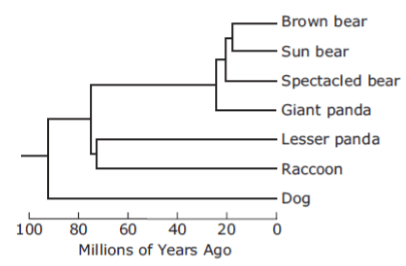
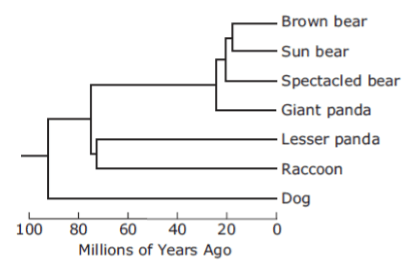
Based on this phylogenetic tree, which statement is true?

a)

Lesser pandas are more genetically similar to giant pandas than they are to raccoons

b)

Brown bears are more genetically similar to giant pandas than they are to sun bears

c)

Lesser pandas are more genetically similar to raccoons than they are to giant pandas

d)

The bear species are all more genetically similar to dogs than they are to giant pandas
6.

Who is the closest relative to the brown bear?

a)

Giant panda

b)

Dog

c)

Lesser panda

d)

Sun bear

7.

Which organism is the most distantly related to all the others?

a)

Raccoon

b)

Dog

c)

Giant Panda

d)

Sun Bear

8.
Which species’ DNA is most similar to the DNA of the toothed whale? 
a)
Hippopotamus 
b)
Baleen Whale
c)
Grazing Mammals
d)
Camels
9.
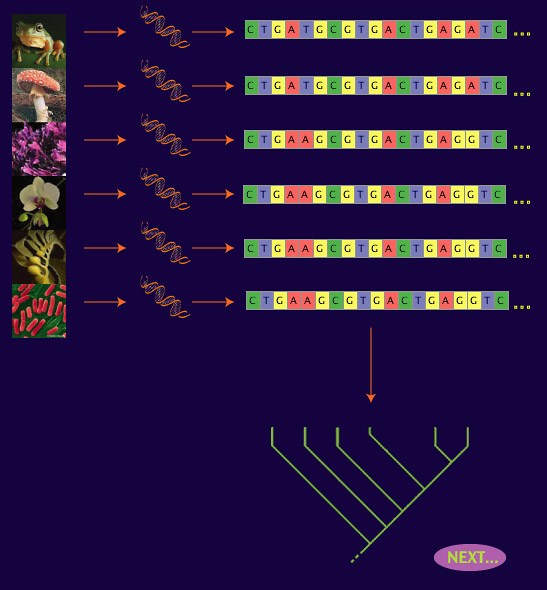
Two organisms that are closely related would have
a)
very similar DNA sequence
b)
exactly the same DNA sequences
c)
no proteins in common
d)
completely different DNA sequence
10.

What happens if a population grows past its carrying capacity?

a)

The population keeps growing

b)

The population starts to die off

c)

The entire species will go extinct

d)

The carrying capacity just increases

11.

The largest number of individuals that an environment can support long term is...

a)

carrying capacity

b)

emigration

c)

immigration

d)

population density

12.

Something that regulates the size of a population is called...

a)

a limiting measure

b)

a limiting factor

c)

carrying capacity

d)

biodiversity

13.

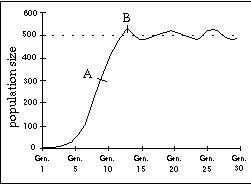
What is the carrying capacity of the graph?

a)

around 500

b)

more than 800

c)

less than 300

d)

around 700

14.
Which of the following would INCREASE the carrying capacity of an ecosystem?
a)
increase in predators
b)
disease
c)
increase in available food
d)
drought
15.

When death rate is equal to birth rate...

a)

population increases

b)

population decreases

c)

population stays the same.

d)

population rapidly increases then becomes stable

16.

When birth rate is high and death rate is low...

a)

population increases

b)

population decreases

c)

population stays the same

d)

all of these

17.

Which of the following is a biotic factor that would affect the carrying capacity of a population?

a)

Soil

b)

Predator

c)

Rainfall

d)

Sunlight

18.

Which statement best describes the predator-prey relationship displayed on this graph?

a)

There is no relationship between the predator and prey.

b)

When the prey population increases, the predator population decreases.

c)

When the prey population increases, the predator population increases.

d)

when the predator population increases, the prey population increases.

19.
A few deer wander out of their native woods into a completely new park where no deer had ever been before. They go on to create an entirely new population.
a)
Genetic Drift
b)
Natural Selection
c)
Non-random mating
d)
Mutation
20.
Five hundred years after the deer had established a flourishing population in the park, a few of them venture back to their original woods and have babies with the deer there.
a)
Genetic Drift
b)
Mutations
c)
Non-random mating
d)
Gene flow
21.
Logan was born with unique abilities for quick healing and awesome claws that stick out of his fingers.
a)
Gene flow
b)
Natural Selection
c)
Mutation
d)
Genetic Drift
22.
What does the image represent?
a)
Founder effect
b)
Bottleneck effect
c)
Natural Selection
d)
Mutations
23.
Gene Flow tends to ___________ genetic variation (diversity)
a)
Increase
b)
Decrease
c)
Stabilize
d)
Exaggerate 
24.

Bats are common in Texas, especially in rocky regions. Bats with longer hang claws have demonstrated higher fitness because of their ability to cling to rock while resting. This adaptation is becoming more frequent in the population. What mechanism of evolution is this?

a)

Natural Selection

b)

Non-random mating

c)

Gene Flow

d)

Genetic Drift

25.

Which of the following is an example of the bottleneck effect?

a)

Cheetah populations reach their lowest levels with reduced diversity and as they rebound are so genetically similar they appear to be inbred.

b)

Affected individuals with blue skin can trace their ancestry back to one of the first settlers in the region.

c)

The environment of a fox population changes and over time foxes who are white survive and pass on their genes to their offspring.

d)

Humans choose two dogs they like the characteristics of and breed them together.
26.
Which of the following is an example of the founder effect?
a)
Bald Eagles are hunted until near extinction, population recovers.
b)
Small group of iguanas floats to an island, starts a new population.
c)
Red fox pups are more likely to survive in a snowy environment if they are born white.
d)
Farmer chooses seeds from largest apples to plant next year.  This results in larger apples from year to year.
27.

A physical trait favored by an environmental change can be called an

a)

adaptation

b)

extinction

c)

possibility

d)

mutation

28.

After a long time in isolation, Island fruit flies and mainland fruit flies meet. They do not produce viable eggs due to genetic differences. The flies have resulted in two seperate lineages due to:

a)

Gene Pool

b)

Genetic Drift

c)

Gene Frequency

d)

Speciation

29.
Which option is the best example of environmental pressures that cause natural selection?
a)
Ranchers breeding cows
b)
Farmers creating bigger corn
c)
Climate and Predators 
d)
Artificial Selection 
30.

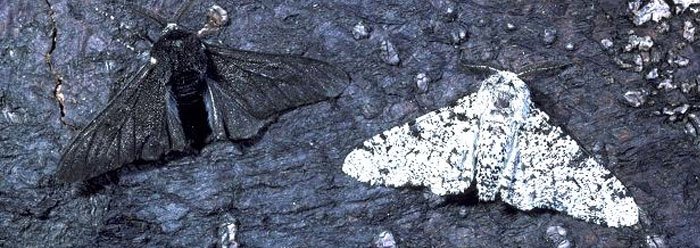
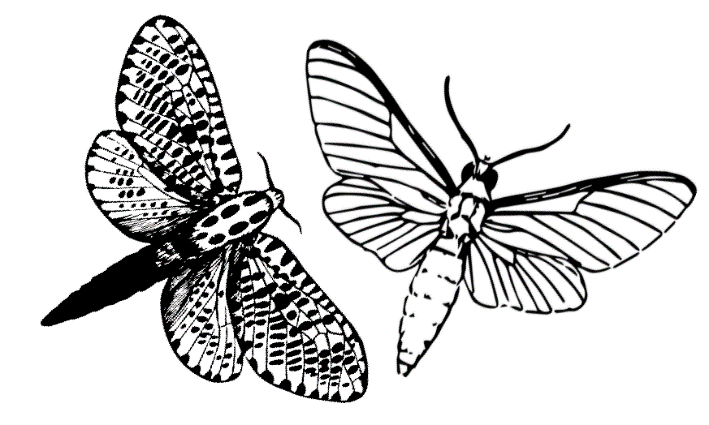
The trees these moths used to live on were white, but have been covered in soot from coal factories. Which moth will be more successful in this new, darker environment?

a)

Dark moth

b)

Light moth

c)

Both will be equally successful

d)

Neither will be successful

31.
Artificial selection is...
a)
the process by which humans select who lives and dies based on traits of animal or plant.
b)
the process by which natures selects who lives and dies.
c)
the process by which animals adapt to their surroundings.
d)
the process by which people take over ecosystems.
32.
Ten brown mice and ten white mice are placed in a desert environment. What will happen to the white population over time?
a)
It will increase
b)
It will decrease
c)
It will stay the same
d)
There is no way to tell
33.
T6. Mutations are important because they bring about
a)
death of the organism in which they develop
b)
genetic variation needed for a population to evolve
c)
benefits for the individual, not for the population
d)
Hardey-Weinberg equilibrium within a population
34.
Why are advantageous traits more likely to be passed onto offspring?
a)
Because they are more likely to survive and reproduce.
b)
Because they come from dominant alleles.
c)
Because they come from recessive alleles.
d)
Because the trait is an acquired phenotype.
35.
Charles Darwin called the ability of an organism to survive and reproduce in its specific environment 
a)
diversity.
b)
evolution
c)
adaptation. 
d)
 fitness.
36.
According to the diagram, when did the common ancestor of giant pandas and spectacled bears exist? 
a)
5-10 mya
b)
10-15 mya
c)
15-20 mya
d)
20-25 mya
37.

In the graph to the right, what is the population of deer at the carrying capacity of the environment?

a)

3

b)

7

c)

70

d)

40

38.

All of the meerkats that live in the same place at the same time make up a ____________.

a)

Community

b)

Ecosystem

c)

Population

d)

Biosphere

39.
Carrying Capacity is
a)
the capacity of what one person can carry per day 
b)
how many animals you have in your daily bag limit at the end of the year
c)
wildebeest at a watering hole with zebras
d)
the maximum number of individuals that the environment can support
40.
How can a populaiton grow?
a)
Emigration and death
b)
Immigration and death
c)
Immigration and birth
d)
Emigration and birth
41.
What pattern of growth will a population with limited resources show?
a)
density-dependent
b)
exponential 
c)
logistic
d)
logical 
42.
Which individual in the first generation is a carrier?
a)
The male
b)
The female
c)
individual 1
d)
None of the above
43.
In the second generation-how many people have the disease or display the physical trait?
a)
2
b)
4
c)
5
d)
6
44.
What is the mode of inheritance shown here?
a)
Autosomal Dominant
b)
Autosomal Recessive
c)
Sex Linked Recessive
45.
What is the mode of inheritance shown here?
a)
Sex Linked
b)
Autosomal Dominant
c)
Autosomal Recessive
46.
What is the mode of inheritance shown here?
a)
Autosomal Recessive
b)
Autosomal Dominant
c)
Sex Linked
47.
What is the mode of inheritance shown here?
a)
Autosomal Dominant
b)
Sex Linked
c)
Autosomal Recessive
48.
What is the mode of inheritance shown here?
a)
Autosomal Recessive
b)
Autosomal Dominant
c)
Sex Linked
49.
If this pedigree shows an autosomal recessive disorder, what MUST the genotype of individual II-3 be?
a)
HH
b)
Hh
c)
hh
d)
None of the above
50.
What type of heredity is shown in the pedigree?
a)
Autosomal Recessive
b)
Sex-Linked
c)
Autosomal Dominant
51.
If hemophilia is a sex-linked recessive trait, what genotype would individual IV-2 have?
a)
XBXb
b)
XbXb
c)
XBY
d)
XbY
52.
If hemophilia is a sex-linked recessive trait, what genotype would individual III-3 have?
a)
XBXb
b)
XbXb
c)
XBY
d)
XbY
53.
If hemophilia is a sex-linked recessive trait, what genotype would individual I-2 have?
a)
XBXb
b)
XbXb
c)
XBY
d)
XbY
54.
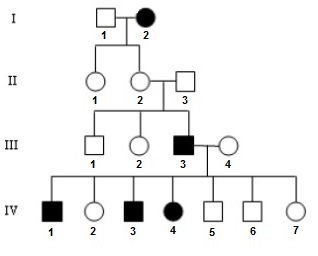
From this pedigree, give the genotype for person III-3
a)
GG
b)
Gg
c)
gg
d)
G_
55.
What type of trait is shown in the pedigree? (look at the difference between males and females)
a)
Autosomal Recessive
b)
Sex-Linked
c)
Autosomal Dominant
56.
What does this shape represent in a pedigree?
a)
Not Affected Male (doesn't have the trait)
b)
Not Affected Female (doesn't have the trait)
c)
Affected Male (has the trait)
d)
Affected Female (has the trait)
57.
How many generations are shown in this pedigree?
a)
1
b)
2
c)
3
d)
4
58.
What do half colored symbols represent?
a)
The individual is a carrier (heterozygous).
b)
The individual expresses the trait.
c)
The individual has both recessive alleles.
d)
The individual has both dominant alleles.
59.
Is this trait (the shaded individuals) dominant or recessive?
a)
dominant
b)
recessive
60.
How many females are in this pedigree?
a)
3
b)
4
c)
6
d)
7
61.
If a gene is found only on the X chromosome and not the Y chromosome, it is said to be what?
a)
sex-linked trait
b)
polygenic trait
c)
codominant trait
d)
incomplete dominance trait
62.

How many alleles does a person carry for a trait?

a)

1

b)

2

c)

3

d)

4

63.

How many alleles does a child get from each parent for a trait?

a)

1

b)

2

c)

3

d)

4

64.

Why do all the daughters in Generation II carry the colorblind gene?

a)

Because mom passed on the gene.

b)

Because dad passed on the X chromosome.

65.

Match the following

a)

movement of individuals out of an area

1.

emigration

b)

movement of individuals into an area

2.

immigration

c)

largest number of individuals in a population that the environment can support

3.

carrying capacity

66.

Match the following

a)

density independent

1.

weather

b)

density dependent

2.

disease

c)

natural disaster

3.

density independent

d)

biotic

4.

living

e)

abiotic

5.

non-living

67.
What 2 factors decrease population size?
a)
Immigration, Births
b)
Emigration, Births
c)
Emigration, Deaths
d)
Immigration, Deaths
68.
Which of the following will increase the size of a population?
a)
emigration and births
b)
immigration and deaths
c)
immigration and births
d)
emigration and deaths
69.

Which of the following is an example of a limiting factor that could affect the growth of a plant population?

a)

Increased sunlight exposure.

b)

Abundance of plant nutrients.

c)

Introduction of a new plant species.

d)

Decrease in soil moisture.