
 Worksheets
Chemical Reaction Types
Total questions: 70
Worksheet time: 1hrs 20mins
What reaction has the following general formula:
A + CD --> C + AD
Combination
Decomposition
Single Replacement
Double Replacement
Combustion
What reaction has the following general formula:
AB --> A + B
Combination
Decomposition
Single Replacement
Double Replacement
Combustion
What reaction has the following general formula:
AB + CD --> CB + AD
Combination
Decomposition
Single Replacement
Double Replacement
Combustion
What reaction has the following general formula:
A + B --> AB
Combination
Decomposition
Single Replacement
Double Replacement
Combustion
What reaction has the following general formula:
CxHy + O2 −>CO2 + H2O
Combination
Decomposition
Single Replacement
Double Replacement
Combustion
What is the general reaction scheme for a single replacement reaction?
A + B --> AB
AB --> A + B
A + CD --> C + AD
AB + CD --> CB + AD
CxHy+O2 −> CO2+H2O
What is the general reaction scheme for a combustion reaction?
A + B --> AB
AB --> A + B
A + CD --> C + AD
AB + CD --> CB + AD
CxHy+O2 −> CO2+H2O
What is the general reaction scheme for a combination reaction?
A + B --> AB
AB --> A + B
A + CD --> C + AD
AB + CD --> CB + AD
CxHy+O2 −> CO2+H2O
What is the general reaction scheme for a double replacement reaction?
A + B --> AB
AB --> A + B
A + CD --> C + AD
AB + CD --> CB + AD
CxHy+O2 −> CO2+H2O
What is the general reaction scheme for a decomposition reaction?
A + B --> AB
AB --> A + B
A + CD --> C + AD
AB + CD --> CB + AD
CxHy+O2 −> CO2+H2O
What type of reaction is the following:
2H2+O2−>2H2O
Combination
Decomposition
Single Replacement
Double Replacement
Combustion
What type of reaction is the following:
BaCl2+2KI −> 2KCl + BaI2
Combination
Decomposition
Single Replacement
Double Replacement
Combustion
What type of reaction is the following:
C11H24+17O2−> 11CO2 + 12H2O
Combination
Decomposition
Single Replacement
Double Replacement
Combustion
What type of reaction is the following:
2KI −> 2K + I2
Combination
Decomposition
Single Replacement
Double Replacement
Combustion
What type of reaction is the following:
2NaHCO3−> Na2CO3+CO2+H2O
Combination
Decomposition
Single Replacement
Double Replacement
Combustion
What type of reaction is the following:
Zn + 2HCl −> ZnCl2+H2
Combination
Decomposition
Single Replacement
Double Replacement
Combustion
What type of reaction is the following:
3CuS +2Al −> Al2S3+3Cu
Combination
Decomposition
Single Replacement
Double Replacement
Combustion
What type of reaction is the following:
2C4H10 +13O2 −> 8CO2+10H2O
Combination
Decomposition
Single Replacement
Double Replacement
Combustion
What type of reaction is the following:
Na2S +2HCl −> H2S+2NaCl
Combination
Decomposition
Single Replacement
Double Replacement
Combustion
What type of reaction is the following:
Ag3N + 3HBr−>3AgBr+H3N
Combination
Decomposition
Single Replacement
Double Replacement
Combustion

H2 + O → H2O
3 Pb + 2 H3PO4 ----> 3 H2 + 1 Pb3(PO4)2
Synthesis (or combination)
Decomposition
Single replacement
Double replacement
Combustion reactions will always involve
Oxygen and a solid
Liquid nitrogen and heat
Oxygen and heat/energy
CO and H2O

-->
mean?
H2 + O → H2O
H2 + O → H2O
What are products?
The chemicals that start the reaction.
The chemicals that the reaction produced.
The chemicals that are on the left side of the arrow.
The products are on the right side of the chemical equation.
True
False
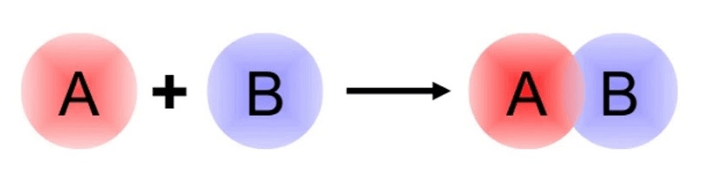
What is the type of reaction shown above?
Synthesis
Decomposition
Single Replacement
Double Replacement
Identify the reaction type:
NaCl + KOH --> KCl + NaOH
Double replacement
Combustion
Synthesis
Decomposition


What type of reaction involves 2 substances combining to form 1 new compound?
Decomposition Reaction
Single Displacement Reaction
Double Displacement Reaction
Synthesis Reaction

The right side of the equation below is called the
products
reactants

Matter and mass can not be
Shaken or stirred
Made
created or destroyed
Transferred

The Law of Conservation of Mass states that the total mass of the reactants should be
More than the mass of the products
Equal to the mass of the products
Ignored during the reaction
Less than the mass of the products


Some chemical reactions require a substance called a catalyst. The purpose of a catalyst is
to warm up the reaction
to speed up the reaction
to create more reactants
to stop the reaction
Which of the following is a common sign that a chemical change has occurred?
A chemical has turned a different color, bubbled, and/or changed temperature.
A chemical has changed to a different state of matter, such as a liquid to a solid.
A chemical has changed size.
A chemical has become a different shape.

