

Wayground logo

Free Printable Worksheets

Font size

S
M
L
XL
Worksheets

Chemical Properties, Reactions, and Equations

Total questions: 68

Worksheet time: 1hrs 9mins

Name
Class
Date
1.

What is matter?

a)

Matter is made of atoms.

b)

Matter is a measure of the amount of material in an object.

c)

Matter may exist as a solid, liquid, or a gas.

d)

Matter forms when particles chemically bond together.

e)

Matter includes both elements and compounds.

2.

What type of chemical reaction is burning paper?

a)

Chemical

b)

Physical

3.

What breaks during a chemical reaction?

a)

glass

b)

bonds

c)

molecules

d)

atoms

4.

Instead of using a chemical's long name, scientists use this instead when writing a chemical equation.

a)

Shorthand

b)

Braile

c)

Elemental symbols

d)

Elemental Code

5.

When I want to balance a chemical equation, this is the only number that I can change.

a)

Subscript

b)

Coefficient

c)

Elemental Symbol

d)

Yields

6.

The subscript tells you how many of what there are in a chemical reaction?

a)

atoms of that element

b)

molecules of that compound

c)

number of reactions

d)

They don't tell you anything.

7.

A coefficient tells you what about the chemical reaction?

a)

Numbers of atoms in that element

b)

Numbers of molecules for that compound.

c)

How many reactions there are.

d)

They don't tell you anything.

8.
Which of the following lists all the elements that are present in a molecule of potassium carbonate, K2CO3 ?
a)

Arbon and Oxygen

b)
phosphate and calcium
c)
potassium, carbon, and oxygen
d)
phosphorus, oxygen, and calcium
9.
The formula for glucose is C6H12O6. How many elements does glucose contain?
a)
1
b)
3
c)
24
d)
432
10.

Acetic acid is a compound found in vinegar. The chemical formula for acetic acid is CH3COOH.

How many different elements are in acetic acid?

a)
3
b)
5
c)
6
d)
8
11.

The Best Friend's Club uses "invisible ink" to write notes to each other. The invisible ink is actually lemon juice that is clear when it dries on paper but turns brown when a club member holds a burning candle under the paper. Once it is heated, it is never invisible again.

What type of change is occurring when the paper is heated?

a)

chemical change

b)
elemental change
c)
physical change
d)
temperature change
12.
Which of the following is the BEST evidence that rusting is a chemical property rather than a physical property of iron?
a)
Rust forms slowly.
b)
Rust can form on any iron.
c)
Rust cannot turn back into iron.
d)
Rust does not look the same as iron.
13.
In which of these compounds are there twice as many oxygen atoms as hydrogen atoms?
a)
H3PO4
b)
H2SO4
c)
HCIO3
d)
H2O
14.
The chemical formula for sodium sulfate is Na2SO4. How many sulfur atoms are in the formula for sodium sulfate?
a)
1
b)
2
c)
6
d)
7
15.
How many atoms are in one molecule of baking soda, NaHCO3?
a)
5
b)
4
c)
12
d)
6
16.
Which of the following equations follows the law of conservation of mass?
a)
3H2O → 3H2 + 3O2
b)
C2H4 + 3O2 → 2CO2 + 2H2O
c)
C + 4H2→ CH4
d)
2Na + Cl → NaCl
17.
Which of the following chemical equations is balanced?
a)
3Na + Cl2 --> 3NaCl
b)
3AgBr + GaPO4 --> Ag3PO4 + GaBr3
c)
CO2 + H2O -->  C6H12O6 + O2
d)
2H2O + O2 --> 2H2O + OH
18.

Serotonin is a chemical substance that acts as a neurotransmitter. It helps relay messages in the human brain. The formula for one molecule of serotonin is shown below.

C10H12N2O

How many atoms in all are in a molecule of serotonin?

a)
1
b)
4
c)
24
d)
25
19.
Which of the following formulas contain the same number of oxygen atoms?I. Mg(NO)2II. NH4NO2III. Ca(ClO2)2IV. NaClO2V. Co(NO3)2
a)
Formulas I and II
b)
Formulas II and IV
c)
Formulas I, II, and III
d)
Formulas I, II, and IV
20.

2AgNO3 + CaCl2 --> 2AgCl + Ca(NO3)2

Identify the products in the chemical equation above.
a)
2AgNO3 and CaCl2
b)
2AgCl and Ca(NO3)2
c)
CaCl2 and Ca
d)
Ag, Cl, N, and Ca
21.
NaOH + HCl --> NaCl + H2O Identify the reactants in the chemical equation above.
a)
NaOH and HCl
b)
NaCl and H2O
c)
HCl and H2O
d)
HCl and NaCl
22.
In a chemical equation, is it true that -
a)
the reactant side and product side can have different numbers of atoms for each element
b)
there can be different elements on the reactant side and the product side
c)
an element or compound must be accompanied by a phase change
d)
the coefficients indicate the number of molecules of each reactant used and the number of molecules of each product made
23.
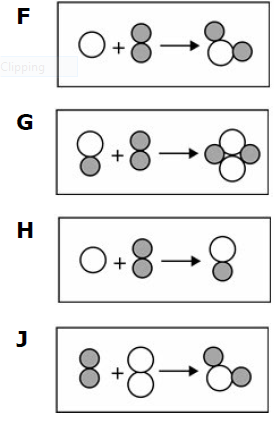
Which of the following models best demonstrates a balanced chemical equation?
a)
F
b)
G
c)
H
d)
J
24.
Which of the following equations demonstrates an actual chemical reaction that forms a new substance?
a)
A
b)
B
c)
C
d)
D
25.
Which of these formulas contain equal numbers of nitrogen atoms?
a)
Formulas I and III
b)
Formulas I and IV
c)
Formulas II and III
d)
Formulas I, II, and V
26.
The reactants are on the left side of the chemical equation.
a)
True
b)
False
27.
Two clear colorless solutions were combined.
The student observed that the temperature changed from 25 •C to 23 •C when the solutions were combined and that a white substance rapidly formed and settled to the bottom of the container. What most likely happened to produce these results?
a)
One of the original compounds came out of solution
b)
The solutions reacted chemically
c)
Some of the water froze into ice crystals
d)
Rapid evaporation of water occurred, leaving a solid
28.
Blue Color
a)
Physical Property
b)
Chemical Property
29.
Density
a)
Physical Property
b)
Chemical Property
30.
Flammability (burns)
a)
Physical Property
b)
Chemical Property
31.
Solubility (dissolves)
a)
Physical Proeprty
b)
Chemical Property
32.
Reacts with acid
a)
Physical Property
b)
Chemical Property
33.
Supports combustion
a)
Physical Property
b)
Chemical Property
34.
Sour taste
a)
Physical Property
b)
Chemical Property
35.
Melting point
a)
Physical Property
b)
Chemical Property
36.
Reacts with water
a)
Physical Property
b)
Chemical Property
37.
Hardness
a)
Physical Property
b)
Chemical Property
38.
A student removes a loaf of bread hot from the oven. The student cuts a slice off the loaf and spreads butter on it. 
a)
Physical Change
b)
Chemical Change
39.
Your friend decides to toast a piece of bread, but leaves it in the toaster too long. The bread is black and the kitchen if full of smoke. 
a)
Physical Change
b)
Chemical Change
40.
You forgot to dry the bread knife when you washed it and reddish brown spots appeared on it. 
a)
Physical Change
b)
Chemical Change
41.
You blow dry your wet hair. 
a)
Physical Change
b)
Chemical Change
42.
In baking biscuits and other quick breads, the baking powder reacts to release carbon dioxide bubbles. The carbon dioxide bubbles cause the dough to rise. 
a)
Physical Change
b)
Chemical Change
43.
You take out your best silver spoons and notice that they are very dull and have some black spots. 
a)
Physical Change
b)
Chemical Change
44.
A straight piece of wire is coiled to form a spring. 
a)
Physical Change
b)
Chemical Change
45.
Food color is dropped into water to give it color. 
a)
Physical Change
b)
Chemical Change
46.
In a fireworks show, the fireworks explode giving off heat and light. 
a)
Physical Change
b)
Chemical Change
47.
Chewing food to break it down into smaller particles represents a _________ change, but the changing of starch into sugars by enzymes in the digestive system represents a ___________change. 
a)
Chemical then Physical 
b)
Physical then Chemical
c)
Both Physical
d)
Both Chemical
48.
A gas
a)
has a definite shape but no definite volume
b)
has a definite volume but no definite shape
c)
has fast-moving particles
49.
At higher temperatures
a)
particles in an object have less energy
b)
particles in an object move faster
c)
a gas contracts
50.
The opposite phase of melting is 
a)
freezing 
b)
sublimation
c)
condensation 
d)
deposition 
51.
Melting
a)
liquid to solid
b)
solid to liquid
c)
solid to gas
d)
gas to liquid
52.
Freezing
a)
Solid to gas
b)
Liquid to solid
c)
Gas to solid
d)
Liquid to gas
53.
Boiling
a)
liquid to gas
b)
gas to solid
c)
gas to liquid
d)
solid to liquid
54.
Which state of matter has tightly packed molecules?
a)
solid
b)
liquid
c)
gas
55.
The drops of water that appear on the outside of a glass of cold juice on a warm day are an example of?
a)
sublimation
b)
condensation
c)
evaporation
56.
Which of these is an example of sublimation?
a)
water turning to ice
b)
ice cream dripping
c)
a puddle drying up
d)
dry ice being used to make fog
57.
Define a liquid.
a)
Indefinite shape, indefinite volume
b)
Definite shape, definite volume
c)
Found in stars
d)
Definite volume, indefinite shape
58.

Phase change going from a Liquid to a Gas...

a)

Vaporization

b)

Deposition

c)

Condensation

d)

Melting

59.

Phase change going from a Solid to a Gas...

a)

Deposition

b)

Sublimation

c)

Condensation

d)

Recombination

60.

Phase change going from a Gas to a Solid...

a)

Deposition

b)

Sublimation

c)

Condensation

d)

Vaporization

61.
The red numbers in the image below represent ________
a)
subscripts
b)
coefficients
c)
I don't know, and don't want to try
d)
None of the answers are correct
62.
The blue numbers in the image below represent ________
a)
I don't know, and don't want to try
b)
coefficients
c)
subscripts
d)
none of the answers are correct
63.
Balance this equation...
H2 + Cl2 --> HCl
a)
It is balanced 
b)
3H2 + Cl2 --> 6H2Cl
c)
H2 + Cl2 --> 2HCl
d)
I don't know! Oh well.
64.
Balance this equation...
HgO --> 2Hg + O2
a)
It is balanced 
b)
2HgO --> Hg + O2
c)
2HgO --> 2Hg + O2
d)
I don't know...Oh well!
65.
Balance this equation...
Sb2S3 + O2 --> Sb + SO2
a)
It is balanced
b)
Sb2S3 + 3O2 --> 2Sb + 3SO2
c)
Sb2S3 + O2 --> 2Sb + SO2
d)
I don't know...Oh well!
66.
Which of the following is an unbalanced equation?
a)
CaCO3 --> CaO + CO2
b)
PbO2 + 2H2-->2Pb + H2O
c)
2Na+ 2H2O-->2NaOH + H2
d)
CS2 + 2O2 --> CO2 + 2SO2
67.
Which of the following shows the correct way to balance the chemical equation?
Fe + O2 -> Fe2O3
a)
4Fe + 3O2 -> 2Fe2O3
b)
2 Fe + 3O2 -> Fe2O6
c)
4 Fe + O6 -> 2Fe2O3
d)
None of the options are correctly balanced.
68.
Is this equation balanced?
a)
yes
b)
no
c)
Not enough information
