
Font size
 Worksheets
Sci 8 Unit C 1.0 Knowledge about Light
Total questions: 61
Worksheet time: 1hrs 15mins
Fibreoptics

The image shows light changing direction as it passes from one clear medium to another. This optical effect is a result of
Refraction
Reflection
Transmission
Absorption

In a curved line
at 100 000 km/s
In a straight line
When all 3 primary light colors: blue, green, red are mixed which color is produced?
black
magenta
white
cyan
A student uses an optical device, then decides to take it apart to learn more about how it works.
The student's observations are listed below:
1. the device has two lenses
2. a lens is in the eyepiece
3. an objective lens collects the light
4. the image is inverted
5. the device consists of one long tube
reflecting telescope
refracting telescope
microscope
binoculars
A student uses an optical device, then decides to take it apart to learn more about how it works.
The student's observations are listed below:
1. the device has one lens
2. a lens is in the eyepiece
3. a mirror redirects the image to the eyepiece
4. the image is inverted
5. a mirror focuses the image
reflecting telescope
refracting telescope
microscope
binoculars
Categorize the following theories of light as Correct or Incorrect.
incoming angle of the beam equals the reflected
beam of light when hitting a mirror
our eyes give off light to iilluminate objects
white light is a mixture of all colours of light
the speed of light is 150 000 km/s
light chcnges direction when it travels from air to water
light is given off by water particles
A student uses an optical device, then decides to take it apart to learn more about how it works.
The student's observations are listed below:
1. the device has four lenses
2. there are two eyepiece lenses
3. there are two objective lenses that collect light
4. the image is not inverted
5. the device consists of two tubes with prisms
reflecting telescope
refracting telescope
microscope
binoculars

Transmission
Absorption
The scientist that incorrectly thought light rays are produced from our eyes was

Which optical device is pictured?
binoculars
The scientist that correctly discovered how vision works was
Archimedes
Pythagoras
Euclid
al-Haytham

Light is predictable because it will always travel in a _________ line.
Curved
Straight
Perpendicular

When light passes from air through a glass of water, what will it do?
Check all that apply.
Refract
Change Direction
Bend
What do Reflecting Telescopes have?
Only Lenses
Curved Mirror
Water

Light is transmitting

What property of light is shown in the diagram?
Reflecting
Refracting
Absorbing
Transmitting
A ______ telescope uses a mirror to collect light.
When light is _____________, it bounces back from a surface.
reflected
refracted
absorbed
transmitted

What is refraction?
A type of change in direction
A type of lens
A type of matter
A type of reflection
Barry wants to see how white light can separate into different color. Which object could he hold in front of a beam of sunlight to see this happen?
mirror
silver spoon
prism
When light is _____________, it passes from one transparent material to another and changes direction.
reflected
refracted
absorbed
When light travels through a convex lens in a magnifying glass, it changes direction and we see a larger view of the object. This is an example of ....
Check all that apply.
reflection
refraction
absorption
bending

binoculars
microscope
The speed of light is approximately
3000 km/s
300,000 km/s
300 km/s
30,000 km/s

What type of optical device is this?
Refractor telescope
Reflector telescope
Binoculars
Microscope

Which scientific instrument did Galileo use to change the world of astronomy?
telescope
microscope
binoculars
magnifying glass
Which instrument uses lenses to focus on the light going through a very small object?
Compound microscope
Refracting Telescope
Reflecting Telescope
Binoculars
The scientist that correctly discovered that white light was made up of all the colours of light was...
Archimedes
Newton
Euclid
al-Haytham
The scientist that correctly discovered that light bounces off objects, then goes into our eyes was ...
Archimedes
Newton
Euclid
al-Haytham
The scientist that tried to use reflected light as a weapon was ...
Archimedes
Newton
Euclid
Pythagoras
Which of the following is made of 2 telescopes joined together?
microscopes
telescopes
binoculars
prisms

The scientist that showed how light reflected in equal angles:
Archimedes
Newton
Euclid
Pythagoras

The scientist that discovered the property shown in the image below.
Pythagoras
Newton
Michelson
al-Haytham

This is a diagram of
microscope
binoculars
telescope
pinhole camera

Is this a correct diagram of a pinhole camera?
yes
no
Telescopes ______________ & ___________________ light.
magnify & collect
decrease & collect
magnify & diminish
reduce & disperse
Light is a form of
matter
energy
Any device that uses light to allow humans to see an image is called:
a particle device
an optical device
a mechanical device
thermal device
Mixing red and blue light creates
magenta light
cyan light
white light
yellow light
Mixing green and blue light creates
magenta light
cyan light
white light
yellow light

This window...
transmits almost all of the light, absorbs none of the light, reflects none of the light
transmits some of the light, reflects some light, absorbs some light
transmits none of the light, absorbs all the light, reflects none of the light

This piece of glass..
transmits almost all of the light, and reflects a little light
transmits a little bit of the light, absorbs some of the light
transmits none of the light

This basketball...
transmits most of the light and reflects some of the light
absorbs most of the light and reflects some of the light
absorbs all of the light
absorbs some of the light and transmits some of the light
When an image is seen through a microscope, telescope or your eye, the image is always
inverted
upright

Why does this flower appear magenta to our eyes?
Only red and blue light are absorbed into our eye
Because all colours of the visible spectrum are absorbed
Because that's what colour the flower is
Only red and blue light are reflected into our eye
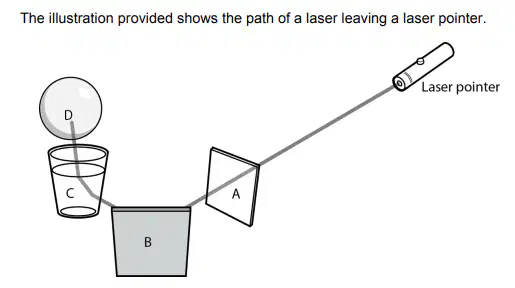
At what point in the diagram is the laser light ray being reflected?
A
B
C
D
The color of the object you see is the color that is ___.
reflected
absorbed

Which object in the diagrams refracted the laser beam?
Silver locket
Picture frame
Glass marble
Notebook
When a light ray is moving from air to water, its speed will (a) , and it will (b) .
A black-coloured, solid object absorbs almost all light.
True
False
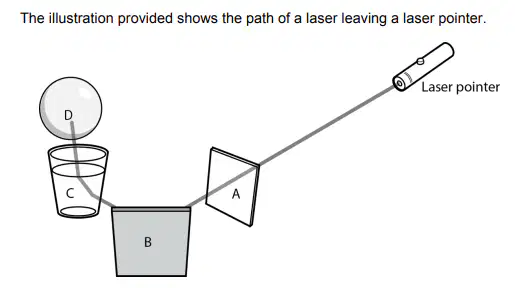
At what point in the diagram is the laser light ray being transmittted?
A
B
C
D
At what point in the diagram is the laser light ray being refracted?
A
B
C
D
At what point in the diagram is the laser light ray being absorbed?
A
B
C
D
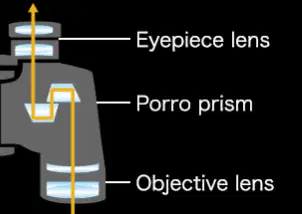
This diagram is showing how light travels in
binoculars
a microscope
a telescope
a pinhole camera
A similarity between a microscope, binoculars and a magnifying glass, it that they all have
lenses
mirrors
An object absorbs RYGBIV.
What colour is the object?
orange
blue
violet
red

