
 Worksheets
PS TEST 3 Practice: Heat, Heating curve, Temp
Total questions: 82
Worksheet time: 1hrs 21mins

Where does the ball have the most kinetic energy?
A
B
C
D

What is the height of the object at C?
4.1 m
8.2 m
28 m
None of the above
What is happening to the potential energy of the ball as it is falling
hard to tell
decreasing
staying same
increasing

What is the mass of the object?
5 kg
25 kg
2 kg
None of the above
Where does the object have both potential and kinetic energy?
A
B
B and C
A, B, C, and D
What is the kinetic energy of the object at C?
980 J
200 J
50 J
780 J

A 50 kg object starts from rest at a height 30 m above the ground. Where does the skier have the most speed?
A
B
C
A, B and C
A 50 kg object starts from rest at a height 30 m above the ground. What is the mechanical energy of the object at A?
14700 J
1560 J
14,700 N
None of the above
A 50 kg object starts from rest at a height 30 m above the ground. What is the potential energy of the object at B?
4900 J
1560 J
4900 N
None of the above
A 50 kg object starts from rest at a height 30 m above the ground. The energy graph for the object at B is __________.


How much heat energy does it take to raise the temp of the 0.250 kg water at 1000 C to steam at 1000 C? (Heat of Vaporization = 2260000 J/kg )
565000 J
104,650 J
125,000 J
1043 J

B is heat transfered to the handle. This is an example of heat transfer by_____
conduction
convection
radiation
none of the above
Through which of the following will convection most likely occur?
solids
solids and liquids
solids and gases
liquids and gases

A is heat coming from the heating coils. The pot is not touching the coils. This is an example of heat transfer by_____.
radiation
convection
conduction
none of the above
The transfer of energy that does not require matter is ____.
radiation
convection
conduction
none of the above
Radiation is the transfer of energy in the form of _______.
waves
signals
current
surges

Energy from the sun travels to Earth as ____.
radiant energy
mechanical energy
chemical energy
combustion

C is heat transfered to entire liquid in the pot which is not touching the coils. This is an example of heat transfer by_____.
convection
conduction
none of these
radiation
A metal with a specific heat of 80 J/kg oC requires 900 J of heat to raise its temperature by 4 C. What is its mass?
2.8 Kg
8.2 Kg
3 Kg
100 Kg
Object 10 kg object A at 100 oC is in contact with an 120 kg object B at 100 oC. Heat will
will not flow
flow from A to B
flow from B to A
none of these
Object 10 kg object A at 100 oC is in contact with an 120 kg object B at 1 oC. Heat will
will not flow
flow from A to B
flow from B to A
none of these

When is the ball’s potential energy increasing?
A to D
B to F
D to G
none of these
When does the ball have the most kinetic energy?
A and G
D
B and F
none of these
When does the ball have the most potential energy?
A and G
D
C and E
none of these

A .050 kg of water at 20 oC is mixed with .075 kg of water at 100 oC. The equilibrium temperature of the mixture is 70 oC. (specific heat of water = 4186 J/kg oC). How much heat is gained by the cold water in this experiment?
10,465 J
15,698 J
30,090 J
40 J
A .050 kg of water at 20 oC is mixed with .075 kg of water at 100 oC. The equilibrium temperature of the mixture is 70 oC. (specific heat of water = 4186 J/kg oC). How much heat is lost by the hot water in this experiment?
9,419 J
15,698 J
20,718 J
6,279 J

Gravitational potential energy depends on the ____
the acceleration due to gravity.
the height of the object.
the mass of the object.
All of the above
Thermal energy is measured in units of ____.
Joules (J)
Celsius
Kelvin
Fahrenheit
The S.I unit of temperature is _______.
K
oC
oF
None of these
75 oF = ? oC
HINT: oC = 5/9 (oF -32)
24 oC
42 oC
12 oC
28 oC
_______ is the measure of how hot or cold something is.
Temperature
specific heat
Radiation
Heat
The law of ____ states that energy in a system can change forms but can never be created or destroyed.
conversion of energy
conservation of energy
consecration of energy
construction of energy

As the temperature of a material decreases, the particles move _________ and their kinetic energy __________.
slower ; decreases
slower ; increases
faster ; increases
faster ; decreases
Which of the following can be measured with a thermometer?
temperature
radiation
heat
all of the above
How much heat energy does it take to completely change 8.5 kg of ice cube at 0 oC to water at 0 oC? (Heat of Fusion of ice = 334000 J/kg)
2.84 x 10⁶ J
2,839 J
2.8 J
None of the above
If the velocity of an object triples, the KE of the object will ___________.
increase 9 times
increase 6 times
increase 3 times
decrease 9 times
If the velocity of an object doubles, the KE of the object will ___________.
increase 4 times
increase 2 times
increase 0 times
decrease 4 times

A material that reduces the flow of heat by conduction, convection, and radiation is a(n) ____
insulator
radiator
solar collector
conductor
250 oC = ? oF
HINT: oC = 5/9 (oF -32)
482 oF
171 oF
530 oF
32 oF
A measure of the average kinetic energy of the particles in a sample of matter is its ________.
temperature
heat
kinetic energy
potential energy
A slice of bread contains about 419000 J of energy. If the specific heat of a person is 4190 J/kg·°C, by how many degrees Celsius would the temperature of a 70 kg person increase if all the energy in the bread were converted to heat?
1.43°C
1.86°C
1.00°C
2.25°C
If molecules of a liquid gain enough kinetic energy to break free from intermolecular forces and become a vapor, we call this process ___________. (No heat is supplied)
evaporation
condensation
equilibrium
freezing point
Silver, copper, and nickel are examples of _______.
good conductors
insulators
super conductors
bad conductors
All of the following are good conductors of heat EXCEPT ____.
air
aluminum
silver
copper
Which of the following statements is true?
Heat flows from a higher temperature to a lower temperature.
The amount of heat in a closed system is a constant.
Heat is energy that is flowing into an object
Heat is energy that flows from a lower temperature to a higher temperature.

What is the freezing point of the substance? (Be careful with the units)
333 K
60 K
393 K
283 K
What is happening to the substance at line segment D-E ?
Boiling
melting
condensation
freezing
During which part is melting happening?
B to C
C to B
D to E
E to D
What state is the substance in at line segment E-F?
Gas
Liquid
Solid
Plasma
When is there a change in the potential energy of the molecules (hint: Phase change)? Pick two answers.
BC
DE
EF
AB
CB
When is there an increase in kinetic energy of the molecules? Pick three answers.
AB
CD
EF
DE
BC
What is the boiling point of the substance? (Be careful with the units)
393 K
283 K
393 J
120 J
100 oC


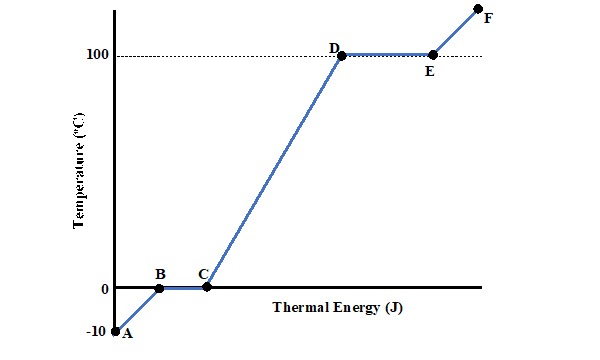
Between which two points is Heat of Vaporization?
A <----> B
B <----> C
C <----> D
D <----> E
E <----> F


From point A to point E, the sample is going through an
exothermic process by releasing heat to the surroundings
exothermic process by absorbing heat from the surroundings
endothermic process by releasing heat to the surroundings
endothermic process by absorbing heat from the surroundings

