Wayground logo

Free Printable Worksheets

Font size

S
M
L
XL
Worksheets

1011 - Midterm Lab Practical

Total questions: 60

Worksheet time: 1hrs 8mins

Name
Class
Date
1.
A piece of copper has a mass of 89g and a volume of 10 cm3.  What would be the density of the copper?
a)
0.89 g/cm3
b)
89 g/cm3
c)
8.9 g/cm3
d)
890 g/cm3
2.
What is the measuring unit for mass?
a)
centimeter 
b)
millimeter 
c)
grams 
d)
pounds
3.
What units are used to measure Density?
a)
cm3/g
b)
g
c)
g/cm3
d)
cm3
4.

What is the approximate size of one of the cells in the field of view shown?

a)

0.5 mm

b)

1.0 mm

c)

1.5 mm

d)

2.0 mm

5.
What is the length of the image below?
a)
43 cm
b)
403 cm
c)
40.3 cm
d)
4.3 cm
6.
What is the basic unit for LENGTH in the metric system?
a)
gram
b)
meter
c)
liter
d)
inch
7.

Which unit is used for a temperature reading in Metric?

a)

Celsius

b)

Fahrenheit

c)

Kelvin

d)

degrees

8.

What is the meniscus?

a)

where the liquid creeps up as it clings to the side of the cylinder

b)

the bottom of the dip that the liquid makes in the cylinder

c)

the ring on a graduated cylinder that helps it from breaking if tipped

d)

the line on the graduated cylinder that you read from

9.

How do you find the mean of a data set?

a)

Add up the numbers and divide by how many there are.

b)

Multiply the numbers and subtract the smallest.

c)

Add up the numbers.

d)

Find the middle number.

10.
What is the liquid volume measurment in the image below?
a)
503 mL
b)
53 mL
c)
5.3 mL
11.
Oils are which type of macromolecule?
a)
carbohydrates
b)
lipids
c)
nucleic acids
d)
proteins
12.
Which macromolecule is made of simple and complex sugars?
a)
lipids
b)
proteins
c)
carbohydrates
d)
nucleic acids
13.
Another name for fats and oils
a)
proteins
b)
sugar
c)
lipids
d)
nucleic acids
14.
What do you grasp when carrying the microscope?
a)
The stage and nosepiece
b)
The top and stage
c)
The base and stage
d)
The arm and base
15.
This organelle is in all eukaryotic cells. It is the control center of the cell because it holds the DNA.
a)
Mitochondria
b)
Nucleus
c)
Chloroplasts
d)
Ribosomes
16.
What is the mass number of this element?
a)
104
b)
157
c)
261
d)
312
17.
The solvent is the substance dissolved in a solution.
a)
True
b)
False
18.
On which end of the pH scale do you find bases?
a)
left (0 - 6.9)
b)
right (7.1 - 14)
19.

When two or more elements combine, they form a ___________.

a)

mixture

b)

atom

c)

compound

d)

cell

20.

Lipids and water mix easily under the right conditions

a)

Yes

b)

No

21.
Compounds that contain carbon are called... (Section 1)
a)
Inorganic Compounds
b)
4-Type Compounds
c)
Organic Compounds
d)
Clear Compounds
22.
If the eyepiece of your scope has a power of 10, and the selected objective lens has a power of 20,what is the total magnification?
a)
20x
b)
30x
c)
200x
d)
2000x
23.
When should the fine adjustment knob always be used?
a)
with the low power objective only
b)
with the medium power objective only
c)
with the high power objective only
d)
with both the medium and high power objectives
24.
When you focus on a new specimen, always begin with
a)
low power and coarse adjustment.
b)
low power and fine adjustment
c)
high power and coarse adjustment
d)
high power and fine adjustment
25.
Which part of the microscope controls the amount of light available?
a)
coarse adjustment knob
b)
diaphragm
c)
objective lens
d)
revolving nosepiece
26.
Which part lets you turn up the power of magnification, such increasing from 40x to 100x?
a)
coarse adjustment knob
b)
diaphragm
c)
field-of-view
d)
revolving nosepiece
27.
Which part is the lighted area you see when looking through the eyepiece?
a)
coarse adjustment knob
b)
diaphragm
c)
field-of-view
d)
revolving nosepiece
28.
What part is 5?
a)
coarse adjustment
b)
fine adjustment
c)
diaphragm
d)
stage
29.
What is part 11?
a)
coarse adjustment
b)
fine adjustment
c)
diaphragm
d)
stage
30.

Label the part of the microscope. What is part D?

a)

body

b)

foot

c)

objective lens

d)

turret

31.

The specimen slide is placed on the ___

a)

platform

b)

table

c)

stage

d)

base

32.
Osmosis is the movement of _____ across a membrane.
a)
food
b)
energy
c)
oxygen
d)
water
33.
What is diffusion?
a)
when molecules move 
b)
when molecules move from a high concentration to a low.
c)
no movement 
d)
molecules move everywhere
34.
The term used to describe when some molecules are able to pass through a membrane and others are not.
a)
Osmosis
b)
Diffusion
c)
Selective Permeability
d)
Equilibrium
35.
When both inside and outside of a cell have the same amount of water it is said that the cell has reached a state of
a)
Osmosis
b)
Diffusion
c)
Equilibrium
36.
A person would never have pure water put into their veins in a hospital because their cells would...
a)
Shrink/Dehydrate
b)
Expand
37.
A person should never drink salty water because their cells would
a)
shrink
b)
expand
38.
 An animal cell placed in a hypertonic (salty) solution will
a)
Stay the same
b)
Shrink- get smaller
c)
Swell- get bigger
39.

What happened to the CELL WALL and the CELL MEMBRANE in these plant cells?

a)

Both the CELL WALL and CELL MEMBRANE shrunk

b)

Only the CELL WALL shrunk, the CELL MEMBRANE stayed the same

c)

The CELL WALL stayed the same, only the CELL MEMBRANE shrunk

d)

Both the CELL WALL and CELL MEMBRANE stayed the same

40.
Ideally, your cells should be in a(n) _______ solution
a)
Hypertonic
b)
Hypotonic
c)
Isotonic
d)
Cola
41.
The cell below is in a _________ solution.
a)
Hypotonic
b)
Hypertonic
c)
Isotonic
42.
Which cell is placed into a hypotonic environment? 
a)
A
b)
B
c)
C
d)
D
43.
The property where water can dissolve almost all substances on Earth.
a)
adhesion
b)
capillary action
c)
cohesion
d)
universal solvent
44.

What is a substance called if it speeds up a chemical reaction?

a)

fuel

b)

catalyst

c)

cofactor

d)

inhibitor

45.

Enzymes are an example of

a)

Lipids

b)

Carbohydrate

c)

Protein

d)

Nucleic Acid

46.
What is the purpose  of an enzyme?
a)
give permission for the reaction
b)
raise activation energy
c)
speed up reactions
d)
control how many reactions occur
47.
Each enzyme only has 1 substrate that will fit its active site.  What is this called?
a)
reusable
b)
catalyst
c)
specific
d)
fragile
48.
What 3 letters do enzymes typically end in?
a)
-ose
b)
-ase
c)
-ese
d)
-tic
49.
Any substance that is acted upon by an enzyme is called a(n)?
a)
Coenzyme
b)
Substrate
c)
Vitamin
d)
Polypeptide
50.
After the enzyme and substrate bind together and perform the reaction, what does the substrate become?
a)
a substrate
b)
an enzyme
c)
a product
d)
an active site
51.
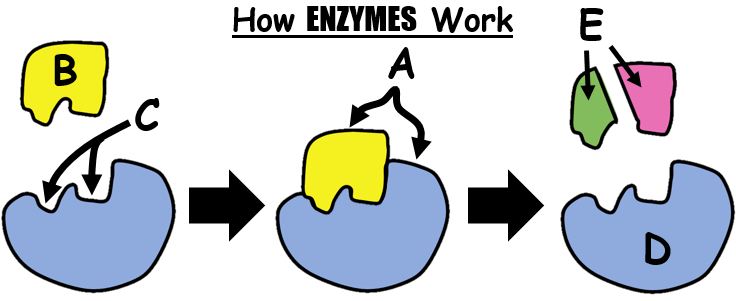
In the diagram, what is letter A? 
a)
product
b)
substrate
c)
enzyme-substrate complex
d)
active site
52.
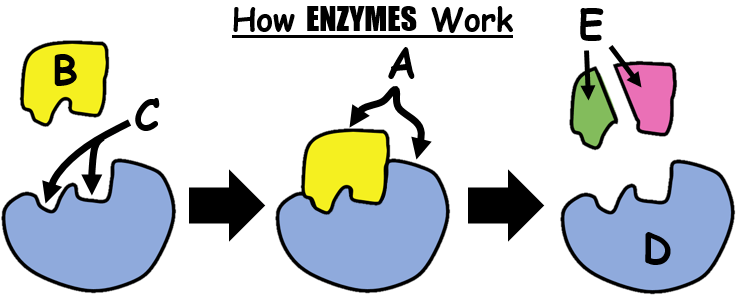
Letter D...
a)
active site
b)
enzyme
c)
substrate
d)
products
53.
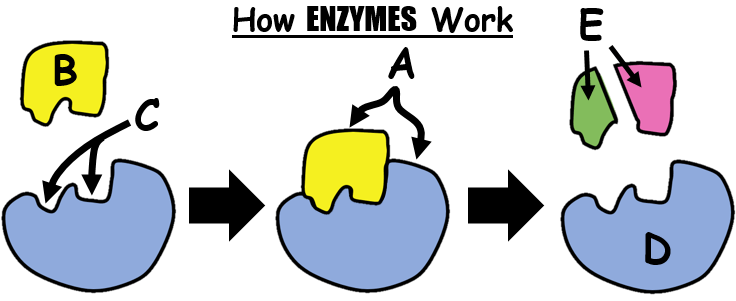
Letter C...
a)
active site
b)
enzymes
c)
substrate
d)
products
54.
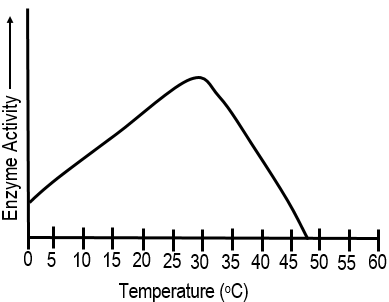
Based on the graph, what is the optimal temperature for this enzyme? 
a)
15oC
b)
40oC
c)
30oC
d)
35oC
55.
An enzyme speeds up a chemical reaction in the cell but can only be used once.  True or False? 
a)
true
b)
false
56.
At 40 degrees Celsius, your biological enzymes will...
a)
Functional optimally
b)
Denature
c)
Wait until the temp. increases
d)
Wait until the temp. decreases
57.
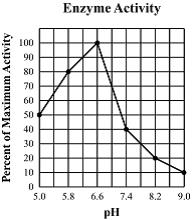
Which of the following conclusions can be drawn from this graph?
a)
The optimum pH of the enzyme is 6.6.
b)
The optimum pH of the enzyme is 5.8
c)
The enzyme’s activity increases as pH increases 5.0 to 9.0
d)
The enzyme’s activity is greater around pH of 8.0 .
58.
What makes an enzyme substrate specific?
a)
Size
b)
Shape
c)
Name
d)
Location it is found in
59.

What is the formula for finding the volume?

a)

mass x length

b)

length x width x mass

c)

length x width x height

d)

height x mass

60.

To find the volume of an irregular object you should use this method:

a)

mass divided by density

b)

water displacement

c)

length x width x height

d)

electric balance