
 Worksheets
BenchMark 3 Review
Total questions: 56
Worksheet time: 3620secs
Which organ is responsible for removing waste?
Brain
kidney
heart
lungs
Which body system is responsible for removing liquid waste from your body?
respiratory
circulatory
excretory
nervous
Which body system is responsible for bringing nutrients and oxygen to every cell in the body?
respiratory
circulatory
excretory
nervous
Which system is responsible for carrying oxygen and carbon dioxide in and out of your body?
respiratory
circulatory
excretory
nervous
Which three body systems is responsible for locomotion?
Muscular, skeletal, circulatory
muscular , skeletal, respiratory
muscular, skeletal, digestive
muscular, skeletal, nervous
What is the function of the skeletal system?
movement
only protection
protection and structure
only structure
Which organ is responsible for filtering waste?
kidney
lungs
excretory
respiratory
Which of the following is in order from most complex to least complex?
cell, tissue, organ system, organism
cell, tissue, organism, organ system
Organism, organ system, tissue, cell
Organism, organ system, cell, tissue
Which of the following is in order from least complex to most complex?
cell, tissue, organ system, organism
cell, tissue, organism, organ system
Organism, organ system, tissue, cell
Organism, organ system, cell, tissue
One example of a force is
gravity
light
liquid
oxygen
Which of the following is not a force?
Friction
energy
gravity
magnetism

Which changes in energy form are illustrated in the diagram?
sound -> mechanical -> light and electrical
light -> electrical -> mechanical and sound
electrical -> sound -> light and mechanical
mechanical -> light -> sound and electrical
Heat transfer: direct touch (solid to solid))
convection
conduction
radiation
heat transfer: indirect touch ( through fluids: liquids & gas)
convection
conduction
radiation

What type of heat transfer?
Conduction
Convection
Radiation

what type of heat transfer pictured?
conduction
convection
radiation
Which of the following is an example of kinetic energy?
a book sitting on a shelf
a basketball rolling across the field
a coat hanging in the closet
a train stopped at the station

Which statement about the image is correct?
Student A has more potential energy because their position is lower.
Student B has more potential energy because their position is lower.
Student B has more potential energy because their position is higher.
Student A has more potential energy because it higher than the pool.
A blender transforms electrical energy into mechanical energy. Which form of energy is also produced during this energy transformation?
chemical
solar
heat

Which has the most KE?
A
B
C
D

What happens to the ball's energy between point A and point B in the diagram above?
KE is created
PE is destroyed
PE is transformed into KE
KE is transformed in PE
A wet shirt is put on a clothesline to dry on a sunny day. The shirt dries , because water molecules
gain heat energy and condense
gain heat energy and evaporate
lose heat energy and condense
lose heat energy and evaporate

Which letter represents the point at which the basketball has the greatest potential energy?
Point A
Point B
Point C
Point D

Which ball shown in the diagram above has the greatest potential energy?
Ball A
Ball B
Ball C
Ball D
Which statement best describes the energy changes that occur as a child rides on a sled down a steep, snow-covered hill?
Both potential energy and kinetic energy decrease
both potential energy and kinetic energy increase
kinetic energy decreases, and potential energy increase
kinetic energy increase, and potential energy decreases


A drawn bow possesses mechanical energy in the form of _______________. After the arrow is released, the energy is transformed into _________________.
potential energy; mechanical energy
elastic potential energy; kinetic energy
gravitational potential energy; kinetic energy
elastic kinetic energy; mechanical kinetic energy
The law of conservation states that can not be created nor destroyed: it can only be
Destroyed a little bit
Invisible
Transformed, changed
None of the above
What is the force that pull things toward the earth?
magnestim
gravity
friction
light
How is the spinal cord important to the nervous system?
it helps it move waste
it helps it circulate blood
it helps it send and receive signals (stimuli)
What is a stimuli?
the ability to sense and feel
the ability to move

Which position does this image have the most Potential energy?
A
B
C
How do you make an electromagnet stronger?
add more coils
remove coils
add a light bulb
get a new battery

What is structure in the picture?
cell
tissue
organ
organ system

What structure is pictured?
cell
tissue
organ
organ system
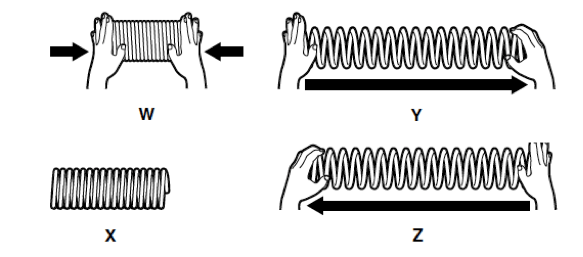
Elastic potential energy is energy stored in an object, such as a spring, due to the object being stretched or compressed. In which position is it most likely that the spring has lost its elastic potential energy?
W
Y
X
Z
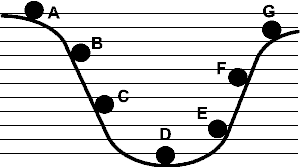
At which point does the ball has the greatest gravitational potential energy (GPE)?
A
G
D
C
G
How could you increase the gravitational potential energy of an object without changing its mass and gravity?
Make the object larger
Lower the object towards the ground
Raise the object farther off the ground
Allow the object to roll on the ground

How is food changed in structure 3?
broken down by chewing
following the path way to get broken down further
broken down by chemicals called enzymes
Broken down by saliva

What law is best described
A magician pulls a tablecloth out from under dishes and glasses on a table without disturbing them.
Newton's 1st Law
Newton's 2nd Law
Newton's 3rd Law


Which of the following is an example of an unbalanced force?


Newtons law states that for every action, there is an_________ reaction
unequal and opposite
stronger and opposite
equal and similar
equal and opposite

How is this an example of Newton's Third law
Only the ball is using the head
only the head is pulling the ball
They are both exerting an equal force on each other

When a small car pushes a big truck, the truck applies an equal and opposite force on the car.
False
True
As the force increases, the acceleration__________
Increase
decrease
Remain the same

