wayground logo

Free Printable Worksheets

Font size

S
M
L
XL
Worksheets

Electricity Review

Total questions: 65

Worksheet time: 2hrs 58mins

Name
Class
Date
1.

The continuous flow of electrons is ______

a)

Current

b)

Static electricity

c)

Voltage

d)

Resistance

2.

The amount of "push" available to move electrons is _____

a)

Current

b)

Resistance

c)

Voltage

d)

Static Electricity

3.

The opposition to electron movement

a)

Voltage

b)

Static electricity

c)

current

d)

Resistance

4.

If a bulb is added between the battery and the switch, ____

a)

The bulbs get brighter

b)

The bulbs get dimmer

c)

The bulb brightness stays the same

d)

All the bulbs go out

5.

If you add another bulb in parallel,_____

a)

The bulbs get brighter

b)

The bulbs get dimmer

c)

The bulb brightness stays the same

d)

All the bulbs will go out

6.

If the top bulb goes out,

a)

All the bulbs go out

b)

The other bulbs get dimmer

c)

There is no effect on the other bulbs

d)

The other bulbs get brighter

7.

If the middle bulb goes out, _______

a)

The other bulb gets brighter

b)

The other bulb goes out

c)

The other bulb's brightness stays the same

d)

The other bulb gets dimmer

8.

Devices in a parallel circuit receive

a)

equal current but different voltage

b)

equal voltage but different current

c)

equal voltage and equal current

d)

different voltage and different current

9.

Devices in a series circuit receive

a)

Equal current but different voltage

b)

Equal voltage but different current

c)

Equal voltage and equal current

d)

different voltage and different current
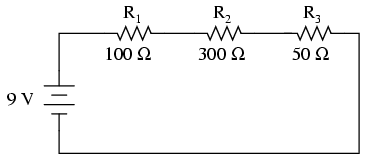
10.
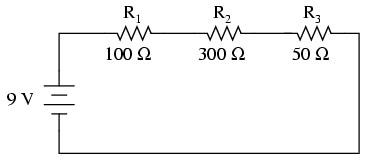
The picture shows an electrical circuit. This circuit is a series circuit because: 
a)
It has 3 light bulbs.
b)
The same current flows through all three light bulbs.
c)
It uses a single battery.
d)
The electrical current is divided between the three light bulbs.
11.
The total resistance in this circuit is 
a)
100 ohms
b)
450 ohms
c)
400 ohms
d)
30 ohms
12.
The total current through this circuit is
a)
0.02 amps
b)
0.09 amps
c)
50 amps
d)
9 amps
13.
The voltage dropped across the 300 ohm resistor is 
a)
6 V
b)
9 V
c)
2 V
d)
30 V
14.

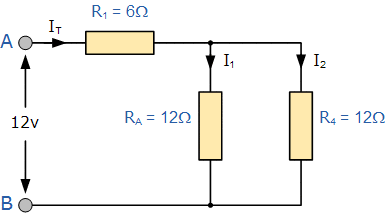
What is the total resistance (RT) across this circuit?

a)

3 kΩ

b)

10 kΩ

c)

13 kΩ

d)

18 kΩ

15.
As resistors are added in series to a circuit, the total resistance will...
a)
increase
b)
decrease
c)
stay the same
16.
As the resistance of a circuit increases, the current will...
a)
increase
b)
decrease
c)
stay the same
17.
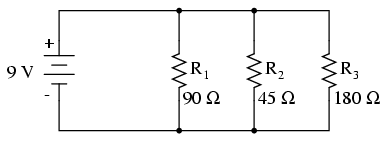
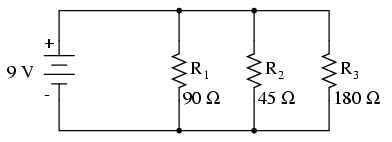
In a parallel circuit which of the following is the same value throughout the circuit?
a)
Voltage
b)
Current
c)
Resistance
d)
Charge
18.
The current going through the 45 ohm resistor is 
a)
0.05 amps
b)
0.2 amps
c)
0.1 amps
d)
5 amps
19.
The total resistance of this circuit is 
a)
25.7 ohms
b)
315 ohms
c)
324 ohms
d)
90 ohms
20.
The total current going through the battery of this circuit is
a)
0.35 amps
b)
0.0286 amps
c)
0 amps
d)
9 amps
21.
Pick the correct sentence.
a)
This circuit will work because it is a closed circuit.
b)
Energy will freely flow in this circuit.
c)
This circuit will not work because there is no energy source.
d)
This circuit will not work because there is no switch.
22.
What will happen if one light bulb is removed from this circuit?
a)
The other bulbs will go out.
b)
The other bulbs will stay on
c)
The other bulbs will get dimmer.
d)
The battery will become stronger.
23.
Does this diagram represent a series or parallel circuit?
a)
series circuit
b)
parallel circuit
24.

How many lightbulbs will work if there is a break in the circuit at POINT A?

a)

1

b)

2

c)

3

d)

NONE

25.
If the current through the battery was 10A in this diagram. What would the current through each bulb be?
a)
10A
b)
5A
c)
20A
d)
0A
26.
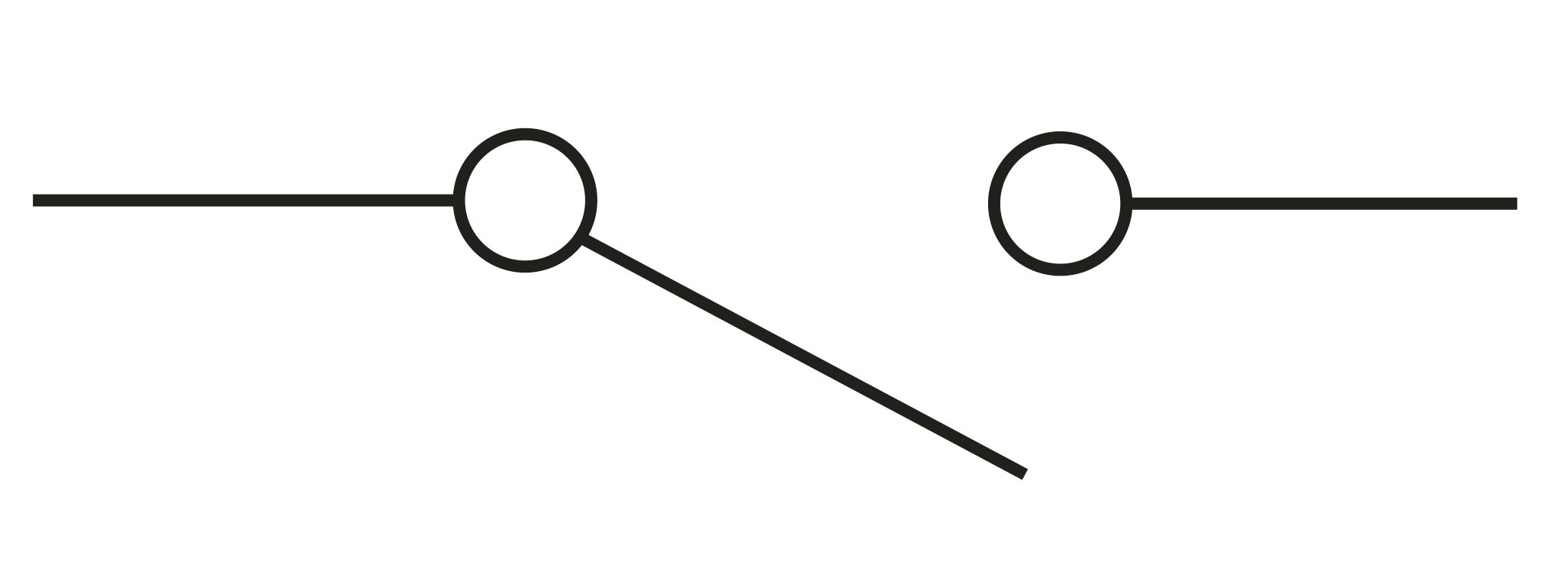
this is the symbol for a _____?
a)
switch
b)
light 
c)
battery
d)
wires
27.

A 2.0-ohm resistor and a 4.0-ohm resistor are connected in series with a 12-volt battery. If the current through the 2.0-ohm resistor is 2.0 amperes, the current through the 4.0-ohm resistor is

a)

1.0 A

b)

2.0 A

c)

3.0 A

d)

4.0 A

28.

Where should an ammeter be located to correctly measure the total current and where should a voltmeter be located to correctly measure the total voltage?

a)

ammeter at 3 and voltmeter at 4

b)

ammeter at 1 and voltmeter at 4

c)

ammeter at 2 and voltmeter at 3

d)

ammeter at 1 and voltmeter at 2

29.

The total current through this circuit is

a)

0.02 amps

b)

0.09 amps

c)

50 amps

d)

9 amps

30.

The voltage dropped across the 300 ohm resistor is

a)

6 V

b)

9 V

c)

2 V

d)

30 V

31.

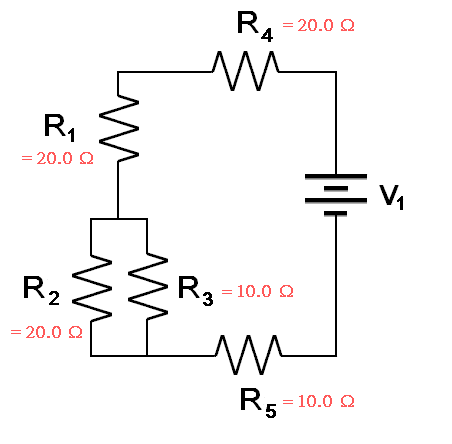
Find the total resistance.

a)

12Ω

b)

c)

18Ω

32.

What current flows through the battery? if v1= 10.2

a)

I= 0.18 A

b)

I= 0.15 A

c)

I= 1.5 A

33.

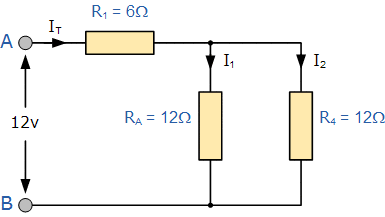
Find I total.

a)

1A

b)

2A

c)

4A

d)

12A

34.
When distance increases, electrostatic force ____________; we call this relationship ____________ proportional
a)
decreases;directly
b)
decreases;inversely
c)
increases;inversely
d)
increases;directly
35.
What variable is a Coulomb the unit for?
a)
Charge
b)
Force
c)
Distance
d)
Mass
36.
What variable do "Newtons" represent?
a)
Electrostatic Charge
b)
Force
c)
Distance
d)
Mass
37.
What happens to the force between two charged objects when you double the distance between them?
a)
2X
b)
1/2X
c)
4X
d)
1/4X
38.
What happens to the force between two charged objects if you double the distance between them and double the magnitude of one charge?
a)
4X
b)
6X
c)
1/2X
d)
1/6X
39.
If each of the charges doubles, what happens to the force?
a)
Quadruples
b)
Doubles
c)
Stays the same
d)
Reduced by half
40.
An object becomes negatively charged by
a)
losing protons
b)
gaining electrons
c)
losing electrons
d)
gaining protons
41.
An object becomes positively charged by
a)
losing protons
b)
gaining electrons
c)
losing electrons
d)
gaining protons
42.
What method of static charging is shown in this picture
a)
Polarization
b)
Friction
c)
Induction
d)
Conduction
43.
If you rub a glass rod with a piece of silk, the rod becomes positively charged. This means that
a)
friction destroyed electrons in the rod.
b)
the silk has become negatively charged.
c)
protons have moved to the rod.
d)
glass attracts more protons.
44.
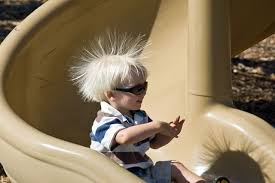
Rubbing a balloon on hair is an example of static charge build up created by....
a)
conduction
b)
friction
c)
induction
d)
hairduction
45.
A charged balloon is brought near an electroscope but DOES NOT touch the electroscope.  This is an example of charging by
a)
Conduction
b)
Convection
c)
Friction
d)
Induction
46.

A kettle has a power rating of 2kW, if it's left on for 6 hours, how many units of electricity does it use?

a)

10

b)

3

c)

12

d)

24

47.

Calculate the power generated as a 20 A current flows through a 10Ω resistor?

a)

2 W

b)

200 W

c)

4000 W

d)

400 W

48.
What is the power of a 20V bulb with 5A through it?
a)
100W
b)
100V
c)
6.3W
d)
6.3A
49.
Is Iron a Conductor or Insulator?
a)
Conductor
b)
Insulator
50.
Which is NOT an insulator.
a)
Wool
b)
Plastic
c)
Copper
d)
Glass
51.
Is Wood a conductor or Insulator?
a)
Conductor
b)
Insulator
52.
What is the difference between a conductor and an insulator?
a)
An insulator allows electricity to flow through it easily and a conductor does not
b)
A conductor allows electricity to flow through it easily and an insulator does not.
c)
An insulator is magnetic and a conductor is not
d)
A conductor is magnetic and an insulator is not
53.
The unit of measurement for electric current
a)
voltage
b)
current
c)
ampere
d)
discharge
54.
An object becomes negatively charged by
a)
losing protons
b)
gaining electrons
c)
losing electrons
d)
gaining protons
55.
An object becomes positively charged by
a)
losing protons
b)
gaining electrons
c)
losing electrons
d)
gaining protons
56.
A subatomic particle that has a negative charge
a)
electron
b)
proton
c)
ion
d)
neutron
57.
This is the symbol for a _____?
a)
switch
b)
light 
c)
battery
d)
wires
58.
This is the symbol for a _____?
a)
an AC current source
b)
a DC current source
c)
a battery
d)
a single cell
59.

Calculate current if a charge of 10 Coulombs flows past a point in 5 seconds

a)

2 Amps

b)

50 Amps

c)

0.5 Amps

60.

Where would you place a voltmeter in the circuit?

a)

Green ?

b)

Red ?

61.

the formula to find current when the values of V and R are known is

a)

I = V2R

b)

I = V/R

c)

I = R/V

d)

I=VR

62.
a)
A2 = A3
b)
A2 + A3 = A1
c)
A1 + A2 = A3
d)
A4 = A2 - A3
63.

What is the missing value on the ammeter?

(a)  

64.

What is the missing value on the voltmeter?

(a)  

65.

What is the reading on the voltmeter around the cell?

(a)