wayground logo

Free Printable Worksheets

NEW

Font size

S
M
L
XL
Worksheets

Midterm Lab Practical 1121

Total questions: 80

Worksheet time: 1hrs 20mins
Name
Class
Date
1.
What organ transports sugar throughout the plant
a)
Phloem
b)
Stomata
c)
Guard cells
d)
Cambium
2.
The water needed for photosynthesis comes into the leaves through the
a)
upper epidermis
b)
stomata
c)
guard cells
d)
xylem cells
3.
The important gases, carbon dioxide and oxygen, enter and leave the leaf through the
a)
upper epidermis
b)
phloem
c)
stomata
d)
guard cells
4.
Which structures open and close stomata to allow gas exchange but prevent water loss in leaves?
a)
Epidermis
b)
Vascular tissue
c)
Guard cells
d)
Spongy mesophyll
5.
Which structure helps prevent water loss and protects the leaf?
a)
Palisades mesophyll
b)
Spongy mesophyll
c)
Vascular tissue
d)
Cuticle
6.

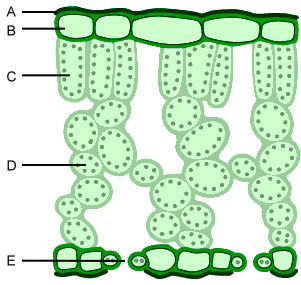
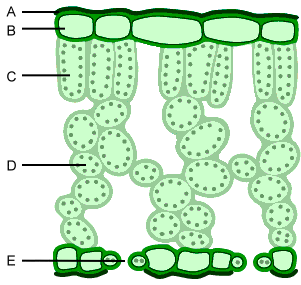
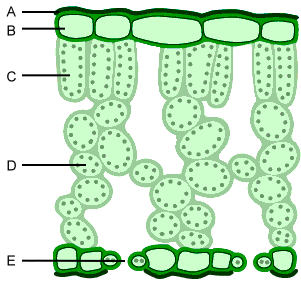
What is letter "A" pointing to?

a)

cuticle

b)

upper epidermis

c)

lower epidermis

d)

palisade mesophyll

7.

What is letter "D" pointing to?

a)

upper epidermis

b)

palisade mesophyll

c)

spongy mesophyll

d)

bundle sheath

8.

Which number is pointing to the xylem of the leaf?

a)

3

b)

4

c)

5

d)

6

9.

Which of the following is pointing to the "guard cell"?

a)

B

b)

C

c)

D

d)

E

10.

Which part of the leaf consists of xylem and phloem?

a)

vascular bundle

b)

bundle sheath

c)

palisade mesophyll

d)

spongy mesophyll

11.

Which part of the leaf consists of xylem and phloem?

a)

vascular bundle

b)

bundle sheath

c)

palisade mesophyll

d)

spongy mesophyll

12.

The outermost layer of CELLS of the leaf is the

a)

cuticle

b)

epidermis

c)

spongy mesophyll

d)

bundle sheath

13.
Which of the following organisms are LEAST closely related?
a)
organisms that share a domain
b)
organisms that share a family 
c)
organisms that share a genus 
d)
organisms that share a species 
14.
Who first proposed binomial nomenclature as a way of classifying organisms?
a)
Carl Linnaeus
b)
Carl's Jr.
c)
Charles Darwin
d)
Henry Groseclose
15.
Cells that do not have a true nucleus are called....
a)
eukaryote
b)
prokaryote
c)
unicellular
d)
multicellular
16.
Organisms in this smallest taxonomic group share many characteristics.
a)
domain
b)
kingdom
c)
species
d)
class
17.
The science of describing, classifying, and naming living things is called:
a)
Geology
b)
Biology
c)
Taxonomy
d)
Chemistry
18.

Members of this kingdom are always multicellular and heterotrophic.

a)

Plantae

b)

Protista

c)

Animalia

d)

Achaebacteria

19.

In what kingdom do unicellular, prokaryotic organisms that live in extreme environments belong?

a)

Animal

b)

Archaea

c)

Bacteria

d)

Plant

20.

I am prokaryotic and am found everywhere that's not extreme. What kingdom do I belong to?

a)

Bacteria

b)

Archaea

c)

Fungi

d)

Protista

21.

Modern Classification (Phylogeny) adds what to Linnaeus's taxonomic criteria?

a)

evolutionary relationships & DNA (biochemical characters)

b)

habitat type

c)

fewer categories than Linnaeus

d)

a naming system called binomial nomenclature

22.

What makes the Protist Kingdom (Kingdom Protista) different from all other kingdoms?

a)

It's the only eukaryotic kingdom

b)

Its members aren't very similar to one another

c)

It is the only unicellular kingdom

d)

It's the only kingdom that has viruses

23.

The endosymbiotic theory is a way of explaining

a)

how eukaryotic cells evolved from prokaryotic cells

b)

how prokaryotic cells came from eukaryotic cells

c)

how mitochondria & chloroplasts are really the same thing

d)

how prokaryotic cells got their nucleus

24.

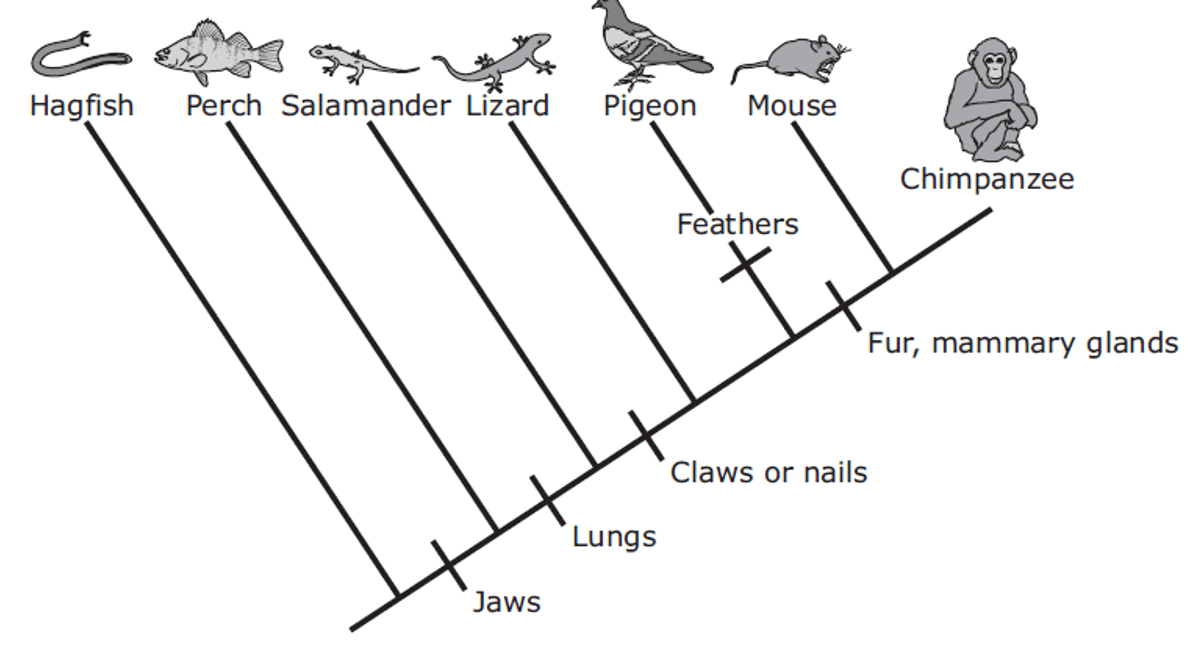
Which trait do only humans have, according to the cladogram?

a)

jaws

b)

mammary glands & hair

c)

terrestrial during all life stages

d)

bipedal & opposable thumbs

25.

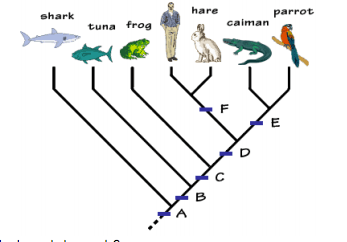
On the cladogram, which organism is the closest relative of the parrot?

a)

Frog

b)

Hare

c)

Caiman

d)

Parrot

26.
All the animals to the right of the hagfish would have the common characteristic of -
a)
Fur
b)
Claws or nails
c)
Lungs
d)
Jaws
27.
Cladograms are constructed by grouping organisms together based on their____________ characteristics.
a)
shared
b)
different
c)
similar
d)
opposite
28.

A common ancestor for both A and E could be at position __.

a)

1

b)

2

c)

3

d)

4

29.

What type of structures are shown?

a)

Homologous

b)

Analogous

c)

Vestigial

d)

Heterologous

30.

What type of structures are shown?

a)

Homologous

b)

Analogous

c)

Vestigial

d)

Heterologous

31.

Which process is most likely responsible for the changes that have led to the increased size, strength, and speed in horses?

a)

natural selection

b)

migration

c)

inbreeding

d)

commensalism

32.

What type of structures are shown?

a)

Homologous

b)

Analogous

c)

Vestigial

d)

Heterologous

33.

Which of the following is not considered a VESTIGIAL structures in humans.

a)

coccyx

b)

appendix

c)

wisdom teeth

d)

kidneys

34.
which of the folllowing is an exammple of a vestigial structure?
a)
the wings of a red-tailed hawk
b)
the hind limbs of a house cat
c)
the fins of sharks
d)
the wings of an ostrich
35.
Two organisms that are closely related would have
a)
very similar DNA sequence
b)
exactly the same DNA sequences
c)
no proteins in common
d)
completely different DNA sequence
36.
Darwin’s finches is an example of this type of evolution.
a)
Divergent
b)
Coevolution
c)
Convergent
d)
Artificial
37.
Wings of a bat and wings or an insect are an example of this…
a)
Homologous Structure
b)
Analogous Structure
c)
Vestigial Structure
d)
None of the above
38.

What does it mean when organisms share a common ancestor?

a)

They evolved from 1 species that lived in the past

b)

They are the same species

c)

The organisms have exactly the same traits

d)

The organisms are very different from one another

39.
If an organism has a vestigial structure, that structure likely once had a function in a(n)
a)
close relative
b)
early ancestor
c)
unrelated organism
d)
embryological stage
40.
What part of a seed is the arrow pointing to?
a)
seed coat
b)
embryo
c)
cotyledon (food)
41.
What part of a seed is the arrow pointing to?
a)
seed coat
b)
embryo
c)
cotyledon (food)
42.
Is this plant flowering or nonflowering?
a)
flowering
b)
nonflowering
43.
Nonflowering plants make their seeds through what 2 things?
a)
cones & spores
b)
flowers & plants
c)
plants & cones
d)
spores & flowers
44.
Flowering plants make their seeds inside of what?
a)
cones
b)
flowers
c)
spores
d)
plants
45.
Which is not an example of a flowering plant?
a)
roses
b)
oak trees
c)
mosses
d)
tomato plants
46.

Most bryophytes are only a few centimetres tall because they lack

a)

vascular tissues

b)

reproductive organs

c)

stems

d)

leaves

47.

The haploid form of the life cycle of a plant, characterized by ‘alternation of generation’ is called

a)

seed

b)

embryo

c)

sporophyte

d)

gametophyte

48.
What do spores become after they are released from sporophytes?
a)
liverworts
b)
rhizoids
c)
cryptophobic
d)
gametophytes
49.
In bryophytes' life cycle, how does a sperm cell get to an egg cell? 
a)
through the help of water 
b)
through self-pollination
c)
through cross-pollination
d)
through the help of the wind
50.
Gametophytes are __.
a)
haploid
b)
diploid
51.
The generation of a non-vascular plant that produces the spores is called the...
a)
gametophyte
b)
sporophyte
c)
protonema
d)
rhizoid
52.

which is an example of a seedless, vascular plant

a)

angiosperm

b)

evergreen

c)

oak

d)

fern

53.
Which protist is this?
a)
Amoeba
b)
Paramecium
c)
Plasmodium
54.
Which protist is this?
a)
Euglena
b)
Plasmodium
c)
Water mold
d)
Algae
55.
How do amoebas move?
a)
Flagella
b)
Cytoplasmic streaming (psuedopods)
c)
Cilia
56.
How do paramecium move?
a)
Cilia
b)
Flagella
c)
Cytoplasmic streaming (psuedopods)
57.
Protist belong to which Domain?
a)
Eukarya
b)
Bacteria
c)
Archaea
58.
Protist?
a)
Euglena
b)
Paramecium
c)
Amoeba
d)
Volvox
59.

Identify the contractile vacuole.

a)

Structure 1

b)

Structure 3

c)

Structure 4

d)

Structure 5

e)

Structure 6

60.

What type of protist is this?

a)

euglena

b)

volvox

c)

paramecium

d)

amoeba

61.

Which two protists can make their own food?

a)

amoeba, paramecium

b)

volvox, euglena

c)

euglena, amoeba

d)

paramecium, volvox

62.

Which two protists ingest their food to get energy?

a)

amoeba, paramecium

b)

volvox, euglena

c)

euglena, amoeba

d)

paramecium, volvox

63.
What is the role of the eye spot on the Euglena?
a)
It allows the Euglena to swim towards the light.
b)
Movement
c)
Scoops up food as it swims along.
d)
To preform photosynthesis
64.
Which protist is often found in colonies? 
a)
Volvox
b)
Amoeba
c)
Euglena
d)
Paramecium 
65.

Trichonympha is a zooflagellate that

a)

causes African Sleeping Sickness

b)

behaves like algae

c)

invades red blood cells in malaria

d)

breaks down cellulose in the gut of a termite

66.

The protozoan that causes malaria and is carried by the Anopheles mosquito is

a)

Trypanosoma

b)

Plasmodium

c)

Giardia

d)

Trichonympha

67.

Trypanosoma is a zooflagellate that causes

a)

African Sleeping Sickness and is carried by the tse tse fly.

b)

hiker's disease and is carried by snails.

c)

malaria and is carried by the Anopheles mosquito.

d)

bubonic plague and is carried by fleas.

68.

What is pictured here?

a)

Member of Archaeplastida

b)

Brown Algae (Sargassum)

c)

a nonvascular protist

d)

all of the above

69.

The dominant phase in the life cycle of a moss is the:

a)

diploid gametophyte

b)

diploid sporophyte

c)

haploid gametophyte

d)

haploid sporophyte

70.

The dominant phase of a pine tree is the:

a)

diploid sporophyte

b)

diploid gametophyte

c)

haploid sporophyte

d)

haploid gametophyte

71.

Pine trees are capable of producing:

a)

flowers

b)

seeds

c)

fruits

d)

both flowers and seeds

72.
The male part of the flower is known as the _____.
a)
stamen
b)
pistil
c)
ovary
d)
petal
73.
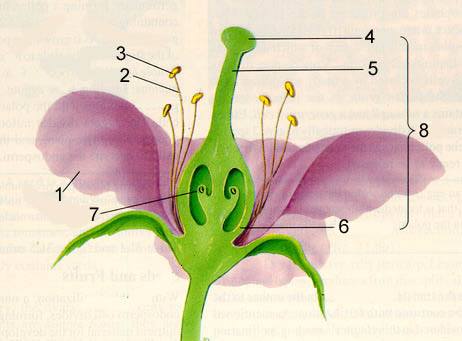
What is #3 pointing to?
a)
stigma
b)
filament
c)
ovary
d)
anther
74.
What is #4 pointing to?
a)
anther
b)
style
c)
stigma
d)
ovary
75.
What is #6 pointing to?
a)
stigma
b)
style
c)
ovary
d)
petal
76.
Where is pollen made?
a)
ovary
b)
petal
c)
pistil
d)
anther
77.
What is the sticky part of the flower that catches pollen?
a)
style
b)
stigma
c)
ovary
d)
petal
78.
What part of the flower will turn into a fruit?
a)
petal
b)
ovary
c)
ovule
d)
stamen
79.

What is letter "A" in the image?

a)

Pistil

b)

Stamen

c)

Sepal

d)

Petal

80.

The image shows:

a)

immature female cones

b)

male cones

c)

pine tree fruit

d)

exotic pine tree flower