wayground logo

Free Printable Worksheets

Font size

S
M
L
XL
Worksheets

Plate Tectonics

Total questions: 146

Worksheet time: 2hrs 25mins

Name
Class
Date
1.

What does the theory of Continental Drift explain?

a)

Ocean currents move continents around the planet

b)

Convection works deep within the asthenosphere

c)

Mid-ocean ridges force tectonic plates to move

d)

Continents were once together and slowly drifted to where they are today

2.

Tectonic plates are made of?

a)

The mantle

b)

Continental and oceanic lithosphere

c)

The outer core

d)

The mesosphere

3.

Where are the youngest rocks on Earth found?

a)

Along mid-ocean ridges

b)

Along transform boundaries

c)

On the edges of the continents

d)

Near ocean trenches

4.

Who was the scientist who proposed the theory of continental drift?

a)

Alfred Powell

b)

Harry Hess

c)

Alfred Wegener

d)

Ernest Rutherford

5.

Where does seafloor spreading take place?

a)

Convergent boundaries

b)

The continentals shelves

c)

Transform boundary

d)

Mid-ocean ridges

6.

What is the driving force behind the movement of the tectonic plates?

a)

Gravity

b)

Convection

c)

Wave motion

d)

Seismic activity

7.

The super continent that existed when all continents were together was named

a)

Gondwana

b)

Laurasia

c)

Eurasia

d)

Pangea

8.

What is the process of convection?

a)

The process of hot material rising and cooler material sinking in circular patterns

b)

The process of hot rock solidifying and forming new crust

c)

The process of explaining what goes up must come down

d)

Strong ocean currents moving tremendous amounts of material

9.

This type of boundary creates rift zones and shallow earthquakes

a)

Transform

b)

Continental-Continental Convergent

c)

Divergent

d)

Oceanic-Continental Convergent

10.

At this boundary plates slide past one and other and earthquakes are created

a)

Transform

b)

Continental-Continental Convergent

c)

Divergent

d)

Oceanic-Continental Convergent

11.

At this boundary, old crust is destroyed and deep earthquakes occur

a)

Transform

b)

Continental-Continental Convergent

c)

Divergent

d)

Oceanic-Continental Convergent

12.
The physical layer of Earth made of solid rock and soil is called the ___________. 
a)
mesosphere
b)
lithosphere
c)
asthenosphere
d)
mantle
13.
The type of plate boundary where two plates come together is a .....
a)
Convergent Boundary
b)
Divergent Boundary
c)
Transform Boundary
d)
Plate Boundary
14.
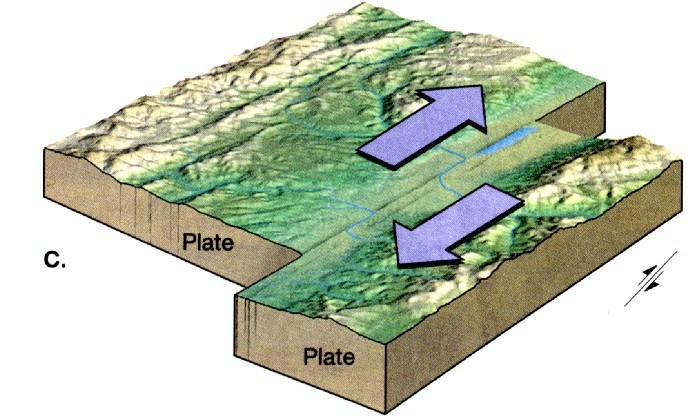
What type of plate boundary is this?
a)
Plate
b)
Divergent
c)
Convergent
d)
Transform
15.
Which of the following causes Earth's tectonic plates to move?
a)
Energy from the Sun
b)
Magnetic Pole Reversal
c)
Convection currents in the mantle
d)
Faults in Mountain Ranges
16.
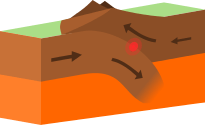
What type of event will occur at this boundary?
a)
Earthquake
b)
Volcano Eruption
c)
Tornado
d)
Mountain Building
17.
A divergent boundary occurs when plates ....
a)
Pull apart
b)
Come together
c)
Slide past each other
d)
subducting
18.
What type of plate boundary is this?
a)
Transform
b)
Convergent
c)
Divergent
d)
Plate
19.
Oceanic Trenches are formed by _______ plate boundaries
a)
Convergent
b)
Transform
c)
Plate
d)
Divergent
20.
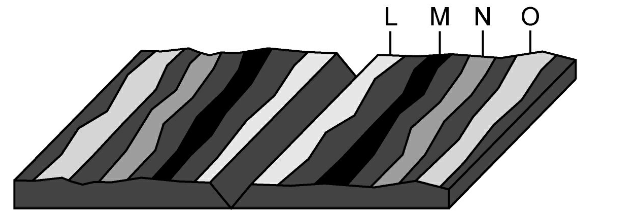
Where would the oldest rock be found?
a)
L
b)
M
c)
N
d)
O
21.
Islands can from from magma which is pushed up at a __________ plate boundary
a)
Divergent
b)
Convergent
c)
Transform
22.
How is it possible for new crust to be formed without increasing the surface area of the Earth?
a)
Crust is destroyed at the same time it is created
b)
New crust is underwater where it sinks
c)
New crust breaks more easily than old crust
23.
Mountains are created when....
a)
Two continental plates collide
b)
Two oceanic plates pull apart
c)
An Oceanic plate subducts under a Continental Plate
d)
Two continental plates pull apart
24.

What type of event will occur at this boundary?

a)

Earthquake

b)

Volcano Eruption

c)

Tornado

d)

Mountain Building

25.

Which of the following causes Earth's tectonic plates to move?

a)

Energy from the Sun

b)

Magnetic Pole Reversal

c)

Convection currents in the mantle

d)

Faults in Mountain Ranges

26.

The type of plate boundary where two plates come together is a .....

a)

Convergent Boundary

b)

Divergent Boundary

c)

Transform Boundary

d)

Plate Boundary

27.

A divergent boundary occurs when plates ....

a)

Pull apart

b)

Come together

c)

Slide past each other

d)

subducting

28.

Mountains are created when....

a)

Two continental plates collide

b)

Two oceanic plates pull apart

c)

An Oceanic plate subducts under a Continental Plate

d)

Two continental plates pull apart

29.

The Great Rift Valley in Africa and the Mid-Ocean Ridge were all created by this boundary

a)

Divergent

b)

Convergent

c)

Reform

d)

Transform

30.

Which of these events can ONLY happen on a DIVERGENT BOUNDARY?

a)

Rift Valley

b)

Mountain

c)

A peninsula

d)

An Insanely complex, long answer that you will click out of instinct.

31.

The tectonic plates float on the

a)

lithosphere

b)

lower mantle

c)

outer core

d)

asthenosphere

32.

What occurs when two plates come together and the denser one is forced under back into the mantle?

a)

reduction

b)

conduction

c)

subduction

d)

convection

33.

Most geologists rejected Alfred Wegener's idea of continental drift because...

a)

it did not agree with their current theory

b)

Wegener was interested in what Earth was like millions of years ago

c)

Wegener used several different types of evidence to support his hypothesis

d)

Wegener could not identify the force that moved the continents

34.

What geologic process formed the Himalayas?

a)

two continental plates converging

b)

an earthquake in a subduction zone

c)

a tectonic plate moving over a hot spot

d)

movement at a transform fault boundary

35.

Earth's plates meet at ____________.

a)

plate tectonics

b)

plate boundaries

c)

continental drift

d)

oceans

36.

Breaks in the crust called __________ form where plates meet.

a)

mountains

b)

rift valleys

c)

faults

d)

trenches

37.

Plates slide past each other at _________________ boundaries.

a)

divergent

b)

convergent

c)

transform

d)

universal

38.

Plates slide apart along _____________ boundaries.

a)

convergent

b)

divergent

c)

transform

d)

universal

39.

________________ currents drive Earth's plate movement.

a)

ocean

b)

atmosphere

c)

wind

d)

convection

40.

________________ currents drive Earth's plate movement.

a)

ocean

b)

atmosphere

c)

wind

d)

convection

41.

Which theory describes the motion of the force driving Earth's Plates?

a)

continental drift

b)

plate tectonics

c)

first law of motion

d)

third law of motion

42.

What is the motion of Earth's plates like?

a)

fast and in stages

b)

slow and in stages

c)

fast and constant

d)

slow and constant

43.

The San Andreas fault is an example of which type of boundary?

a)

transform

b)

divergent

c)

convergent

d)

universal

44.

Which feature forms at convergent boundaries?

a)

trench

b)

rift valley

c)

mountain range

d)

mid-ocean ridge

45.

What type of plate boundary is shown in the picture?

a)

Convergent

b)

Divergent

c)

Transform

46.

What type of plate boundary is shown in the picture?

a)

Convergent

b)

Divergent

c)

Transform

47.

What landform would you most likely find at a divergent boundary between two pieces of oceanic crust?

a)

Rift Valley

b)

Mountain

c)

Mid-Ocean Ridge

d)

Volcano

48.

What landform would you most likely find at a convergent boundary between two pieces of oceanic crust?

a)

Rift Valley

b)

Mid-Ocean Ridge

c)

Mountain

d)

Ocean Trench

49.

Which type of boundary do plates move away from each other?

a)

Convergent

b)

Divergent

c)

Transform

50.

When one tectonic plate sinks under another, this is called...

a)

Convegent

b)

Divergent

c)

Subduction

d)

Transform

51.

Plates slide past one another at ____ boundaries.

a)

Convergent

b)

Divergent

c)

Transform

52.

When plates collide together, this boundary occurs...

a)

Convergent

b)

Divergent

c)

Transform

53.

Boundary between two colliding plates, often associated with mountain building, ocean trenches and volcanic islands

a)

plate boundary

b)

magma

c)

divergent boundary

d)

convergent boundary

54.

the region where an oceanic plate sinks down into the asthenosphere at a convergent boundary, usually between continental and oceanic plates

a)

subduction zone

b)

lava zone

c)

nitrogen zone

d)

continental zone

55.

where two plates are moving apart, magma comes up to create new crust

a)

lithosphere

b)

trench

c)

ridge

d)

magma

56.

A long narrow deep depression in the ocean bed

a)

ridge

b)

fault

c)

trench

d)

rift

57.

A deep crack in the Earth's surface associated with divergent boundary

a)

lava

b)

rift

c)

ridge

d)

trench

58.

Circular currents in the mantle caused by the magma being heated by the core off the Earth.

a)

convection currents

b)

lava

c)

magma

d)

hot air

59.

formed by two continental plates colliding and forcing each other upwards during convergent boundary

a)

grassland

b)

mountain ranges

c)

snow

d)

trench

60.

What boundary do the plates scrap across each other?

a)

Subduction

b)

Buckling

c)

Transform

d)

Divergent

61.

What type of boundary is it when the plates go towards each other and go up?

a)

Transform

b)

Divergent

c)

Subduction

d)

Buckling

62.

What causes the movement of tectonic plates?

a)

ocean currents

b)

Earth's magnetic field

c)

uneven heating of Earth's asthenosphere

d)

uneven heating by Earth's inner core

63.
The image illustrates what type of boundary?
a)
Divergent
b)
Convergent
c)
Transform
d)
Emergent
64.
The image illustrates what type of boundary?
a)
Divergent
b)
Convergent
c)
Transform
d)
Emergent
65.
The image illustrates what type of boundary?
a)
Divergent
b)
Convergent
c)
Transform
d)
Emergent
66.
As you approach the center of the earth what happens to the temperature, pressure , and density.
a)
They all increase
b)
They all decrease
c)
They remain the same
d)
They disappear
67.
Which layer is molten nickel and iron?
a)
Crust
b)
Mantle
c)
Outer core
d)
Inner core
68.
Which layer is solid nickel and iron?
a)
Crust
b)
Mantle
c)
Outer core
d)
Inner core
69.
Which layer is the thinnest?
a)
Crust
b)
Mantle
c)
Outer core
d)
Inner core
70.
Which layer includes the crust and the upper mantle?
a)
Asthenosphere
b)
Lithosphere
c)
Mesosphere
71.
What is the correct order from the center of the earth to the surface of the earth?
a)
Crust, Mantle, Inner core , Outer core
b)
Crust, Mantle, Outer core , Inner core
c)
Inner core, Outer core, mantle, crust
d)
Outer core , Inner core, Mantle, Crust
72.
A reverse fault occurs because of 
a)
tension
b)
compression
c)
shearing
73.

Earth is composed of layers of material with different properties. Which of the following is most likely to contain material that is in constant motion?

a)

inner core

b)

mantle

c)

outer core

74.

Lithospheric plates have moved to form land formations on Earth’s surface. Which land formation occurs as a result of the plates folding upon one another?

a)

a river

b)

a volcano

c)

an earthquake

d)

a mountain range

75.

In the region where two continental plates collide, what geological feature most often forms?

a)

an ocean

b)

a volcano

c)

a river valley

d)

a mountain chain

76.

During subduction, one tectonic plate is forced below another. The subducting plate is forced into the

a)

mantle

b)

crust

c)

outer core

d)

inner core

77.

The Hawaiian Islands are in the middle of a large tectonic plate with many volcanoes. The volcanoes are the direct result of the tectonic plate

a)

being forced under another tectonic plate at a subduction zones.

b)

colliding with one another tectonic plate and being forced upward.

c)

moving over a hot spot where magma breaks through the crust.

d)

applying great pressure on the crust causing constant earthquakes.

78.

Crustal plates that pull apart from one another most likely form

a)

volcanic island arcs.

b)

strike-slip faults.

c)

mid-ocean ridge.

d)

rift zones

79.

The first person to introduce the idea of the continents moving around the surface of Earth was

a)

Neils Bohr

b)

Albert Einstein

c)

Charles Darwin

d)

Alfred Wegener

80.

This image here shows what type of boundary?

a)

Divergent

b)

Convergent: Subduction

c)

Convergent: Collision

d)

Transform

81.

What kind of boundary is shown in this image?

a)

Divergent

b)

Convergent: Subduction

c)

Convergent: Collision

d)

Transform

82.
These plate boundaries pushes and collides toward other plate boundaries.
a)
Transform
b)
Continental
c)
Divergent
d)
Convergent
83.
Which layer of the Earth are the tectonic plates located?
a)
Mantle
b)
Lithosphere
c)
Asthenosphere
d)
Outer Core
84.
These plate boundaries slide and grind past one another
a)
Transform
b)
Continental
c)
Divergent
d)
Convergent
85.
The most explosive Volcanoes can be found along these plate boundaries.
a)
Transform
b)
Continental
c)
Divergent
d)
Convergent
86.
These plate boundaries pull apart creating rift valleys and mid ocean ridges.
a)
Transform
b)
Continental
c)
Divergent
d)
Convergent
87.
Subduction occurs with this plate boundary. 
a)
Transform
b)
Continental
c)
Divergent
d)
Convergent
88.
Alfred Wegener's Theory
a)
Seismic Waves
b)
Continental Drift
c)
Plate Tectonics
d)
Convection Currents
89.
Earthquakes are most likely to form along these plate boundaries.
a)
Transform
b)
Continental
c)
Divergent
d)
Convergent
90.
These plate boundaries pull apart.
a)
transform
b)
Continental
c)
Divergent
d)
Convergent
91.
These plates transport land masses.
a)
Transform
b)
Continental
c)
Divergent
d)
Convergent
92.
Pangea was a 
a)
Supercontinent
b)
Convergent Boundary
c)
Hoax
d)
Continental Boundary
93.
The Lithospheric Plates move due to a process in the mantle called... 
a)
Pressure
b)
Seismic Waves
c)
Convection
d)
Subduction
94.
A break in Earth's crust along which rocks move is called a ________.
a)
plate
b)
rift
c)
fault
d)
breach
95.
The process by which molten material adds new oceanic crust to the ocean floor is called ___________.
a)
Divergent boundary
b)
Sea-floor spreading
c)
Convergent boundary
d)
Renovating 
96.
What is the process by which oceanic crust sinks beneath a deep-ocean trench and back into the mantle at a convergent plate boundary?
a)
Subduction
b)
Induction
c)
Abduction 
d)
Reduction
97.
___________ is the theory that pieces of Earth's lithosphere are in constant motion, driven by convection currents in the mantle.
a)
Seismic waves
b)
Convection current
c)
Divergent boundary
d)
Plate tectonics
98.

What type of event will occur at this boundary?

a)

Earthquake

b)

Volcano Eruption

c)

Tornado

d)

Mountain Building

99.

Which of these events can ONLY happen on a DIVERGENT BOUNDARY?

a)

Rift Valley

b)

Mountain

c)

A peninsula

d)

An Insanely complex, long answer that you will click out of instinct.

100.
Where would the oldest rock be found?
a)
L
b)
M
c)
N
d)
O
101.
If we were in a plane, Path B --> C is about the same distance as path E --> N. But, which path is the easier walk? 
a)
B --> C is the easier walk
b)
E --> N is the easier walk
c)
B --> C and E --> N are the same walking distance
102.

Divergent plates move _______ each other.

a)

away from

b)

towards

c)

underneath of

d)

over-top of

103.

If a process builds up the Earth's surface it is _________.

a)

Destructive

b)

Constructive

104.

Which 2 can be directly formed from plate movement?

a)

Mid-Ocean Ridges

b)

Sand Dunes

c)

Mountains

d)

Coral Reefs

105.

_________ explain the heat flow and movement of molten rock within the interior of the Earth.

a)

Continental Drift

b)

Convection Currents

c)

Plate Tectonics

d)

Gravity

106.

Earth's lithospheric plates only move occasionally.

a)

True

b)

False

107.

Convergent plates form mountains as well as __________.

a)

Valleys

b)

Rifts

c)

Volcanoes

d)

Sand Dunes

108.

Volcanic islands form when ____________.

a)

two oceanic plates converge.

b)

two continental plates converge.

c)

one ocean and one continental plate converge.

109.
What are the two basic types of plates on earth?
a)
oceanic and atmospheric
b)
continental and oceanic
c)
continental and magnetic
d)
oceanic and divergent
110.
The surface of the Earth is broken up into pieces called
a)
tectonic plates
b)
continental sections
c)
boundaries
d)
faults
111.
A mid-ocean ridge is formed at which type of boundary?
a)
Convergent
b)
Transform
c)
Subduction
d)
Divergent
112.
Who is the person credited with developing the theory of continental drift?
a)
Harry Hess
b)
Galileo
c)
Alfred Wegener
d)
Newton
113.
Plate movement is caused by ______________.
a)
the rotation of the Earth
b)
ocean tides
c)
convection currents in the mantle
d)
the moon's gravity
114.
The crust of the Earth like a . . . . 
a)
broken jar
b)
peeled orange
c)
cracked hard boiled eggg
d)
cracked glass
115.
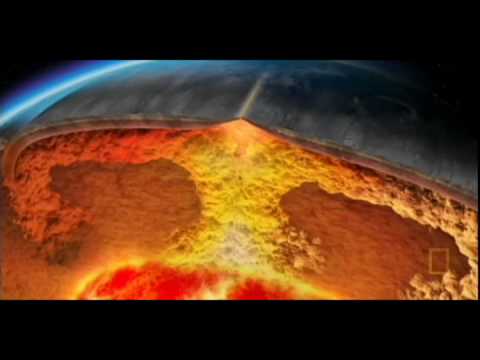
The force behind plate tectonics is . . . . (the answer is in the picture)
a)
magma
b)
convection current
c)
lava
d)
volcanoes
116.
How many major tectonic plates are there? (Look @ the picture)
a)
5
b)
8
c)
6
d)
7
117.
Plate boundaries are . . . . 
a)
Colliding
b)
Spreading
c)
Sliding
d)
All the above
118.
The name for tectonics of the future was _____________________?
a)
Pangaea
b)
Gondwanaland 
c)
Laurasia
d)
Pangaea Ultima
119.
The theory of Pangaea Ultima believes that the surface of the Earth will ______________
a)
continue to be seperated
b)
come back together
c)
travel to opposite poles (North & South) 
d)
collide into smaller pieces.  
120.
What is Pangaea Ultima?
a)
Continental Drift
b)
Continental Drift in Reverse
c)
Gondwana & Laurasia 
d)
A Baby Panda
121.
Read and answer.
a)
A
b)
B
c)
C
d)
D
122.
Read and answer.
a)
A
b)
B
c)
C
d)
D
123.
Which plate boundary creates trenches and volcanic islands? 
a)
Transform
b)
Divergent
c)
Convergent
d)
Convection
124.
Read and answer.
a)
Ana
b)
Carol
c)
Jose
d)
Peter
125.
What caused the change in the island?
a)
A
b)
B
c)
C
d)
D
126.
Which two plates have a transform plate boundary?
a)
North American & South American Plates
b)
Indo-Australian & Eurasian Plates
c)
Pacific Plate & Antarctic Plates
d)
North American & Pacific Plates
127.

A section of the lithosphere that slowly moves over the asthenosphere, carrying large slabs of continental and oceanic crust.

a)

Pangaea

b)

Plate

c)

Continent

d)

Crust

128.

A break (crack) in Earth's crust along which rocks move.

a)

Boundary

b)

Rift

c)

Fault

d)

Canyon

129.

A deep valley along the ocean floor beneath which oceanic crust slowly sinks toward the mantle.

a)

Subduction

b)

Deep-ocean trench

c)

Rift

d)

Crater

130.
Scientists think that convection currents that move the plates flow in Earth's
a)
Mesosphere
b)
Outer core
c)
Asthenosphere
d)
Lithosphere
131.
What type of boundary is the SAN ANDREAS FAULT on?
a)
Covergent Boundary
b)
Transformers
c)
Divergent Boundary
d)
Transform Boundary
132.
Where does the heat come from that drives this convection current in the mantle? 
a)
The sun
b)
Electricity
c)
the mantle
d)
the core
133.
What type of plate boundary is this?
a)
Plate
b)
Divergent Boundary
c)
Convergent Boundary
d)
Transform Boundary
134.
This landform can occur at a divergent plate boundary.
a)
ocean trench
b)
Mid-ocean ridge
c)
tall mountains
d)
transform fault
135.
The mantle of Earth is made partly of magma. When magma rises and sinks, this is called ______________. 
a)
a conduction current
b)
a hot spot
c)
a volcanic eruption
d)
a convection current
136.
A divergent boundary occurs when plates ....
a)
Pull apart
b)
Come together
c)
Slide past each other
d)
subducting
137.
When an oceanic plate and a continental plate collide, which one will subduct?
a)
oceanic
b)
continental
c)
bread crust
138.

This famous fault in California has a lot of earthquakes!

a)

New Madrid

b)

Denali Fault

c)

Ramapo Seismic Zone

d)

San Andreas Fault

139.
Lava that is still deep inside the earth is called ____________________________.
a)
lava
b)
magma
c)
volcano
d)
earthquake
140.

What type of boundary is shown in the diagram?

a)

Divergent

b)

Convergent

c)

Transform

141.

What type of boundary is shown in the diagram?

a)

Divergent

b)

Convergent

c)

Slide/Transform

142.

What type of boundary is shown in the diagram?

a)

Divergent

b)

Convergent

c)

Slide/Transform

143.
Mountains form from....
a)
Tectonic plates sliding past one another
b)
Collision of tectonic plates
c)
Tectonic plates moving away from each other
d)
Tectonic plates disappearing
144.
What was the name given to all the continents when they were joined as one super continent?
a)
Supreme Continent
b)
Eurasia
c)
Plate tectonics
d)
Pangea
145.
This is the driving force behind the movement of tectonic plates.
a)
Mantle convection currents
b)
Oceanic convection currents
c)
Atmospheric convection currents
d)
Solar convection currents
146.
 A land feature that is produced at a convergent boundary is
a)
a valley
b)
an ocean
c)
a canyon
d)
a volcano