
 Worksheets
3/6 Chemistry Review
Total questions: 30
Worksheet time: 38mins
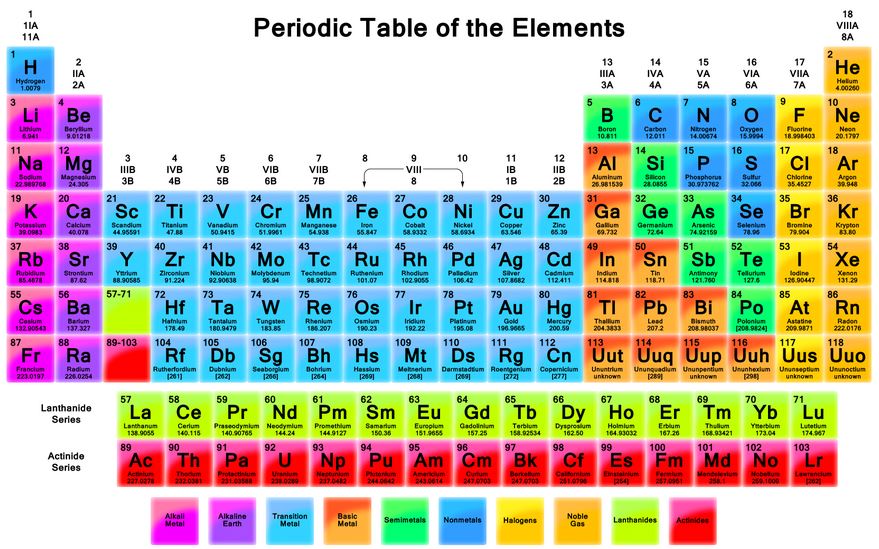
Why do atoms bond?
They typically don't bond
To add or take away energy levels
To have a full valance shell.
To have a full inner shell
Ionic bonding is between a
nonmetal and nonmetal
metal and nonmetal
metal and metal
Depends on the situation
What kind of reaction is this:
2H2O2 →2 H2O + O2
Combination
Decomposition
Single Replacement
Combustion
Double Replacement
What kind of reaction is this:
2C3H7OH +9O2 → 6CO2 + 8H2O
Double Replacement
Combustion
Single Replacement
Decomposition
Combination
What kind of reaction is this:
Fe + CuSO4 → Cu + FeSO4
Double Replacement
Decompostion
Single Replacement
Combustion
Combination
Balance this equation.
Cl2 + MgF2 --> F2 + MgCl2
Cl2 + MgF2 --> F2 + MgCl2 (already balanced)
Cl2 + 2MgF2 --> F2 + 2MgCl2
2Cl2 + MgF2 --> 2F2 + MgCl2
Cl2 + 2MgF2 --> 2F2 + MgCl2
Balance this equation.
Cl2 + MgF2 --> F2 + MgCl2
Cl2 + MgF2 --> F2 + MgCl2 (already balanced)
Cl2 + 2MgF2 --> F2 + 2MgCl2
2Cl2 + MgF2 --> 2F2 + MgCl2
Cl2 + 2MgF2 --> 2F2 + MgCl2
Balance this equation-
P4 + O2 --> P2O3
P4 + O2 --> P2O3 (already balanced)
P4 + 3O2 --> 2P2O3
P4 + O2 --> 2P2O3
2P4 + 3O2 --> 2P2O3
Balance this equation
N2 + H2 --> NH3
N2 + H2 --> NH3 (already balanced)
N2 + 3H2 --> 2NH3
N2 + H2 --> 2NH3
N2 + H2 --> N2H2
You balance an equation by adding
ion charges
subscripts
random numbers
coefficients
Where in a chemical equation is the catalyst?
Left (before the arrow)
Right (after the arrow)
Above the arrow
It depends on the reaction
Predict the product(s)
K + CuCl2 --> ???????
KCu + Cl2
KCl + Cu
KCl2 + Cu
KCuCl2
Predict the product(s)
C2H6 + O2 --> ???????
H2O + CO2
H2O
CO2
C2H6O2

The reactivity of metals that determines whether a single replacement reaction will occur is called
activity series of metals
single replacement reaction chart
reactivity order of metals
none of the above
Pb + KCl -->
How will we know if this reaction will occur?
If Pb is LOWER than K
If Pb is HIGHER than K
If Pb is LOWER than Cl
If Pb is HIGHER than Cl
There is no way to know without doing the reaction
Al + KCl -->
Will this reaction occur?
Yes
No
Sometimes
There is no way to know without doing the reaction
Ca + FeCl2 -->
Will this reaction occur?
Yes
No
Sometimes
There is no way to know without doing the reaction
What kind of reaction is this:
Hydrogen Peroxide breaks down to form Water and Hydrogen gas
Combination
Decomposition
Single Replacement
Double Replacement
Combustion
What kind of reaction is this:
Propane (C3H8) and Oxygen gas react to form Carbon Dioxide and Water
Combination
Decomposition
Single Replacement
Double Replacement
Combustion
Which best represents a balanced equation?
120 grams of carbon plus 20 grams of oxygen → 200 grams of carbon dioxide
120 grams of carbon plus 50 grams of oxygen → 200 grams of carbon dioxide
120 grams of carbon plus 80 grams of oxygen → 200 grams of carbon dioxide
What coefficient for O2 demonstrates the law of conservation of mass?
CH4(g) + __O2(g) → CO2(g) + 2H2O(g)
1
2
3
4

