
Font size
 Worksheets
AP market structures
Total questions: 81
Worksheet time: 54mins
Define the term price elasticity of supply.
the responsiveness of supply (or, of quantity supplied) to a change in price.
the responsiveness of demand (or, of quantity demanded) to a change in price.
the responsiveness of supply (or, of quantity supplied) to a change in quantities.


Which letter accurately demonstrates consumer surplus
A
B
C
D

Which letters represent DWL if the price ceiling is placed at P1
E+F
A+B+C
D
B+C+E+F
What is producer surplus if this economy is operating at P3
B+C+D
E+F
A+B+D+E+F
D

P2 is an example of
an effective price floor, and would result in a surplus
an effective price floor, and would result in a shortage
an effective price ceiling, and would result in a surplus
an ineffective price floor, and would result in a shortage

Which graph would represent an inferior good if consumer income increased
Graph 1
Graph 2
Graph 3
Graph 4
Which graph represents a government adding a subsidy
Graph 1
Graph 2
Graph 3
Graph 4
Which of the following could not cause an increase in price
The price of a products complement decreases
The price of a resource increases
The government adds an excise tax
Consumers expect future price of the product to increase
If price of product X increased as a result of a price decrease of Product Y, then which of the following is true?
Product X and Product Y are complements
Product X and Product Y are Substitutes
Product X is an inferior good and product Y is a Normal good
Product Y is an inferior good and product X is a Normal good

If this product sells at 7$, it will result in a
Surplus
shortage
market clearing price
Neither a surplus or shortage
Which of the following would increase price of Potato chips
decrease in the price of potatoes
There is new productive technology in the production of potato chips
Government adds an excise tax on high calorie foods (which includes potato chips)
The price of peanuts (a substitute for potato chips) decreases
If the price of a complement increases and the price of a resource (input) increases, what is the outcome
EQ decreases, EP indeterminant
EQ increases, EP indeterminant
EQ indeterminant, EP increases
EQ indeterminant, EP decreases

Taste of sea is food truck serving seafood baskets. It has total fixed costs of $300 and its total variable costs are given in this table.
What is the MC of the 5th seafood basket?
$70,00
$20,00
$18,00
$12,00
What defines average variable cost?
total cost divided by the quantity of the variable factor employed
total variable cost divided by the quantity of the variable factor employed
total variable cost divided by the output produced
the addition to total variable cost by producing one more unit of output
The vertical distance between the firm’s average cost and average variable cost curves represents ___________________.
average fixed cost.
marginal cost.
total cost.
variable cost.
In the long run, ______________________.
all costs are fixed costs.
all costs are variable cost.
at least one is a fixed cost.
none of the above occurs
Of the following, which is not avariable cost?
Labour costs
Raw material costs
Transportation fuel costs
Machinery purchase costs
When average product curve is rising, _____________________.
the marginal product curve lies above the average product curve.
the marginal product curve lies below the average product curve.
the marginal product curve cut the average product curve.
none of the above.
Which of the following is most likely to be a variable cost?
Property insurance premiums.
Interest on bonded indebtedness.
Rental payments on IBM requirement.
Payment for raw materials purchased from Company Y.

Before MC intersects ATC and AVC,which of the following is true?
ATC and AVC are decreasing
AVC is decreasing and ATC is increasing
ATC and AVC are increasing
AFC is constant
What is accounting Profit?
Rent= $15,000/yr
You gave up a job to be an entrepreneur ($40,000/yr)
You pay your workers $50,000/year
Your supply to sell cost $20,000/year
You gave up $2000 in interest for the year
Your total revenue= $150,000
$85,000
$127,000
$65,000
$23,000

four units of pizza and three units of shakes
two units of pizza and four units of shakes
six units of pizza and two units of shakes
five units of pizza and one unit of shakes
If TU of product X changes from 40 utils to 50 utils and
TU of product Y changes from 20 to 25 utils.
Price of X= 5$ and Price of Y=$1, what should the consumer do
Not change consumption
consume more of X and less of Y
Consume more of Y and less of X

When Marginal product is at its max, then
Marginal cost is at its minimum
next unit Diminishing marginal returns sets in
Average variable cost is at its minimum
AP is at its minimum

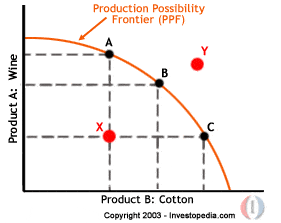
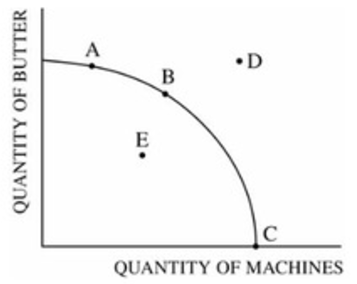
What is the shape of this curve?
concave to its origin
convex to its origin
Proportional
Bowed out
If a Production Possibilities curve is bowed out, which of the following is true
Resources are perfectly adaptable
Resources are substitutable
The curve represents proportional opportunity cost
The economy is producing more Capital goods than consumer goods
If TP changed from 20 to 25, then to 27, what stage of production is the firm in?
Diminishing marginal returns
Increasing marginal returns
Negative marginal returns
diminishing marginal utility
After graduating from high school, Maria chose to go to college, while Omar chose to work full- time. Which of the following best describes the opportunity costs for these decisions?
Maria’s opportunity cost (implicit cost) includes the salary she could have earned if she had gone to work
Maria’s opportunity cost (implicit cost) is her living expenses while attending college
Omar’s opportunity cost (implicit cost) is the salary he will earn from working
Omar’s opportunity cost (implicit cost) is the tuition and expenses he would have paid for college
Which of the following graphs will always decrease?
Marginal cost
Average Variable Cost
Average Fixed Cost
Average total cost
Which of the following is an example of an implicit cost?
(i)the owner of a firm forgoing an opportunity to earn a large salary working for Amazon (ii) interest paid on the firm's debt (iii) rent paid by the firm to lease office space (iv) interest earned from savings that was used to purchase equipment for the firm.
i only
i and ii only
i and iii only
i and iv only
i, ii and iv
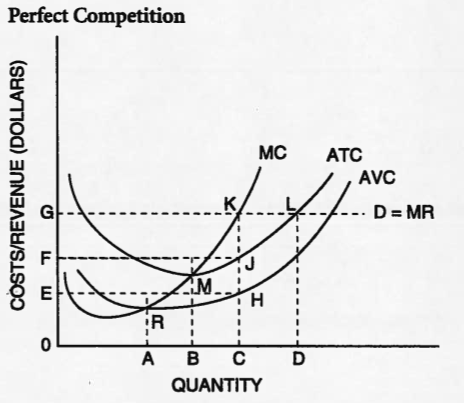

The monopolistically competitive firm's profit-maximising price in the short run will be
0a
0b
0c
0d

The monopolistically competitive firm's profit-maximising output in the short run will be
0e
0f
0g
0h

In the short run, monopolistically competitive firm will make
a per unit loss of cd
a per unit loss of bd
a per unit profit of bc
a per unit profit of ad
Define collusion
When two cars collide on the road
a secret agreement between two competing firms to sell their similar products at the same price
MC = marginal cost, and ATC = average total cost. In monopolistic competition, which of the following most accurately describes the long-run equilibrium conditions for a firm?

Is the firm in short-run or long-run equilibrium?
Short run, because price is greater than marginal cost
Short run, because the firm is earning a positive economic profit
Long run, because price is greater than average total cost
Long run, because marginal revenue is not equal to zero
Either short run or long run, because the firm is producing where marginal revenue equals marginal cost
If profits are negative in a monopolistically competitive market, then:
new firms will enter until profit returns to the optimal positive level.
new firms will enter the market until economic profits are zero.
firms will exit the market until economic profit returns to the optimal positive level.
firms will exit the market until economic profit returns to zero.
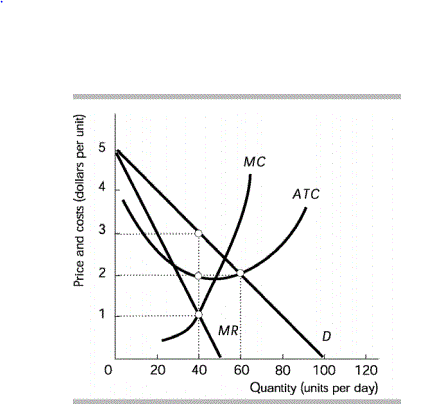
In the above figure, the monopolistically competitive will experience what change into the long run?
a right shift of it's demand curve.
a left shift of it's demand curve.
a right shift of it's supply curve.
a left shift of it's supply curve.
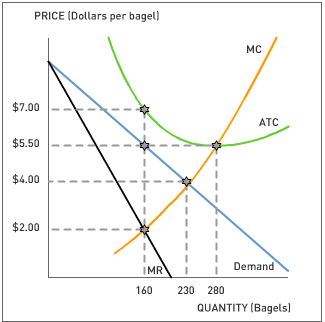
This firm will charge a price of _____ and make a per unit ___ of _____.
7; loss; 1.5.
7; normal profit; 0.
7; profit; 1.5.
5.5: loss; 1.5.
5.5; profit; 1.5.

Which of the following is true about a price discriminating monopoly?
There is no consumer surplus, it all becomes producer surplus
There is no producer surplus, it all becomes consumer surplus
Profits decrease for the firm
They a charge every consumer the same price

Who has a dominant strategy and explain
Player 1, choice B
they should chose this strategy regardless of what the other player does
Player 2, choice A
Their choice depends on what the other player does
What is the long run adjustment if a monopoly is in economic loss?
There is no long run adjustment
they will adjust back to a normal profit
They will adjust back to MR=MC
They will begin earning an economic profit
Which firm(s) are always allocatively efficient
Perfect competition
Monopolistic competition
Monopoly
Oligopoly

If this is a monopolistic competition, what is the long run adjustment?
This MC is in long run
Demand for this firm increases
Supply for this firm increases
Price will decrease

This could demonstrate a
Per unit tax
lump sum tax
per unit subsidy
lump sum subsidy

What is true about the above graph
Its in economic loss
to continue operating, P>AVC
Firms will exit, supply decreases, because there are no barriers to entry
Firms will enter, supply increases, because there are no barriers to entry
what is the primary difference between a Single price monopoly and a regulated/natural monopoly
Regulated monopolies do not usually operate at Profit maximization
Regulated monopolies are always subsidized, whereas Single price monopolies are never subsidized
Single price monopolies are allocatively efficient and Regulated monopolies are not
Single price monopolies are guaranteed a fair return price, Regulated monopolies cannot earn a profit

A pure monopoly will produce the same amount of output as perfect competition when
all the demanders pay one price.
it provides more consumer surplus than perfect competition.
it can perfectly price discriminate.
it is forced into the fair return price.


A perfectly competitive industry will produce a quantity of goods
less than a single price monopoly.
the same as a single price monopoly.
could be more, less, or the same as a single price monopoly depending if the MR curves lies above or below the D curve.
greater than a single price monopoly.

_____________ reveals that equilibrium might not be the best solution for the parties involved.
Social optimization
Price discrimination
Game theory
Excess capacity

