
 Worksheets
Gas Laws
Total questions: 55
Worksheet time: 55mins
Which gas law to solve: A sample of a gas has a volume of 852 mL at 298 K. What temperature is necessary for the gas to have a volume of 945 mL?
Pt = P1 + P2 + P3 + ...
P1V1 = P2V2
V1/T1 = V2/T2
P1V1/T1 = P2V2/T2
Which gas law to solve: If a nitrogen gas occupies a volume of 500 ml at a pressure of 0.971atm. What volume will the gas occupy at a pressure of 1.50 atm?
P1V1 = P2V2
PV = nRT
P1/T1 = P2/T2
V1/n1 = V2/n2
Which gas law to solve: Determine the number of moles in a container of gas at STP with a volume of 99.2 L.
V1/n1 = V2/n2
PV = nRT
P1/T1 = P2/T2
V1/T1 = V2/T2
Which gas law to solve: A container is filled with H2, and H2O. What is the partial pressure of H2 when the pressure of water is 17 kPa. The total pressure of the gases is 750 kPa.
P1V1 = P2V2
Pt = P1 + P2 + P3 +...
P1/T1 = P2/T2
V1/n1 = V2/n2
Which gas law to solve: A gas fills a balloon at a temperature of 27 oC and 1 atm of pressure. What will the pressure of the balloon be if the gas is heated to 127 oC?
P1V1 = P2V2
PV = nRT
P1/T1 = P2/T2
V1/T1 = V2/T2
Which gas law to solve: A 220.0 mL sample of helium gas is in a cylinder at 105 kPa and 275 K. The piston is pushed in until the sample has a new temperature of 310 K and new pressure of 150 kPa. What is the new volume of the gas?
P1V1/T1 = P2V2/T2
PV = nRT
P1V1 = P2V2
Pt = P1 + P2 + P3 + ...
Which gas law to solve: A container has 0.504 moles of a gas at a volume of 2680 mL. When the number of moles changes to 0.423 moles, what is the new volume?
PV = nRT
V1/n1 = V2/n2
P1V1/T1 = P2V2/T2
P1V1 = P2V2
Boyle's Law shows the inverse relationship between between which two factors of a gas?
volume and pressure
temperature and pressure
volume and temperature
volume and moles
Charles's law shows the direct relationship between which two factors of a gas ?
volume and temperature
volume and pressure
pressure and temperature
volume and moles
Gay-Lussac's law shows the temperature and pressure of a gas are always ........
inversely proportional
directly proportional
Temperature describes the ______________ of particles.
volume
mass
kinetic energy
conductivity


If you increase the temperature, what will happen to the pressure, if volume is constant?
Increase
Decrease
Stay the same
It will Blow Up

The temperature at which all molecular motion stops is
-460 .C
-273K
0K
0.C
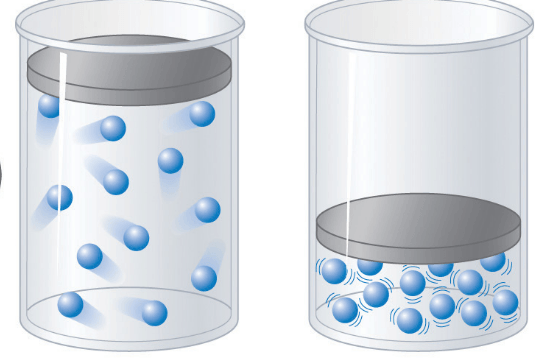
Avogadro's Law explains the relationship between
Pressure and Volume
Pressure and Temperature
Volume and Temperature
Volume and Moles
If a hairspray can is heated, what can be expected of the pressure of the gas inside the can?
The pressure will increase
The pressure will decrease
The pressure will remain constant
The pressure will equalize
Pressure is
defined as the mass that an object exerts when at rest.
not a measurable in gases.
defined as the number of moles of substance divided by the mass of the substance.
created by the force of the gas particles colliding with the walls of the container.
Gases generally have
low density
high density
closely packed particles
do not have motion

Which graph shows the pressure-temperature relationship expected for an ideal gas?
1
2
3
4
Increasing the temperature of a gas with a volume held constant causes
increased pressure
decreased pressure
Increasing the number of moles of a gas with the pressure and temperature held constant causes
increased volume
decreased volume
Decreasing the volume of a gas with temperature held constant causes
increased pressure
decreased pressure
Gay-Lussac's law shows the direct relationship between which two factors of a gas ?
volume and temperature
pressure and volume
pressure and temperature
volume and moles
Avogadro's law shows the direct relationship between which two factors of a gas ?
volume and temperature
pressure and volume
pressure and temperature
volume and moles
Boyle's law shows the volume and pressure of a gas are always ........
inversely proportional
directly proportional
Avogadro's law shows the volume and moles of a gas are always ........
inversely proportional
directly proportional
A hypothetical gas that perfectly fits all the assumptions of the kinetic molecular theory is known as
real gas
ideal gas
imaginary gas
perfect gas
Which of the following is an assumption of the kinetic-molecular theory of gases?
Collisions between gas particles are inelastic.
Gases consist of closely spaced particles.
Gas particles move around in an orderly manner.
The average kinetic energy of a gas depends on the temperature of the gas particles.
Which of the following is not a physical property of gases?
absence of definite volume
high density
high compressibility
diffusion
Under which of the following conditions do gases behave like REAL gases?
polarity; high pressure and low temperature
polarity; high pressure and high temperature
non-polarity; low pressure and low temperature
non-polarity; low pressure and high temperature
Collisions where no energy is lost are
epileptic
elastic
erectic
erratic

