
 Worksheets
SLT TEST 3 through acids
Total questions: 75
Worksheet time: 1hrs 4mins


What is the precise reading (in milliliters) of the liquid volume?
65
66
67
68
Darlene places a bolt in the graduated cylinder to find its volume. Its starting volume is 45.5mL. After she puts the bolt in the graduated cylinder the water level rose to 65.5mL. What is the volume of the bolt?
10 cubic centimeters
19.5 cubic centimeters
20.5 cubic centimeters
21 cubic centimeters
20

Carla needs exactly 100.00 grams of sulfur powder for an experiment. The picture shows the mass on the scale so far. She did not zero the scale before starting. Carla knows that the weighing paper weighs 3.65 grams. How much more sulfur powder does Carla need?
A) 4.5 grams
A) 5.1 grams
A) 5.0 grams
A) 3.45 grams

Kelsey is measuring a sample of iodine crystals for an experiment. What is the mass of the iodine and weighing paper?
A) 162.1 grams
A) 162 grams
A) 163 grams
A) 164 grams


Jordan has a mixture of two solids that he has to separate. The solids are small granules that are the same size but different colors. She knows that the silver granules are aluminum and the white granules are salt. Which procedure is the Most reliable way to separate the mixture?
Dissolve mixture in a universal solvent and filter. Then evaporate solvent to retrieve the salt.
Dissolve mixture in a universal solvent and filter.
Pass a magnet over the mixture.
Sift the mixture through fine wire mesh.

The graph shows the temperature changes in a sample of water that is heated steadily from -40°C. Which process is happening in section 2 of the graph?
A) Ice is getting warmer.
A) Ice is melting.
A) Ice is in the solid phase.
A) Ice is changing to vapor and then to a liquid.
Phillip watches a burning log in the fireplace. He makes these observations:
I. There is a strong smell of smoke.
II. The fire gives off heat.
III. Heat waves appear in the air above the log
IV. Light is emitted where there are flames.
V. Ashes form from the logs.
Which of Phillip’s observations are conclusive evidence that the burning log undergoes chemical changes and not just a physical change?
A) observations I and V only
A) observations II , III, and V only
A) observations I, III, and V only
A) observations I, IV, and V only
Janelle is studying a sample of peroxide. She knows the chemical name for peroxide is Dihydrogen dioxide. What is the chemical formula for peroxide?
H2O2
2HO2
HO
2HO
What is the chemical formula for hepta-carbon penta-hydrogen tetra-oxide ?
C7H5O4
C6H10O6
C6H9O6
C6H10O9
Which inequality correctly compares the masses of electrons, protons, and neutrons?
p+ > n0
n0 < e-
p+ > e-
e- > n0
Holly is examining an isotope of manganese. She determines that each atom has 36 protons, 36 electrons, and 52 neutrons. What is the mass number for this manganese isotope?
72 amu
88 amu
52 amu
104 amu
A Carbon ion in a compound has a -4 charge. How many electrons does the Boron ion have?
2
7
8
10
How does an atom get a -2 charge and become an ion?
They gain 2 protons.
They gain 2 electrons.
They lose 2 protons.
They lose 2 electrons.

Transition metals are located in the _______ of the periodic table while the Nobal gasses are on the ___________?
left, right
right, left
middle, right
right, middle

The diagram shows an outline of the periodic table with four elements labeled. Which element is a non-metal?
1
2
3
4
A Bohr model of an unknown element shows 7p+ . What element is being diagrammed in the model?
A) Oxygen
A) Lithium
A) Nitrogen
A) Carbon
What formula represents hexacarbon monoxide?
C6O
6CO2
C2O
C2O2
Which formula represents the ionic compound Sodium Chloride?
NaCl
NaCl2
NaCL
NaCl2

Jeff used a piece of indicator paper to test an unknown liquid. The result of his test is shown below the pH scale. Based on the pH scale, what is the Best description of the liquid?(About pH of 8)
A) Very acidic
A) Weakly acidic
A) Very basic
A) Weakly basic
The reaction equation showing the formation of iron (III) oxide is not balanced. _?_N3 +_?_H3 --> _?_NH3
Which set of coefficients, when inserted in the blank spaces in order, will balance the equation?
1, 3, 3
1, 2, 2
2, 1, 1
2, 2, 1
6CO2 + 6H2O-->C6 H12 O6 + 6O2
The reaction equation shows a common chemical reaction. Where does this reaction commonly occur?

You are taking the temperature for data for your science class, the temperature is 96 degrees. What month do you predict it is?
September
July
May
December

Dr. Peterson concludes that chemical A does increase the growth rate of mice. Is Dr. Peterson's conclusion supported by scientific knowledge?
What part of the scientific method is illustrated in Step B?
A student noticed that when a dog is cut, the dog periodically licks its wounds. Usually, after a few days, the wound begins to heal without ever showing signs of infection.
The following steps outline the student’s line of reasoning
A. I wonder why the dog's wound doesn’t become infected?
B. The dog’s saliva must prevent the growth of infection-causing bacteria.
C. I’ll obtain a bacterial culture and grow the same kind of bacteria in two identical culture dishes. Once the bacteria start growing, I’ll add dog saliva to only one of the dishes and leave the other alone. I’ll cover both dishes. Then I’ll observe what happens each day for a week.
D. Even after adding the dog saliva to one of the dishes, the bacteria continued to grow in both dishes over the course of the week. However, the bacteria in the treated dish grew more slowly than the bacteria in the untreated dish.
E. I think I'll try something else. I’ll start with two identical culture dishes, as before, and use the same kind of bacteria in each dish, but this time I’ll create one dish with dog saliva before I add the bacteria. I’ll observe what happens each day for a week.
Conclusion
Data
Hypothesis(claim)
Problem
Why were both dishes covered?
A student noticed that when a dog is cut, the dog periodically licks its wounds. Usually, after a few days, the wound begins to heal without ever showing signs of infection.
The following steps outline the student’s line of reasoning
A. I wonder why the dog's wound doesn’t become infected?
B. The dog’s saliva must prevent the growth of infection-causing bacteria.
C. I’ll obtain a bacterial culture and grow the same kind of bacteria in two identical culture dishes. Once the bacteria start growing, I’ll add dog saliva to only one of the dishes and leave the other alone. I’ll cover both dishes. Then I’ll observe what happens each day for a week.
D. Even after adding the dog saliva to one of the dishes, the bacteria continued to grow in both dishes over the course of the week. However, the bacteria in the treated dish grew more slowly than the bacteria in the untreated dish.
E. I think I'll try something else. I’ll start with two identical culture dishes, as before, and use the same kind of bacteria in each dish, but this time I’ll create one dish with dog saliva before I add the bacteria. I’ll observe what happens each day for a week.
To avoid the spread of the infection
To avoid contamination (other bateria getting on the dishes)
To compare the growth
All of the answers are correct
What is the dependent variable (response you are looking for) in this experient?
A student noticed that when a dog is cut, the dog periodically licks its wounds. Usually, after a few days, the wound begins to heal without ever showing signs of infection.
The following steps outline the student’s line of reasoning
A. I wonder why the dog's wound doesn’t become infected?
B. The dog’s saliva must prevent the growth of infection-causing bacteria.
C. I’ll obtain a bacterial culture and grow the same kind of bacteria in two identical culture dishes. Once the bacteria start growing, I’ll add dog saliva to only one of the dishes and leave the other alone. I’ll cover both dishes. Then I’ll observe what happens each day for a week.
D. Even after adding the dog saliva to one of the dishes, the bacteria continued to grow in both dishes over the course of the week. However, the bacteria in the treated dish grew more slowly than the bacteria in the untreated dish.
E. I think I'll try something else. I’ll start with two identical culture dishes, as before, and use the same kind of bacteria in each dish, but this time I’ll create one dish with dog saliva before I add the bacteria. I’ll observe what happens each day for a week.
Dog saliva
Bacterial growth
Culture Dish
Dog's wond
According to the conclusion, of the following experiment, the hypothesis can be described as being?
A student noticed that when a dog is cut, the dog periodically licks its wounds. Usually, after a few days, the wound begins to heal without ever showing signs of infection.
The following steps outline the student’s line of reasoning
A. I wonder why the dog's wound doesn’t become infected?
B. The dog’s saliva must prevent the growth of infection-causing bacteria.
C. I’ll obtain a bacterial culture and grow the same kind of bacteria in two identical culture dishes. Once the bacteria start growing, I’ll add dog saliva to only one of the dishes and leave the other alone. I’ll cover both dishes. Then I’ll observe what happens each day for a week.
D. Even after adding the dog saliva to one of the dishes, the bacteria continued to grow in both dishes over the course of the week. However, the bacteria in the treated dish grew more slowly than the bacteria in the untreated dish.
E. I think I'll try something else. I’ll start with two identical culture dishes, as before, and use the same kind of bacteria in each dish, but this time I’ll create one dish with dog saliva before I add the bacteria. I’ll observe what happens each day for a week.
Valid (supported)
Invalid (unspuported)
Pending
Descriptive
H2 + O → H2O
____ NaF + ____ Br2 ---> ____ NaBr + ____ F2
3,1,2,1
1,2,3,4
2,1,2,1
1,2,1,2
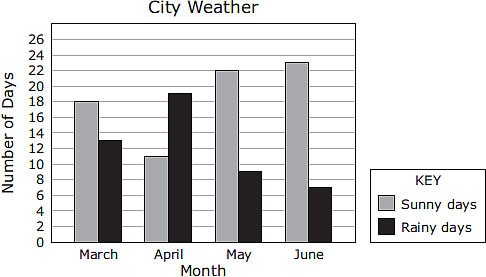
Based on the graph,how many more sunny days than rainy days did this city have during the months of April, May, and June?
The substance in the beaker
acidic or basic.
_______ are corrosive substances characterized as having a strong smell, a sour taste, and a _______.
You make a Kool Aid drink using Kool Aid powder, sugar, & water & you notice your drink still has to much powder sitting at the bottom. What will happen if you add more water to the drink?
decrease the solubility of your drink
decrease the solubility rate of your drink
increase the solubility rate of your drink
increase the solubility of your drink
Which of the following is not a solute?
coffee grounds
Kool Aid powder
food die in water
paint thinner

calcium oxide
Ca2O2
Ca2O
CaO
CaO2

Which group is the control group?
The juice is the ____ variable
The stacks of paper is the _____ variable
Which group is the experimental group?

