wayground logo

Free Printable Worksheets

NEW

Font size

S
M
L
XL
Worksheets

Elements, Compounds, and Mixtures

Total questions: 60

Worksheet time: 41mins

Name
Class
Date
1.
Which of the following represents an element?
a)
H2O
b)
H2
c)
NaCl
d)
CaCO3
2.
Which of the following is not a compound?
a)
HCl
b)
Cl
c)
NaCl
d)
CO2
3.
Salt has a chemical formula of NaCl.  Salt is a...
a)
Compound
b)
Element
c)
Mixture
d)
None of the Above
4.
What cannot be broken down into other substances?
a)
Compound
b)
Mixture
c)
Solids
d)
Element
5.
How many elements are represented in the compound?
Na2CO3
a)
1
b)
2
c)
3
d)
4
6.
A combination of substances that are not chemically combined is called a(n)____________. 
a)
mixture
b)
compound
c)
physical
7.
Mixtures are separated through ___________changes.
a)
mixture
b)
compound
c)
physical
8.
An element is made up of only one kind of _____.
a)
isotope
b)
plastic
c)
atom
d)
metal
9.
_____ small particles that make up most types of matter on Earth.
a)
compounds
b)
atoms
c)
mixtures
d)
elements
10.
In general, metals are _____. 
a)
poor conductors of heat
b)
brittle
c)
poor conductors of electricity 
d)
good conductors of heat
11.
Vertical columns in the periodic table are called _________ of elements and have similar properties. 
a)
groups
b)
periods
12.
The horizontal rows on the periodic table are known as
a)
periods.
b)
atoms.
c)
groups or families.
d)
valence electrons.
13.
What is H2SO4 
 made up of?
a)
2 hydrogen, 1 sulfur, 4 oxygen
b)
1 hydrogen, 2 sulfur, 4 oxygen
c)
2 hydrogen & 4 sodium
d)
1 hydrogen & 6 sodium
14.
How many atoms are there TOTAL in:
H2SO4
a)
6
b)
5
c)
7
d)
3
15.
Elements can be broken down into simpler substances. 
a)
false 
b)
true 
c)
sometimes 
16.
Examples are milk and gasoline.
a)
elements
b)
mixtures
c)
compounds
17.

Examples are diamonds (C) and Uranium (U)

a)

elements

b)

mixtures

c)

compounds

18.
Sulfur
a)
Metal
b)
Nonmetal
19.
What is salad?
a)
element
b)
compound
c)
mixture
20.
Classify the picture with the correct label.
a)
Element
b)
Compound
c)
Mixture of Elements
d)
Mixture of Compounds
21.
Classify the picture with the correct label.
a)
Element
b)
Compound
c)
Mixture of Elements and Compounds
d)
Mixture of Elements
22.
Classify the picture with the correct label.
a)
Element
b)
Compound
c)
Mixture of Elements & Compounds
d)
Mixture of Compounds
23.
Classify the picture with the correct label.
a)
Compounds
b)
Mixture of Elements
c)
Mixture of Compounds
d)
Mixture of Elements & Compounds
24.
Classify the picture with the correct label.
a)
Mixture of Elements
b)
Compound
c)
Mixture of Compounds
d)
Element
25.
Classify the picture with the correct label.
a)
Element
b)
Compound
c)
Mixture of Compounds
d)
Mixture of Elements
26.
Classify the picture with the correct label.
a)
Mixture of Compounds
b)
Mixture of Elements
c)
Compound
d)
Mixture of Elements & Compounds
27.
A combination of particles of one or more substance that are distributed uniformly throughout another substance is a/an
a)
Mixture 
b)
Substance
c)
Solution
28.
What is CO2 and example of?
a)
element
b)
mixture
c)
compound
29.

The chart below lists some substances and their symbols. How many of these substances are examples of elements?

a)

1

b)

2

c)

3

d)

4

30.

What is the relationship between molecules and atoms?

a)

Molecules are combinations of two or more atoms.

b)

Molecules are the parts that make up atoms

c)

Molecules are the gaseous parts of atoms

d)

Molecules are atoms that have a positive charge

31.

What makes elements and compounds different from mixtures? Elements & compounds-

a)

have a constant composition (pure substances)

b)

are made of gases

c)

Will not change when heated

d)

conduct electric current

32.

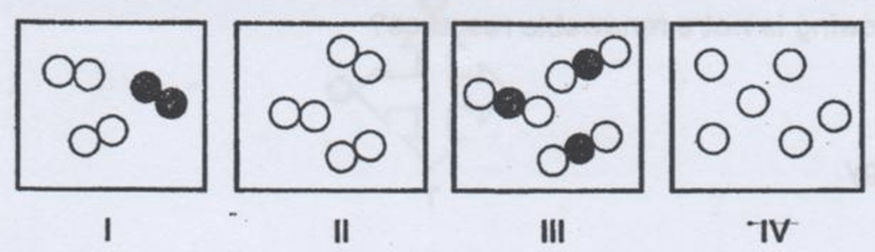
In the diagrams provided, the circles of different colors represent the atoms of different elements. Which diagram represents a mixture?

a)

I

b)

II

c)

III

d)

IV

33.

Mixtures are different than pure substances because mixtures-

a)

have lower boiling points

b)

can be separated physically

c)

are less dense than pure substances

d)

contain only one type of atom

34.

Which of the following is true of oxygen?

a)

Oxygen is an element because its most basic unit is a single type of atom

b)

Oxygen is a compound because its most basic unit is a single type of atom.

c)

Oxygen is a mixture because its most basic unit contains more than one particle.

d)

Oxygen is a compound because its most basic unit contains more than one type of particle.

35.

Beatriz wants to make a mixture out of her bowl of blueberries. Which of the following would turn her bowl of blueberries into a mixture?

a)

adding more blueberries to the bowl

b)

adding raspberries to the bowl

c)

cutting up the blueberries

d)

mashing the blueberries

36.

Humans absorb oxygen from the air they breathe in and exhale carbon dioxide gas, CO2. Carbon dioxide gas is

a)

an element made of carbon and oxygen atoms.

b)

a solution made of carbon and oxygen atoms.

c)

a compound of carbon and oxygen atoms.

d)

a mixture of carbon and oxygen atoms.

37.

Sam's mother is cooking breakfast in a cast-iron frying pan. If the pan is made only of iron, what can Sam conclude?

a)

The pan is a pure substance with the chemical symbol Ir.

b)

The pan is a pure substance with the chemical symbol I.

c)

The pan is a pure substance with the chemical symbol F.

d)

The pan is a pure substance with the chemical symbol Fe.

38.
Compounds contain a _____ set of elements.
a)
fixed
b)
random 
c)
sweet 
d)
inaccurate 
39.
These are mixtures that are the same throughout. 
a)
homogeneous mixtures 
b)
heterogeneous mixtures 
c)
mixed mixtures 
40.
These are mixtures that are not the same throughout. 
a)
homogeneous mixtures 
b)
heterogeneous mixtures 
c)
solutions 
d)
water 
41.

What kind of mixture is shown in the picture?

a)

Homogeneous

b)

Heterogeneous

42.

What kind of mixture is shown in the picture?

a)

Homogeneous

b)

Heterogeneous

43.

What kind of mixture is shown in the picture?

a)

Homogeneous

b)

Heterogeneous

44.

What kind of mixture is shown in the picture?

a)

Homogeneous

b)

Heterogeneous

45.

What kind of mixture is shown in the picture?

a)

Homogeneous

b)

Heterogeneous

46.

What kind of mixture is shown in the picture?

a)

Homogeneous

b)

Heterogeneous

47.
Type of mixture that has the SAME COMPOSITION in every part.
a)
Homogenous
b)
Heterogeneous
48.
Type of mixture that DOESN'T HAVE the same composition in every part.
a)
Homogeneous
b)
Heterogeneous
49.
Chocolate milk is an example of a
a)
homogeneous mixture
b)
heterogeneous mixture
50.
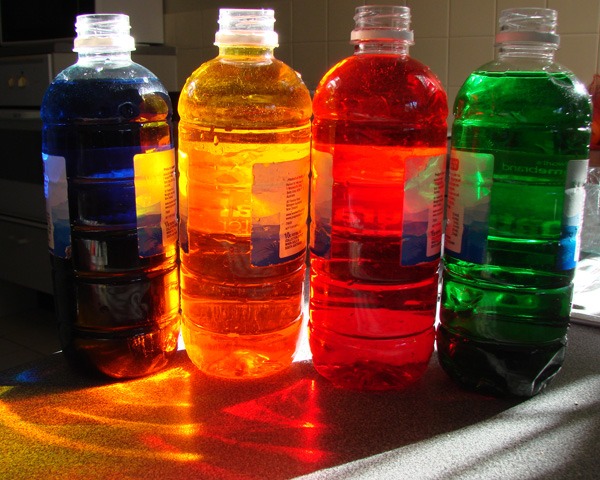
Coloured water is an example of a
a)
homogeneous mixture
b)
heterogeneous mixture
51.
Sand and gravel may be separated from each other through using..
a)
a filter funnel
b)
a sieve
c)
an evaporating basin
d)
a distillation
52.

The greatest amount of solute that can dissolve in a solvent is called the ________.

a)

suspension

b)

solubility

c)

solution

d)

separation

53.

In salt water, the _____ is the solute.

a)

water

b)

salt

54.

The material present in the greatest amount in a solution is the ____.

a)

suspension

b)

solute

c)

separation

d)

solvent

55.
Which is an example of a solvent?
a)
Salt
b)
Egg whites
c)
Water
d)
Sugar
56.
__________ are made up of solutes and solvents.
a)
Solutions
b)
Suspension
c)
Colloid
57.
How does a solution become supersaturated?
a)
dissolve lots of solute in it.
b)
dissolve a little solute in it. 
c)
dissolve more solute than you should be able to. 
d)
dissolve a super amount of solvent in it. 
58.
Amount of solute in a given amount of solvent or solution
a)
Concentration
b)
Miscible
c)
Solute
d)
solubility
59.
Capable of being dissolved
a)
Soluble
b)
concentration
c)
colloid
d)
molarity
60.

An example of a solution is

a)

pebbles and water

b)

sand and water

c)

oil and water

d)

salt and water