wayground logo

Free Printable Worksheets

NEW

Font size

S
M
L
XL
Worksheets

Meiosis and Karyotypes

Total questions: 41

Worksheet time: 24mins

Name
Class
Date
1.
A diploid cell of a normal male human contains 
a)
22 autosomes and two Y-chromosomes.
b)
22 pairs of autosomes and two Y-chromosomes.
c)
22 pairs of autosomes, one X and one Y-chromosome
d)
22 autosomes and two X-chromosomes
2.
How many cell divisions does meiosis have?
a)
1
b)
2
c)
4
d)
0
3.
What chromosome is affected by Down's Syndrome?
a)
23
b)
18
c)
13
d)
21
4.
 Turner's Syndrome is monosomy of which chromosome?
a)
18
b)
21
c)
sex chromosome
d)
13
5.
What would indicate a human male?
a)
XX
b)
X
c)
XY
d)
XXY
6.
What is a picture used to examine chromosomes called?
a)
Sonogram
b)
Electrocardiogram
c)
X-Ray
d)
Karyotype
7.
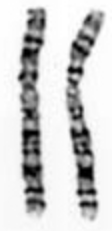
What type of mutation is this?
a)
Deletion
b)
Inversion
c)
Duplication
d)
Substitution
8.
Which would be considered a somatic cell?
a)
Sperm cell
b)
Egg Cell
c)
Skin Cell
d)
All of these
9.
Which of the following would be considered a Gamete cell?
a)
Egg Cell
b)
Sperm Cell
c)
Both of these
d)
None of these
10.
How many chromosomes are in a typical human somatic cell?
a)
23
b)
22
c)
44
d)
46
11.
How many Autosomes are in a typical human somatic cell?
a)
22
b)
23
c)
44
d)
46
12.
In humans, mitosis produces____ chromosomes and _____ chromosomes after Meiosis
a)
46, 46
b)
92, 46
c)
46, 23
d)
23, 23
13.
Determine the sex of the individual whose karyotype is displayed in the image.
a)
female
b)
male
14.
Nondisjunction can result in 
a)
trisomy conditions
b)
monosomy conditions
c)
additional sex chromosomes
d)
all of these
15.
A pair of identical chromosomes shown in a karyotype, one inherited from mom, and one inherited from dad are called
a)
sister chromotids
b)
centromeres
c)
homologous chromosomes
d)
autosomes
16.
What makes this individual's karyotype not normal?
a)
An extra sex chromosome
b)
An extra autosome
c)
A missing sex chromosome
d)
A missing autosome
17.
Is this Karyotype human?
a)
Yes
b)
No
c)
Impossible to Determine
18.

Which process is shown in the image?

a)

crossing over

b)

independent assortment

c)

segregation

d)

mutation

19.

The law of __________________ ___________________ describes how chromosomes (and their genes) are randomly sorted into gamete cells.

a)

independent assortment

b)

independent placement

c)

dependent assortment

d)

dependent variation

20.

Why is crossing over so important ?

a)

It maintains the number of chromosomes in a cell

b)

It ensures that the resulting cells are identical

c)

It creates multiple alleles

d)

It is a source of genetic variation

21.

The diagram shown represents a female human karyotype. What mutation does she have ?

a)

a missing X chromosome

b)

a missing Y chromosome

c)

an extra chromosome on chromosome 9.

d)

a deletion of a section of chromosome 21
22.
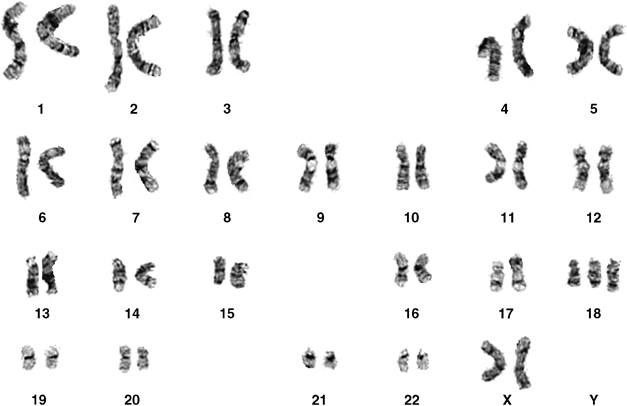
What is the chromosomal condition of the individual whose karyotype is seen in the image?
a)
Monosomy X (Turner's Syndrome)
b)
Trisomy 21 (Down's Syndrome)
c)
Trisomy 13 (Patau Syndrome)
d)
Trisomy 18 (Edwards's Syndrome)
23.
What is the chromosomal condition of the individual whose karyotype is seen in the image?
a)
Trisomy 21 (Down's Syndrome)
b)
Trisomy 13 (Patau Syndrome)
c)
Trisomy 18 (Edward's Syndrome)
d)
XXY Sex Chromosomes (Klinefelter's Syndrome)
24.
What phase is  shown in the picture?
a)
anaphase 1
b)
anaphase 2
c)
metaphase 1
d)
telophase 1
25.
Meiosis makes sperm and egg cells. In humans, sperm and egg cells each have _____ chromosomes. Therefore a fertilized human egg cell (sperm and egg cell combined) would create a cell with _____ chromosomes.
a)
23, 46
b)
46, 23
c)
2, 4
d)
50, 100
26.
If a somatic cell in a butterfly contains 24 chromosomes, a butterfly egg would contain
a)
3
b)
6
c)
12
d)
24
27.
When homologous chromosomes match up, they form a structure call a ___________.
a)
tetrad
b)
triad
c)
diploid
d)
gamete
28.
A male shark has 40 chromosomes in each of its sex cells. How many would be present in its body cells?
a)
20
b)
40
c)
80
d)
160
29.
Chromosomes exchange genetic material during 
a)
crossing over
b)
replication
c)
synthesis
d)
translation
30.
The process of crossing over occurs in what phase of meiosis?
a)
anaphase 1
b)
prophase 1
c)
prophase 2
d)
telophase 1
31.
Which cellular process is shown?
a)
meiosis
b)
endocytosis
c)
mitosis
d)
phagocytosis
32.
What phase is represented?
a)
metaphase 1
b)
metaphase 2
c)
anaphase 1
d)
anaphase 2
33.
What phase is  shown in the picture?
a)
metaphase 2
b)
anaphase 2
c)
metaphase 1
d)
telophase 1
34.
Identify the phase.
a)
Metaphase I
b)
Metaphase II
c)
Anaphase I
d)
Anaphase II
35.

Is this a normal human karyotype?

a)

YES

b)

NO

36.
Females have ____ and males have _____ chromosomes.
a)
XX, XY
b)
XY, XX
c)
XX, XX
d)
XY, XY
37.
What is this?
a)
Trisomy 13
b)
Monosomy 21
c)
47, XXY
d)
Trisomy 21
38.
a)

INCREASES GENETIC VARIATION

b)

TAKES PLACE IN PROPHASE I

c)

CROSSING OVER

d)

ALL ARE TRUE

39.

CROSSING OVER INCREASES

a)

LIFE SPAN

b)

GENETIC VARIATION

c)

THE NUMBER OF OFF-SPRING

d)

ALL ARE TRUE

40.

MEIOSIS

a)

REDUCES THE NUMBER OF CHROMOSOMES BY ONE HALF

b)

PRODUCES UNIQUE SEX CELLS-1N

c)

ALLOWS TRAITS TO BE PASSED TO OFFSPRING

d)

ALL ARE TRUE

e)

INCREASE GENETIC VARIATION

41.
What is the name of the step found above?
a)
Interphase
b)
Prophase I
c)
Metaphase I
d)
Anaphase I