wayground logo

Free Printable Worksheets

NEW

Font size

S
M
L
XL
Worksheets

Chem Midterm

Total questions: 80

Worksheet time: 1hrs 29mins

Name
Class
Date
1.
Try to change the number back to standard form: 3.97  x  10-2
a)
0.000397
b)
0.0397
c)
0.0000397
d)
0.397
2.
125,678,000: Change to scientific notation
a)
1.25678  x  1012
b)
.125678  x  10-9
c)
12.5678  x  108
d)
1.25678  x  108
3.
Change from standard form to scientific notation: 0.004078
a)
4.078  x  10-3
b)
4.078  x  103
c)
40.78  x  10-4
d)
.4078  x  10-2
4.
How many significant figures: 216 m
a)
1
b)
2
c)
3
d)
0
5.
How many significant figures: 2016 m
a)
1
b)
2
c)
3
d)
4
6.
How many significant figures: 153.0 mL
a)
1
b)
2
c)
3
d)
4
7.
How many significant figures: 0.012 km
a)
1
b)
2
c)
3
d)
4
8.
How many significant figures: 1000 mL
a)
1
b)
2
c)
3
d)
4
9.

How many sig figs are in the following measurements?

2.4050 X 10⁻³

a)

1

b)

2

c)

3

d)

4

e)

5

10.
Which of the following numbers has three significant figures?
a)
1014 miles
b)
101 feet
c)
1000 yards
d)
all of the choices
11.
Calculate 5.50 cm + 5.5 cm and give your answer with the correct number of significant figures.
a)
11 cm
b)
11.0 cm
c)
11.00 cm
d)
11.000 cm
12.
Calculate 1.23 m x 0.89 m and give your answer with the correct number of significant figures.
a)
1.0 m2
b)
1.1 m2
c)
1.0947 m2
d)
1.095 m2
13.
Jack has a rock. The rock has a mass of 14g and a volume of 2cm3. What is the density of the rock?
a)
7 mL
b)
7 g/cm3
c)
28 g/cm3
d)
1/7 g/cm3
14.
What units can be used to express density?
a)
g/mL
b)
grams
c)
millimeters
d)
milliliters
15.
The air around was is  a mixture of gases.
a)
True
b)
False
16.
What are the three states of matter?
a)
solid, volume, mass
b)
density, volume, mass
c)
solid, liquid, gas
d)
density, gas, volume
17.
A state of matter that has a definite volume and shape.
a)
solid
b)
liquid
c)
gas
d)
matter
18.
What cannot be broken down into other substances?
a)
Compound
b)
Mixture
c)
Solids
d)
Element
19.
Salt has a chemical formula of NaCl.  Salt is a...
a)
Compound
b)
Element
c)
Mixture
d)
None of the Above
20.
A combination of substances that are not chemically combined is called a(n)____________. 
a)
mixture
b)
compound
c)
physical
21.
Mixtures are separated through ___________changes.
a)
mixture
b)
compound
c)
physical
22.
Physical or Chemical?  Water is nonflammable
a)
Physical
b)
Chemical
c)
Neither
23.
Physical or Chemical Property? If copper comes in contact with water, it will turn green.
a)
Physical
b)
Chemical
c)
Neither
24.
Physical or Chemical Property?  The temperature of boiling water is 100 degrees Celsius.
a)
Physical
b)
Chemical
c)
Neither
25.
Define a Physical Property
a)
A property of matter not involving in its manifestation a chemical change
b)
A property in which stops a chemical reaction from occuring.
c)
A property or behavior of a substance which undergoes a chemical change or reaction.
d)
A property which makes the object smell or taste different.
26.
Define a Chemical Property
a)
A property which depends on the objects size or matter.
b)
A property of matter not involving in its manifestation a chemical change
c)
A property or behavior of a substance which undergoes a chemical change or reaction.
d)
A property which makes the object smell or taste different.
27.
What is matter?
a)
Any subtance that doesn't take up space or have mass.
b)
Any substance that takes up space or have mass.
c)
Any substance that exists on Earth.
d)
Any substance that exists in space.
28.
Boiling point,melting point, and density are some of an element's
a)
pure properties
b)
physical properties
c)
chemical properties
29.
A mixture that appears to be evenly mixed throughout:
a)
an atom
b)
a compound
c)
a homogeneous mixture
d)
a heterogeneous mixture
30.
 mixture that does NOT appear to be evenly mixed throughout:
a)
an atom
b)
a compound
c)
a homogeneous mixture
d)
a heterogeneous mixture
31.
Which of these is an example of a chemical property?
a)
density
b)
melting point
c)
ductility
d)
flammability
32.

How can we separate an insoluble solid from a liquid?

a)

chromatography

b)

evaporation

c)

filtration

d)

condensation

33.
Water and alcohol are easily separated by distillation because of their
a)
different densities
b)
different boiling points
c)
different colours
d)
different melting points
34.
What atom matches this electron configuration?
1s22s22p63s23p64s23d10
a)
Zinc
b)
Copper
c)
Nickel
d)
Germanium
35.
What electron configuration matches an oxygen atom?
a)
1s22s22p63s2, 3p64s23d104p5
b)
1s22s22p4
c)
1s22s22p6
d)
1s22s22p63s23p64s23d1
36.
What is the electron configuration of Sulfur  using noble gas method
a)
[Ne]3s1
b)
[Ne]3s23p3
c)
[Ne]3s23p4
37.

What is the electron configuration of Iodine?

a)

[Kr]5s24d105p6

b)

[Kr]5s24d106p6

c)

[Kr]5s25d106p6

d)

None of the above

38.

There are __ energy levels

a)

1

b)

2

c)

7

d)

8

39.
How many atomic orbitals are there in the p sublevel?
a)
2
b)
3
c)
4
d)
5
40.
Electron arrangement that uses arrows
a)
Electron configuration
b)
Shorthand configuration
c)
Lewis dot structure
d)
Orbital diagram
41.
How many electrons does Si contain? (click to see image)
a)
14
b)
28
c)
2
d)
4
42.
How many valence electrons are found in atoms of group 14?
a)
4
b)
3
c)
14
d)
16
43.
How many valence electrons are found in atoms of group 15?
a)
4
b)
5
c)
2
d)
3
44.

What are valence electrons?

a)

The total number of electrons in an atom

b)

The number of electrons in the outermost shell

c)

The number of electrons in the second shell

d)

The number of protons in the outermost shell

45.
How many valence electrons are in an atom of Ba?
a)
2
b)
8
c)
4
d)
1
46.
How many valence electrons are in an atom of Se?
a)
2
b)
8
c)
6
d)
5
47.
How many valence electrons are in an atom of K?
a)
3
b)
8
c)
4
d)
1
48.
An atom becomes _________ when it gains electrons.
a)
Positive
b)
Negative
c)
Neutral
d)
Invinsible
49.

What is the charge of a sodium ion?

a)

+2

b)

+1

c)

-1

d)

-2

50.
Group 17 always has ions with a charge of 
a)
+1
b)
+2
c)
-1
d)
-2
51.
What quantities vary between isotopes of an element?
a)
protons, electrons, and atomic mass
b)
protons, electrons, and atomic number
c)
neutrons and electrons
d)
neutrons and atomic mass
52.
What is the name of this element?
a)
Lithium
b)
Boron
c)
Carbon
d)
Neon
53.
What are ionic bonds?
a)
valence electrons transferred between atoms
b)
Inner most electrons transferred between atoms
54.
Atoms that lose electrons become...
a)
negatively charged
b)
postively charged
c)
remain neutral, no charge
d)
losers
55.
What will be the compound name of the following chemical formula?
NaCl
a)
Potassium Chloride
b)
Sodium Chloride
c)
Calcium Chloride
d)
Sodium Chlorine
56.
Between  nonmetals
a)
Ionic Bonds
b)
Covalent Bonds
c)
Both bonds
d)
Neither bond
57.
Between metals and nometals
a)
Ionic Bonds
b)
Covalent Bonds
c)
Both bonds
d)
Neither bond
58.
H2O
a)
Ionic Bond
b)
Covalent Bond
c)
Both bonds
d)
Neither bond
59.
In what form can an ionic compound conduct electricity?
a)
when dissolved in water
b)
as a solid
c)
as a crystal
d)
when warmed slightly
60.
Which of the following is a characteristic property of ionic compounds?
a)
They form hard, brittle crystals with characteristic shapes
b)
They have low melting points
c)
They have low boiling points
d)
They contain no charged particles
61.

Which of the following is NOT a property of ionic compounds?

a)

They conduct electricity when molten

b)

They conduct electricity when in solution

c)

They have high boiling points

d)

They are insoluble in water

62.
What is the basis of a metallic bond?
a)
the attraction of neutral metal atoms.
b)
the attraction between protons and neutrons.
c)
the attraction between positive metal ions and interlocking electrons.
d)
the attraction between positive metal ions and free floating electrons.
63.
A mixture of two or more metals is called:
a)
mixture
b)
solution
c)
compound
d)
alloy
64.
How do covalent bonds form?
a)
Donating & receiving valence e- between atoms.
b)
Opposite slight charges attract each other between compounds.
c)
Scientists are still not sure how they form.
d)
Sharing valence e- between atoms.
65.
What do we call a covalent bond where electrons are shared UNEVENLY or UNEQUALLY?
a)
Ionic
b)
Polar Covalent
c)
Nonpolar Covalent
d)
Van der Waals Force
66.
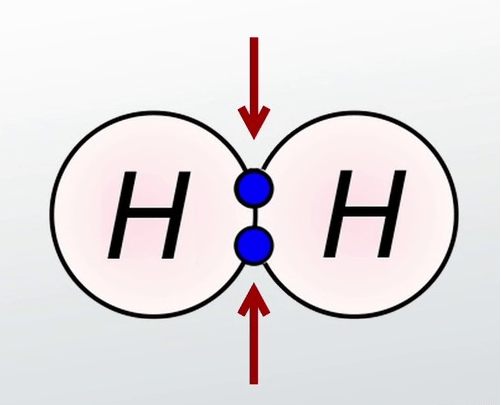
What type of bond is shown in this image?
a)
Ionic
b)
Polar Covalent
c)
Nonpolar Covalent
d)
Van der Waals Force
67.
With the ________ you must have 8 electrons on the outside ring.
a)
anions
b)
ionic bonds
c)
cations
d)
octet rule
68.

Phosphorus tribromide

a)

PBr

b)

PBr7

c)

P3Br

d)

PBr3

69.

Intermolecular forces for: CO2

a)

Dispersion Force

b)

Dipole dipole

c)

Hydrogen bonding

70.
Two Reactants and One Product
a)
Decomposition
b)
Synthesis
c)
Combustion
d)
Single Replacement
71.

In a ___________change, a substance changes into a different substance.

a)

Physical

b)

Chemical

72.

What are reactants?

a)

The chemicals that start the reaction.

b)

The chemicals that the reaction produced.

c)

The chemicals that are on the right side of the arrow.

73.

What are products?

a)

The chemicals that start the reaction.

b)

The chemicals that the reaction produced.

c)

The chemicals that are on the left side of the arrow.

74.
Always starts with a Hydrocarbon that reacts with oxygen and produces carbon dioxide and water. 
a)
Decomposition
b)
Synthesis
c)
Combustion
d)
Single Replacement
75.

The metal ions in two compounds switch.

a)

Synthesis

b)

Combustion

c)

Single Replacement

d)

Double Replacement

76.

Identify the reaction type for the following equation:

K + F2 --> KF

a)

Double replacement

b)

Single Replacement

c)

Synthesis

d)

Decomposition

77.

Identify the reaction type:

C2H6 + O2 --> CO2 + H2O

a)

Double replacement

b)

Synthesis

c)

Acid base

d)

Combustion

78.

Identify the type of reaction:

ZnCl2 + Mg --> Zn + MgCl2

a)

Precipitate

b)

Single Replacement

c)

Double Replacement

d)

Decomposition

79.

Identify the reaction type:

NaCl + KOH --> KCl + NaOH

a)

Double replacement

b)

Combustion

c)

Synthesis

d)

Decomposition

80.

Identify the reaction type:

H2O2 --> H2O + O2

a)

Decomposition

b)

Synthesis

c)

Combustion

d)

Acid Base