wayground logo

Free Printable Worksheets

Font size

S
M
L
XL
Worksheets

Unit 1 Review

Total questions: 121

Worksheet time: 2hrs 12mins

Name
Class
Date
1.

What is the most abundant gas in the atmosphere?

a)

Oxygen

b)

Hydrogen

c)

Nitrogen

d)

Carbon Dioxide

2.

A major source of oxygen for the Earth's atmosphere is

a)

Sea Water

b)

The Sun

c)

Plants

d)

Animals

3.

The bottom layer of the atmosphere, where almost all weather occurs, is the

a)

Stratosphere

b)

Troposphere

c)

Thermosphere

d)

Mesosphere

4.

What percentage of the solar energy that reaches the outer atmosphere is absorbed at the Earth's surface?

a)

20%

b)

30%

c)

50%

d)

70%

5.

The Ozone is located in the

a)

Stratosphere

b)

Troposphere

c)

Thermosphere

d)

Mesosphere

6.

By which method does most thermal energy in the atmosphere circulate?

a)

Conduction

b)

Convection

c)

Advection

d)

Radiation

7.

The balance between incoming energy and outgoing energy is called

a)

The Convection Balance

b)

The Conduction Balance

c)

The Greenhouse Effect

d)

The Radiation Balance

8.

Which of the following is NOT a primary pollutant?

a)

Car Exhaust

b)

Acid Precipitation

c)

Smoke from a factory

d)

Fumes from burning plastic

9.

The Clean Air Act

a)

controls the amount of air pollutants that can be released from many sources.

b)

requires cars to run on fuels other than gasoline

c)

requires many industries to use scrubbers

d)

Both (a) and (c)

10.

Which of the following statements describes how temperature changes in the mesosphere?

a)

Temperature increases as altitude increases.

b)

Temperature decreases as altitude increases.

c)

Temperature decreases as pressure increases

d)

Temperature does not change as pressure increases.

11.

In which layers does temperature decrease as pressure decreases?

a)

the troposphere and the mesosphere

b)

the troposphere and the stratosphere

c)

the ozone layer and the troposphere

d)

the ozone layer and the thermosphere

12.

A research balloon took measurements at 23 km, 35 km, 52 km, 73 km, 86 km, 92 km, 101 km, and 110 km. Which measurements were taken in the mesosphere?

a)

measurements at 23 km and 35 km

b)

measurements at 52 km and 73 km

c)

measurements at 86 km and 92 km

d)

measurements at 101 km and 110 km

13.

An airplane is flying at a speed of 500 km/h when it encounters a jet stream moving in the same direction at 150 km/h. If the plane flies with the jet stream, how much farther will the plane travel in 1.5 h?

a)

950 km

b)

525 km

c)

225 km

d)

150 km

14.

An increase in carbon dioxide in the atmosphere is associated with an increase in global temperature. Which property of carbon dioxide is responsible for this temperature increase?

a)

Carbon dioxide transmits more sunlight than other atmospheric gases.

b)

Carbon dioxide efficiently turns sunlight into heat.

c)

Carbon dioxide keeps heat in the atmosphere from escaping into space.

d)

Carbon dioxide stores solar energy in chemical bonds.

15.

What element makes up most of the air we breathe?

a)

Carbon

b)

Nitrogen

c)

Oxygen

d)

Argon

16.

Which of these statements best describes temperature as elevation in the atmosphere increases?

a)

Temperature remains constant with elevation in the thermosphere.

b)

Temperature remains constant with elevation in the mesosphere

c)

Temperature generally decreases with elevation in the stratosphere.

d)

Temperature generally decreases with elevation in the troposphere.

17.

Atmospheric greenhouse gasses help heat the atmosphere by

a)

increasing the amount of solar radiation reaching Earth.

b)

storing energy produced by human activity.

c)

absorbing infrared radiation released by Earth.

d)

increasing the average density of air.

18.

A weather balloon is about 2 meters wide when it is near the ground. It grows to about 6 meters wide at higher altitudes. Which change most likely makes the balloon become wider at higher altitudes?

a)

More gases enter the balloon.

b)

The gas inside the balloon gets much hotter.

c)

The air pressure surrounding the balloon decreases.

d)

Sunlight breaks down the material of the balloon.

19.

The temperature of the stratosphere increases with altitude because of the presence of

a)

Nitrogen

b)

Water Vapor

c)

Ozone

d)

Carbon Monoxide

20.

How is the stratosphere different from the troposphere?

a)

The clouds in the stratosphere produce more rain.

b)

The air in the stratosphere has a greater density.

c)

The composition of the stratosphere lacks ozone.

d)

The temperature of the stratosphere warms at higher altitude.

21.

When a plane flies, it travels through air that contains gases, liquids, and solids. This area is best described

as the

a)

Atmosphere

b)

Lithosphere

c)

Biosphere

d)

Hydrosphere

22.

Why does the troposphere experience the greatest amount of atmospheric pressure compared to the other atmospheric layers?

a)

It produces the ozone

b)

It has the highest temperatures

c)

It contains a high concentration of gas particles

d)

It is the region in which weather occurs

23.

What trait is common in gasses that contribute to Earth's greenhouse effect?

a)

The ability to trap heat

b)

a tendency to lose electrons

c)

a tendency to exist as diatomic molecules

d)

the ability to bond with multiple other elements

24.

Many countries depend on the energy from fossil fuels. Some scientists suggest using renewable sources of energy instead. Why would scientists most likely suggest using renewable sources of energy?

a)

They are safer for the environment

b)

They are cheaper to develop

c)

They are easier to transport

d)

They produce more energy

25.

Nonrenewable energy sources, such as oil and natural gas, are formed from the remains of organisms buried beneath the surface of Earth. What is one advantage of using natural gas instead of solar power to generate electricity?

a)

Natural gas is free to extract and use.

b)

Natural gas plants can convert gas to electricity.

c)

Natural gas is safer than solar energy.

d)

Natural gas plants can make power at night.

26.

In the 1970s scientists began investigating the chemical reactions that caused the destruction of ozone in the upper atmosphere. Which statement best describes a direct result of their research on society and on the environment?

a)

Research in space travel was moved to the forefront

b)

The fields of “frontier” and “junk” science were established.

c)

Alternatives to ozone-depleting aerosols were invented.

d)

Grocery stores began using plastic bags instead of paper.

27.

Measurements of carbon dioxide concentrations in the air taken over the past decade have shown a

a)

leveling off.

b)

slow increase.

c)

steady decline.

d)

dramatic increase.

28.

Automobile engines built today are designed to be gas efficient. Gas-efficient engines most likely affect a city by reducing

a)

air pollution.

b)

heat pollution.

c)

noise pollution.

d)

light pollution.

29.

The atmosphere is important because

a)

it provides conditions that support life

b)

it protects us from meteoroids

c)

it protects us from harmful UV radiation from the sun

d)

all of the above

30.

A tornado begins as a ___________ cloud that pokes through the bottom of a cumulonimbus cloud.

a)

cirrus

b)

cumulus

c)

funnel

d)

stratus

31.
What are thunderstorms?
a)
a storm with thunder and lighting and typically also heavy rain or hail
b)
a storm that can be the same as thunderstorms, but even more dangerous
c)
a mobile, destructive vortex of violently rotating winds having the appearance of a funnel shaped cloud and advancing beneath a large storm system.
d)
a huge storm with strong winds and storm surges
32.
A severe storm that involves high winds and forms over water is:
a)
tornado
b)
thunderstorm
c)
hurricane
d)
blizzard
33.
A severe storm which involves a funnel cloud forming over land is:
a)
hurricane
b)
tornado
c)
thunderstorm
d)
blizzard
34.
These can be produced by thunderstorms
a)
stationary fronts
b)
tornadoes
c)
volcanoes
d)
tsunamis
35.
What do hurricanes feed on?
a)
warm tropical water
b)
hot water
c)
cold artic water
d)
rain
36.
Hurricanes develop in ________ regions.
a)
Arctic
b)
Tropical
c)
Arid
d)
None of the above
37.
Where is Tornado Alley located?
a)
Near the equator of the Earth
b)
Near the North Pole
c)
South Central Los Angeles
d)
Middle states of United States
38.
This person studies the Earth's atmosphere and monitors and forecasts the weather
a)
Seismologist
b)
Meteorologist
c)
Volcanologist
d)
Geologist
39.
What is the scale used to measure hurricanes?
a)
MPH scale
b)
Fujita Scale
c)
Weight Scale
d)
Saffir/Simpson Scale
40.
What is the scale that is used to measure tornadoes?
a)
Mohs Scale
b)
Enhanced Fujita Scale
c)
Saffir Simpson Scale
d)
McDonalds Scale
41.
What happens if a hurricane moves over land or cold ocean water?
a)
it will get stronger
b)
it will get weaker
c)
it will upgrade its category
d)
it will morph into a typhoon
42.
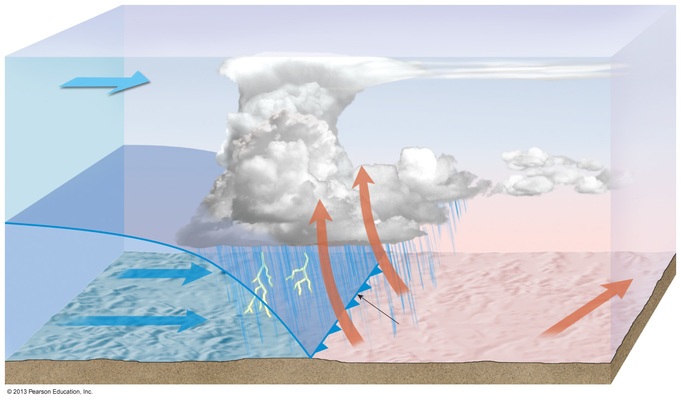
A rapidly moving cold air mass runs into a warm air mass. The cold air slides under the warm air. This is called a(n)  .....
a)
cold front
b)
warm front
c)
stationary front
d)
occluded front
43.
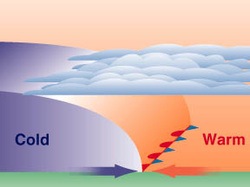
When a warm air mass gently slides on top of a cold air mass, and you have drizzly rain and then warmer weather, what type of front is it?
a)
warm front
b)
cold front
c)
occluded front
d)
stationary front
44.
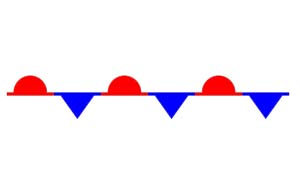
What type of storm front is this? 
a)
warm front
b)
cold front
c)
stationary front
d)
occluded front
45.
A front is
a)
where warm air is cooling at earth's surface
b)
a line where hot and cold air are separating
c)
a line where two different air masses meet
d)
where cold air is rising and forming rain clouds
46.
Which most likely produces clear, cool weather?
a)
zero air pressure
b)
stable air pressure
c)
a low pressure system
d)
a high pressure system
47.
Which type of front is pictured?
a)
Cold front
b)
Warm front
c)
Occluded front
d)
Stationary front
48.
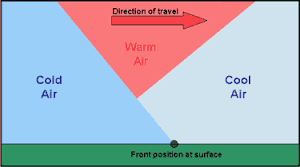
Which type of front is pictured?
a)
Cold front
b)
Warm front
c)
Occluded front
d)
Stationary front
49.
Which type of front is associated with the front not moving in either direction?
a)
Cold
b)
Warm
c)
Stationary
d)
Occluded
50.
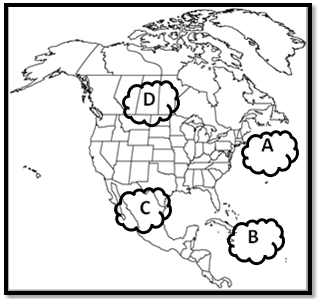
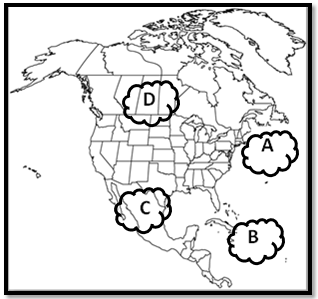
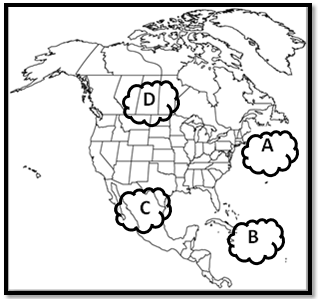
Which type of air would you find at air mass A?
a)
cold, dry
b)
warm, humid
c)
warm, dry
d)
cold, humid
51.
Which type of air would you find at air mass C?
a)
cold, dry
b)
warm, humid
c)
warm, dry
d)
cold, humid
52.
Which type of air would you find at air mass D?
a)
cold, dry
b)
warm, humid
c)
warm, dry
d)
cold, humid
53.
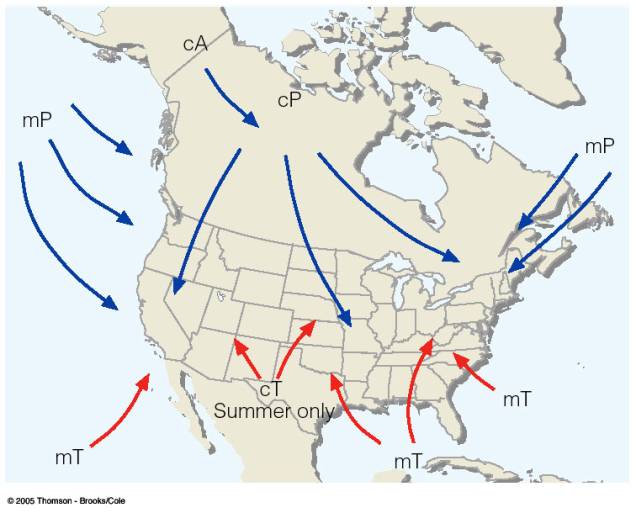
A wet, cold air mass would be - 
a)
maritime tropical 
b)
maritime polar
c)
continental tropical 
d)
continental polar
54.
Which abbreviation of an air mass can be identified as cold and humid?
a)
cP
b)
mP
c)
cT
d)
mT
55.
Which abbreviation of an air mass can be identified as dry and cold?
a)
cP
b)
mP
c)
cT
d)
mT
56.

Which is the correct symbol for an occluded front?

a)
b)
c)
d)
57.

Which is the correct symbol for a stationary front?

a)
b)
c)
d)
58.

Which is the correct symbol for a warm front?

a)
b)
c)
d)
59.

Which is the correct symbol for a cold front?
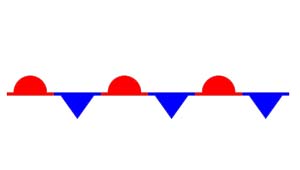
a)
b)
c)
d)
60.
A hurricane rotates _____.
a)
Clockwise
b)
Counterclockwise 
61.
Low pressure will usually bring what kind of weather?
a)
Sunny
b)
Calm
c)
Stormy
62.
High pressure will usually bring what kind of weather?
a)
clear and dry
b)
cloudy and wet
63.
Which kind of weather change will occur with an increase in air pressure?
a)
cooler and dryer
b)
colder and rainier
c)
hotter and stormier
d)
warmer and moister
64.

In what layer of the atmosphere would you find clouds?

a)

mesopshere

b)

troposphere

c)

thermosphere

d)

exosphere

65.

The process where water vapor in the air gets colder and changes back into liquid, forming clouds is called what?

a)

evaporation

b)

transpiration

c)

condensation

d)

concentration

66.

What is the name of the instrument that uses wet-bulb and dry-bulb thermometers to measure relative humidity?

a)

spring scaled

b)

sling psychrometer

c)

barometer

d)

rain gauge

67.

When water falls to Earth as precipitation and ends up on land, it may soak into Earth. What does it become part of?

a)

the groundwater

b)

a tributary

c)

a mist

d)

a river

68.

When white, puffy cumulus clouds appear in South Carolina, the weather that day will MOST LIKELY be...

a)

rainy

b)

fair

c)

stormy

d)

foggy

69.

Layered clouds that often cover much of the sky and may indicate rain are called

a)

cirrus

b)

cumulus

c)

stratus

d)

cumulonimbus

70.

Very high feathery clouds formed mostly of ice crystals are called...

a)

cirrus

b)

cumulus

c)

stratus

d)

cumulonimbus

71.

As water goes through the water cycle, the amount of water _________.

a)

stays the same

b)

decreases

c)

increases and then decreases

d)

increases

72.

The greatest source of moisture entering the atmosphere is evaporation from the surface of...

a)

the oceans

b)

the land

c)

ice sheets and glaciers

d)

lakes and streams

73.

As the air temperature increases, the warm air can hold...

a)

more water vapor

b)

less water vapor

c)

the same amount of water vapor

d)

The change in water vapor is unrelated to air temperature.

74.

When you are passing through a stratus cloud that has formed near the ground, you are experiencing _____.

a)

fog

b)

precipitation

c)

dew

d)

a dream

75.

The student took a reading using a barometer of 1018 millibars. What was he measuring?

a)

air pressure

b)

temperature

c)

relative humidity

d)

rain

76.

Which of these clouds would least likely produce precipitation?

a)

cirrus

b)

stratus

c)

cumulus

d)

cumulonimbus

77.

When a puddle dries up, this is an example of _____.

a)

evaporation

b)

transpiration

c)

condensation

d)

precipitation

78.

What is the source of energy that drives the water cycle?

a)

sun

b)

ocean

c)

land

d)

gravity

79.

What is transpiration?

a)

Transpiration is a process where water vapor exits a plant through holes in the leaves

b)

Transpiration is a process where water vapor enters the atmosphere when animals breathe.

c)

Transpiration is a process where water vapor forms clouds.

d)

ranspiration is a process where water vapor enters the atmosphere as water evaporates from the ground.

80.

What type of clouds are these?

a)

cirrus

b)

cumulus

c)

stratus

d)

cumulonimbus

81.

What types of clouds are these?

a)

cirrus

b)

stratus

c)

cumulus

d)

cumulonimbus

82.

What types of clouds are these?

a)

cirrus

b)

cumulus

c)

stratus

d)

cumulonimbus

83.

What types of clouds are these?

a)

cirrus

b)

cumulus

c)

stratus

d)

cumulonimbus

84.

What layer of the atmosphere is the hottest?

a)

troposphere

b)

mesosphere

c)

thermosphere

d)

exosphere

85.

The amount of water vapor in the air

a)

humidity

b)

evaporation

c)

condensation

d)

air pressure

86.
What does this tool measure?
a)
Wind speed
b)
Wind direction
c)
Air pressure
d)
Temperature
87.
This weather instrument is a...
a)
anemometer
b)
barometer
c)
wind vane
d)
thermometer
88.
A rain gauge measures what?
a)
Air pressure
b)
Wind speed
wind speed
c)
Amount of rain fall
d)
Wind direction
89.
This weather instrument is an...
a)
wind vane
b)
anemometer
c)
barometer
d)
thermometer
90.
The weather forecast tomorrow says there will be a 15 mph northeast wind and a high temperature of 52 degrees. What three instruments will a meteorologist use to make this prediction?
a)
anemometer, wind vane, thermometer
b)
barometer, hygrometer, wind vane
c)
thermometer, satellite image, hygrometer
d)
wind vane, satellite image, barometer
91.
The weather forecast tomorrow says there will be a 15 mph northeast wind and a high temperature of 52 degrees. What three instruments will a meteorologist use to make this prediction?
a)
anemometer, wind vane, thermometer
b)
barometer, hygrometer, wind vane
c)
thermometer, satellite image, hygrometer
d)
wind vane, satellite image, barometer
92.
Which tool measures wind speed?
a)
Anemometer
b)
Hygrometer
c)
Barometer
d)
Wind Vane
93.
A weather vane measures wind direction by...
a)
North, South, East and West
b)
Up, Down, Left and Right
94.

The amount of water vapor in the air is known as ___.

a)

dew point

b)

humidty

c)

relative humidity

d)

rain

95.

Which one of the following is an accurate relative humidity reading?

a)

32 degrees

b)

24 mL

c)

45%

d)

15 NW

96.

Which will hold more water, warm air or cold air?

a)

Warm Air

b)

Cold AIr

97.

Dew is what?

a)

Water that is pushed out by plants

b)

Water that was a gas in the atmosphere, but when it cooled turned into liquid water touching a solid object

c)

Water from the ground

98.
Which weather instrument is useful in measuring relative humidity?
a)
barometer
b)
anemometer
c)
psychrometer
d)
wind vane
99.
The amount of water vapor in the atmosphere compared to how much it could hold.
a)
Saturation
b)
Vaporicity
c)
Absolute Humidity
d)
Relative Humidity
100.
Which cylinder represents the warmest air?
a)
1
b)
3
c)
4
d)
5
101.
The warmer the air the __________ water vapor it can hold.
a)
less
b)
more
102.
Which cylinder represents the highest relative humidity? 
a)
1
b)
3
c)
4
d)
5
103.
How does air temperature affect humidity?
a)
warmer air = lower humidity
colder air = higher humidty
b)
temperature does not affect humidity
c)
colder air = lower humidity
warmer air = higher humidity
d)
warm air and cold air = high humidity
104.
If it's a hot day outside, which statement is true? 
a)
The air molecules move slower. 
b)
There are more clouds in the sky. 
c)
There is little radiation energy in the air. 
d)
There is more radiation energy in the air. 
105.
What is the definition of CONDUCTION?
a)
When heat is transferred from objects like rays of light or electromagnetically.
b)
a  hot liquid or air that  expands, becomes less dense, and rises or becomes more dense, and sinks.
c)
When heat transfers from objects that are touching.
d)
When heat transfers through the heater or AC in your house.
106.
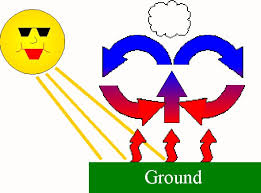
What is the definition of CONVECTION
a)
When heat transfers through waves.
b)
When heat transfers from objects that are touching.
c)
a  hot liquid or air that  expands, becomes less dense, and rises or becomes more dense, and sinks.
d)
Heat traveling from the sun
107.
What kind of heat transfer happens when the sun is heating your body?
a)
Conduction
b)
Radiation
c)
Convection
d)
Density
108.
Which of the following is an example of convection?
a)
A hair dryer is drying up your hair.
b)
When the AC or heater changes the temperature.
c)
When a car engine turns hot after being turned on.
d)
When you are making soup and the water is rising and lowering.
109.
When a pot is  touching a stove that is on, what heat transfer is happening?
a)
I don't know??????
b)
Radiation
c)
Conduction
d)
Convection
110.
The way the heat is moving from the hot coffee is called...
a)
convection
b)
radiation
c)
insulation
d)
conduction
111.
Warm air rises and the cool air sinks demonstrates this type of heat transfer. 
a)
conduction
b)
convection
c)
radiation
d)
Insolation 
112.
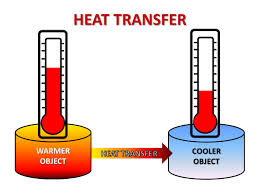
Heat transfers from an area of ____temperature to an area of ___ temperature.
a)
high to low
b)
low to high
c)
high to high
d)
It can travel high to low and low to high. 
113.
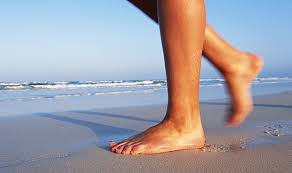
Walking on the warm sand sand with your bare feet demonstrates this type of heat transfer. 
a)
conduction
b)
convection
c)
radiation
114.
Why are there global winds?
a)
because the cold air sinkes from the poles to the equator
b)
because the earth is rotating from east to west
c)
because the sun heats the air at the equator more than anywhere else on earth
115.
Which way to the global winds blow in each hemisphere?
a)
east to west in Northern Hemisphere and west to east in the Southern Hemisphere
b)
west to east in Northern Hemisphere and east to west in Southern Hemisphere
c)
North to south in the Northern Hemisphere and south to north in Southern Hemisphere
d)
south to north in the Northern Hemisphere and north to south in the Southern Hemisphere
116.
When the water is cooler than the land at day, what kind of local wind do you have? 
a)
Land breeze
b)
Sea Breeze
117.

These global winds blow from 30 degree latitude to the equator.

a)

Polar Easterlies

b)

Westerlies

c)

Tradewinds

d)

Doldrums

118.

Air always wants to move from areas of ______________ pressure to _______________ pressure.

a)

low to high

b)

high to low

c)

doesn't matter

d)

huh?

119.

The air we breathe is mostly

a)

oxygen

b)

carbon dioxide

c)

ozone

d)

nitrogen

120.
What is the Coriolis Effect and how does it effect global winds?
a)
Curving of winds due to rotation of earth curves wind counterclockwise in Northern Hemisphere and clockwise in the Southern Hemisphere
b)
Movement of ocean currents caused by earth rotation' counterclockwise in Northern Hemisphere and clockwise in Southern Hemisphere
c)
curve of global winds caused by global rotation clockwise in Northern Hemisphere and counterclockwise in Southern Hemisphere
121.
How does the Coriolis Effect influence hurricanes and cyclones
a)
determines how powerful they will be
b)
determines where they will go
c)
determines where they form
d)
determines the direction of the wind rotation