wayground logo

Free Printable Worksheets

Font size

S
M
L
XL
Worksheets

Life Science Pre-Test 2021

Total questions: 118

Worksheet time: 3hrs 59mins

Name
Class
Date
1.
Original: ATCCAT
Mutation: ATCGCAT
What type of mutation occurred?
a)
deletion
b)
insertion
c)
Viking Bowl
d)
transverse
2.
Original DNA: CAT GAT
New DNA: CAT AT
What type of mutation occurred?
a)
deletion
b)
substitution 
c)
Bob
d)
insertion
3.
DNA molecule segment is : TTACGCAAG
The mutated DNA segment is TTATTATTACGCAAG. This is an example of a ___ mutation.
a)
Substitution
b)
Duplication
c)
Insertion
d)
Inversion
4.
Any change in the sequence of DNA or RNA is a ...
a)
transgenic shift
b)
Single Genotype
c)
Monochromatic 
d)
Mutation
5.
What is a codon?
a)
It is a three letter section of bases that are read by ribosomes to stamp amino acids into a protein
b)
They are the codes on the DNA (hence "code-on"
c)
It is a type of mutation that occurs when there has been a substitution, deletion or insertion.
d)
It is the secret material that gave Captain Marvel his power!
6.
In DNA or RNA, Guanine should always bonds with ______________.
a)
Adenine
b)
Guanine
c)
Cytosine
d)
Thymine
7.
In DNA, Adenine bonds with ______________.
a)
Guanine
b)
Thymine
c)
Cytosine
d)
Adenine
8.
Cigarette smoke, toxic waste, Ultraviolet radiation, and other environmental agents that cause mutations, are called:
a)
Mutagenic ooze
b)
mutagens
c)
carcinoma
d)
flatulents
9.

Are all mutations bad?

a)

Yes

b)

No

c)

Arby's Beef and Cheddar

10.
The following picture is 
a)
DNA
b)
RNA
c)
mRNA
d)
tRNA
11.
How does a child get Tay-Sachs?
a)
Bacteria Infection
b)
Both mom & dad have to be carriers of the gene
c)
Unknown
d)
Mom has allergies
12.

Mutations can benefit humans because they can:

a)

Cause illness

b)

Make an organism more suited to live in its environment.

c)

Make organisms live shorter lives

d)

Cause organisms to grow extra limbs.

13.
In a molecule of double-stranded DNA, the amount of Adenine present is always equal to the amount of
a)
cytosine
b)
guanine
c)
thymine
d)
uracil
14.

How does RNA help DNA to make proteins?

a)

By making partial copies of DNA

b)

RNA doesn't help make proteins

c)

RNA copies all of the DNA

d)

RNA turns proteins into DNA

15.

What does DNA stand for?

a)

donuts need algea

b)

did no algebra

c)

do not answer

d)

deoxyribonucleic acid

e)

Desinenucleic Armature

16.

If a DNA sequence is CATCAT, what are the matching base pairs?

a)

ACGTAC

b)

MEOW

c)

GTAGTA

d)

GCCTAT

17.

How does DNA replicate? Choose the 3 steps.

a)

1st, it unwinds and unzips.

b)

Finally, Elves weave new proteins from the DNA

c)

Then, new bases match up to the parent strands.

d)

Next, the two single strands act as a template for new strands to be created.

18.

Which sequence of DNA bases would pair with this partial strand

ATG TGA CAG

a)

ATG TGA CAG

b)

TAC ACT GTC

c)

GTA AGT GAC

d)

CAT TCA CTG

19.

Which of the following is an example of a harmful mutation?

a)

Developing cancer

b)

Makes the organism faster

c)

Makes the organism a predator

d)

Develops sharp claws

20.
What are the three types of mutation? 
a)
Insertion, Deletion, Subsitution
b)
Deletion, Newstion, Subsitution 
c)
Newstion, Deletion, Insertion 
d)
Insertion, Newstion, Substitution 
21.

Which of the following is an example of a beneficial mutation?

a)

When an organism's lifespan becomes shorter.

b)

When an organism becomes unable to reproduce.

c)

When an organism's body becomes deformed.

d)

When an organism develops immunity to a disease.

22.
which symbiosis is this 
a)
parasitism 
b)
mutualism
c)
commensalism
d)
nonalism 
23.
The image provided is an example of a(n):
a)
Carnivore
b)
Herbivore
c)
Producer
d)
Autotroph
24.
A collection of organisms that belong to different populations but all live in the same area and interact with one another.
a)
Population
b)
Ecosystem
c)
Community
d)
Ecosphere
25.
Osmosis is a form of ______________. 
a)
Passive Transport
b)
Active Transport
26.
The amount of particles in a given space.
a)
diffusion
b)
concentration
c)
permeable
d)
active transport
27.

The process where only water is allowed to pass through the cell membrane (or any selectively permeable membrane) from a high to low concentration.

a)

meiosis

b)

respiration

c)

diffusion

d)

osmosis

28.

Larger particles are removed from a cell (pushed out):

a)

Endocytosis

b)

Exocytosis

c)

Permeable

d)

In high concentration

29.
Cells use energy to move materials across a membrane (low to high concentration).
a)
Active transport
b)
Passive transport
c)
Diffusion
d)
Osmosis
30.

Which of the following solutions shows a higher concentration of red molecules?

a)
b)
31.

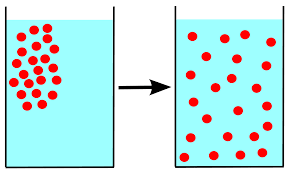
The picture below is an example of _________________.

a)

osmosis

b)

isotonic

c)

diffusion

d)

active transport

32.

What is the correct equation for cellular respiration?

a)

6O2 + C6H12O6 + Energy → 6CO2 + 6H2O

b)

6O2 + C6H12O6 → 6CO2 + 6H2O + Energy

c)

6CO2 + 6H2O + Energy → 6O2 + C6H12O6

d)

6CO2 + 6H2O → 6O2 + C6H12O6 + Energy

33.
What are the products of cellular respiration?
a)
Energy (ATP), Water, and Carbon DIoxide.
b)
Water and Oxygen
c)
Oxygen and Carbon Dioxide
d)
Water and Energy (ATP)
34.
What is the name of the green pigment inside plants?
a)
Monophyll
b)
Chlorophyll
c)
Epiphyll
d)
Glorophyll
35.
Which of the following is the correct equation for PHOTOSYNTHESIS?
a)
6CO2 + 6H2O --> 6O+ C6H12O6
b)
6CO+ C6H12O6 + 6H2O --> O
c)
6O2 + 6H2O --> 6CO+ C6H12O6
d)
C6H12O6 + 6O2 ---> 6H2O + 6CO2 
36.
This picture represents what type of cell transport?
a)
endocytosis
b)
exocytosis
c)
osmosis
d)
vacuole
37.

What are the two general types of cell transport?

a)

Passive and Active

b)

Active and Sleeping

c)

Rohlson's and Facilitated

d)

There is no cell transport, as they are self contained

e)

Arby's and Taco Bell

38.

Which of these are part of Mitosis?

a)

Metaphase

b)

Prophase

c)

Anaphase

d)

Telophase

e)

Cytokines

39.

What are the "X" shaped things in the drawing.

a)

PMATs

b)

Chromosomes

c)

Ribosomes

d)

Telophase

40.

During what phase of Mitosis do the chromosomes line up in the Middle

a)

Metaphase

b)

Prophase

c)

Telophase

d)

Anaphase

41.

How many chromosomes to do most human cells have?

a)

2

b)

46

c)

92

d)

Identical to your age

42.
What phase of mitosis is pictured?
a)
Metaphase
b)
Telophase
c)
Prophase
d)
Anaphase
43.
Why would it be important to replicate DNA before a cell divides in mitosis or meiosis?
a)
In order for genetic information to be transferred into daughter cells.
b)
In order for the cell to be able to increase in size.
c)
In order for the DNA to be contained in the nucleus.
d)
In order for the cell to re-order the DNA sequencing in the new cells.
44.
Name the phase:
a)
Prophase
b)
Metaphase
c)
Anaphase
d)
Telophase
45.

What types of cell have their DNA enclosed in a nucleus?

a)

Prokaryotic

b)

Eukaryotic

c)

Bacterial Cells

d)

All Cells

46.

Where does a cell contain the vast majority of its genetic material?

a)

nucleus

b)

cell membrane

c)

cytoskeleton

d)

golgi apparatus

47.

You start with 1 cell, and that cell undergoes mitosis. At the end of mitosis how many identical cells will you have?

a)

1

b)

2

c)

3

d)

4

48.

In which cell below would a student likely observe a cell plate during mitosis?

a)

rat muscle cell

b)

alligator stomach cell

c)

onion root cell

d)

cat lung cell

49.
The passing of genetic traits from parent to offspring is called
a)
cross-pollination
b)
cross-breeding
c)
heredity
d)
unfortunate 
50.

How can two parents with brown eyes have a child with blue eyes?

a)

The parents both have recessive genes for blue eyes.

b)

The child was born at sea on a cruise ship

c)

Eye color in humans is not an inherited trait

d)

The child was deprived of oxygen during its birth

e)

The mom ate a ton of blue raspberry Snowcones during pregnancy

51.

An allele whose trait always shows up in the organism when the allele is present.

a)

recessive allele

b)

dominant allele

c)

depressed allele

d)

Alejandro allie allele

52.

Having two of the same genes for the trait (sometimes called purebred).

a)

homozygous

b)

hetrozygous

c)

protein

d)

Owendalian

53.
What is a phenotype?
a)
The expression of a trait; physical appearance.
b)
refers to the genetic makeup of an individual
c)
An organism that has the same genes for a trait (ex. TT or tt)
d)
a type of organic cytoplasm
54.
A Heterozygous yellow pea plant's genotype would be:
a)
YY
b)
yy
c)
Yy
d)
Yg
55.
Dominant alleles are represented by a:
a)
Male gene
b)
lowercase letter
c)
recessive trait
d)
capital letter
56.
What is the genotype for this organism?
(E= 3 eyes, e= 1 eye)
a)
EE
b)
Ee
c)
ee
d)
EE or Ee
57.
The Father of Genetics is:
a)
Mike the Barber
b)
Howie Mendel
c)
George Mandible
d)
Gregor Mendel
58.
An organism's genetic make-up, like having a TT or Tt allele:
a)
phenotype
b)
genotype
c)
dominant
d)
recessive
59.
Which of the following is a phenotype?
a)
Aa
b)
red hair
c)
heterozygous
d)
BB
60.
___________is the likelihood, or chance, that a certain event will occur.
a)
Chuck Norris
b)
Probability
c)
Locus
d)
Inheritance
61.
G = green, g = yellow
The genotype for a yellow plant is...
a)
GG
b)
Gg
c)
gg
d)
all of the choices result in yellow
62.

What did Gregor Mendel use to discover the principles that rule heredity?

a)

Pea Plant

b)

Pigeons

c)

Pear trees

d)

Photosynthesis

63.

Made up of One Cell

a)

Unicellular

b)

Multicellular

64.

a grouping of two or more types of tissue that performs a specific function that contributes to the larger purpose

a)

Organ

b)

Organ System

c)

Organelle

d)

Organ in an attic that is super sweet

65.

The Stomach is part of the Digestive System. It's part of a ______________

a)

Organ System

b)

Multi cellular system

c)

pick up

d)

Matrix

66.

Cells form Tissues, Tissues form Organs, organs work together in Organ Systems. These organ systems working together result in an organism.

a)

True

b)

False.

67.

Groups of cells with a similar structure working together for a specific job or function. There are four main types in the human body.

a)

tissue

b)

organ

c)

organ system

d)

homeostasis

e)

stress

68.
What is the correct order of organization
a)
tissues-cells-organs-organ systems-organism
b)
cell-tissue-organs-organ systems-organism
c)
organism-cells-tissues-organ systems-organism
d)
tissues-cells-organs-organ sytems-organism
69.

The four types of animal tissues, such as would be found in the iguana and the banana rat in my picture, include:

a)

nerve, connective, muscle, and protective

b)

transport, ground, nasal, and torpor

c)

Kleenex, Puffs, generic, and America's Best

d)

Blue, Red, Yellow, and Green

70.
Which of the following is NOT an organism?
a)
Kangaroo
b)
Mushroom
c)
Computer
d)
Oak tree
71.
A collection of organisms that belong to different populations but all live in the same area and interact with one another.
a)
Population
b)
Ecosystem
c)
Community
d)
Ecosphere
72.
A collection of organisms that make up a community as well as all of the nonliving aspects of the environment.
a)
Population
b)
Community
c)
Habitat
d)
Ecosystem
73.

True or False: A community is made up of populations of different species that live in the same place and interact.

a)

True

b)

False

74.

All the snakes in the area make up this:

a)

organism

b)

ecosystem

c)

population

d)

confusion

75.

Kittens in the box make up a:

a)

Organism

b)

Population

c)

Community

d)

Supper

76.

All the living creatures and all the nonliving factors make up this:

a)

Organism

b)

Population

c)

Community

d)

Ecosystem

77.
What do gravity, sounds, and light have in common?
a)
They are necessary for survival
b)
They are characteristics of life.
c)
They are experiences all organisms share
d)
They are examples of stimuli
78.
What happens when organisms reproduce?
a)
They grow and develop
b)
They sense change in their environment.
c)
They maintain a stable internal environment. 
d)
They make organisms similar to themselves.
79.

When a duck dives under water, its inner eyelids automatically raise to cover the duck's eyes. In this case, water acts as

a)

homeostasis

b)

a stimulus

c)

a reaction

d)

an enzyme

80.
What does a consumer eat?
a)
other organisms
b)
makes its own food
c)
dead organisms
d)
doesn't need to eat
81.

What kind of organism makes their own food?

a)

consumer

b)

producer

c)

decomposer

d)

Arby's chef

82.
What kind of reproduction results in an offspring that is identical to its parent?
a)
asexual reproduction
b)
sexual reproduction
83.
What is the sum of all an organism's chemical processes?
a)
amino acids
b)
metabolism
c)
ATP
d)
nucleic acids
84.

Unicellular means

a)

more than one cell.

b)

only one cell.

85.

The production of offspring is called

a)

biomes.

b)

communities.

c)

reproduction.

d)

tissues.

86.
An expected _____________________ to touching a hot stove is to flinch away from the heat (pull your hand away).
a)
organism
b)
stimuli
c)
cells
d)
response
87.
Organisms react to environmental ________________, such as heat, sunlight and nutrient availability. 
a)
stimuli
b)
energy
c)
organism
d)
tissues
88.
What is the term for any living thing?
a)
reproduction
b)
organism
c)
development
d)
homeostasis
89.
Which of the following characteristics of living things best explains why your legs and arms get longer and stronger as you get older? 
a)
living things respond to their environment
b)
living things maintain internal balance
c)
living things are made of cells
d)
living things grow and develop
90.
A worm that turns away from light, or a plant that grows towards it, are examples of an organism 
a)
reproducing
b)
doing cellular respiration
c)
having cells
d)
responding to its environment
91.
If two organisms reproduce sexually, then their offspring will exhibit a genetic makeup that is:
a)
identical to only one parent
b)
identical to all of its siblings
c)
a unique combination of traits from both parents
d)
messed the heck up
92.
In asexual reproduction
a)
DNA does not vary between offspring
b)
Many offspring are produced in a short time
c)
Organisms may not be able to adapt to new environments
d)
All of the above
93.
If a person has the XY chromosome combination, the person 
a)
is a female.
b)
is a super powered mutant.
c)
is a male.
d)
has Down syndrome.
94.

In which phase of the cell cycle does a cell completely split apart into 2 distinct cells?

a)

Prophase

b)

Interphase

c)

Mitosis

d)

Cytokinesis

95.

The steps commonly used by scientists in gathering information to test hypotheses and solve problems are called _____ .

a)

descriptive research

b)

pure science

c)

scientific method

d)

applied science

96.

Using one or more of your senses to gather information is called ______ .

a)

observing

b)

inferring

c)

predicting

d)

classifying

97.

A possible explanation, prediction or answer to a question is...

a)

hypothesis

b)

scientific method

c)

data

d)

first aid

98.

What is the basic unit for measuring mass?

a)

Celsius

b)

gram

c)

meter

d)

liter

99.

A scientific ____ is a well-tested explanation for a wide range of observations or experimental results.

a)

inquiry

b)

hypothesis

c)

theory

d)

law

100.

A statement that describes what scientists expect to happen every time under a particular set of conditions is a _____ .

a)

scientific inquiry

b)

scientific hypothesis

c)

scientific theory

d)

scientific law

101.

Life scientists (and all scientists really!) often use _________ to represent complex objects or processes.

a)

tools

b)

toys

c)

charts & diagrams

d)

models

102.

How much space does Sponge Bob displace?

a)

1 cm3

b)

1 mL

c)

2 mL

d)

2 mg

103.
Convert 3.75 kg to grams. 
a)
3750 g 
b)
375 g
c)
37.5 g
d)
3.750 g
104.
A meter is equal to how many centimeters?
a)
1000
b)
100
c)
10
d)
1
105.
Which unit would be best to measure the distance from the classroom to the bathroom?
a)
kilometers
b)
centimeters
c)
millimeters
d)
meters
106.

A bottle of hand sanitizer is 88mL. What is its volume in Liters?

a)

.88 Liters

b)

.088 Liters

c)

8.8 Liters

d)

88 Liters

107.

What is the freezing point of water (in degrees Celsius)?

a)

32 degrees

b)

100 degrees

c)

0 degrees

d)

212 degrees

108.

To measure the distance between two towns, what metric unit of length would you use?

a)

kilometers

b)

meters

c)

millimeters

d)

centimeters

109.

What is the volume of the two red beads?

a)

2.4 cm3

b)

4 cm3

c)

6 cm3

d)

2 cm3

110.

What is the following statement?

“Judging by the shape, the footprint was made by a duck that was migrating southward”

a)

Observation

b)

Inference

c)

Prediction

d)

Fact

111.

In science, a model is a way to ____________ an idea, process, or system in order to describe, explain, or predict something.

a)

repeat

b)

represent

c)

ring

d)

roost

112.

The purpose of graphs, charts and tables is to

a)

help scientists visualize results from an experiment.

b)

make the experiment look nice.

c)

practice what I learned in Math class.

d)

Practice my drawing skills.

113.
The measurable factor in an experiment is known as the: 
a)
Control
b)
Independent Variable
c)
Constant
d)
Dependent Variable
114.

A Punnett Square is used in life science to denote probability for offspring. What type of model is it?

a)

Physical

b)

Mathematical

c)

Conceptual

d)

Plastic

115.

What is the reason for weight?

a)

the amount of matter inside of an object

b)

the amount of volume

c)

the pull of gravity

d)

the smallest particle

116.
Convert 17 m to cm:
a)
0.17 cm
b)
0.017 cm
c)
1,700 cm
d)
170 cm
117.

1000 grams = _____ kilograms

a)

0.0001

b)

1,000,000

c)

10

d)

1

118.

We almost always see building size described by floor space, which is a measurement of _____________. Mr. Hoffman thinks that volume should also be a measurement for buildings.

a)

Area

b)

Time

c)

Mass

d)

Temperature