
 Worksheets
1st Semester Review
Total questions: 121
Worksheet time: 3hrs 47mins
three hydrogen (H)
one sulfur (S)
four oxygen (O)


If the mass number of this chlorine atom is 36, how many neutrons does it have?
17
18
19
can't be determined

What is the mass number of the atom shown in the Bohr model?
11
12
23
Can't be determined
what group number are the noble gases
17
18
14
15
A student added white crystals to a clear liquid. The crystals dissolved in the liquid. After a few seconds, the liquid became quite warm and then turned bright red in color. The first indication that a chemical change was taking place could be observed when?
The crystals were added to the liquid.
The crystals dissolved in the liquid.
The temperature of the liquid increased.
The color of the mixture changed.

The table shows the properties of three classifications of elements. What are the best headings for columns A, B, and C?
Metals, Nonmetals, Metalloids
Nonmetals, Metalloids, Metals
Metals, Metalloids, Nonmetals
Nonmetals, Metals, Metalloids
All of these properties describe metals EXCEPT?
Malleable
Conductor
Brittle
Shiny

The table shows the physical properties of four elements. Which element is classified as a metalloid?
Titanium
Selenium
Potassium
Polonium

The provided table shows the properties of four different sample materials. A student has a substance with a density of 1.28 g/cm3. Which sample does the student have?
Sample 1
Sample 2
Sample 3
Sample 4

The table provided identifies a substance based on its density. A sample of an unknown substance has a mass of 89 grams and a volume of 10 cm3. Based on its density, it could be which of the following substances?
Aluminum
Brass
Copper
Gold

Use the chart below to answer the following question. A student is given the chart above and is told to identify an unknown mineral. The student observes that the mineral has a glassy luster and a hardness less than 3. What is the identity of the mineral?
Actmite
Cobaltite
Jadeite
Talc
Which of the following is an example of a physical change that occurs during digestion?
In the stomach, pepsin turns proteins to amino acids
In the mouth, enzymes break down carbohydrates
In the stomach, contractions mix and churn food
In the intestines, fatty acids are extracted from lipids
What is the mass of an atom with seven protons, seven neutrons, and eight electrons?
7
8
14
22

How many molecules of Carbon are in the following formula? 3C2H6
3
6
12
18
Al + O2 --> 2Al2O3
H2O


Which statement correctly describes the location and charge of the electrons in an atom?
F
G
H
J

Which statement accurately describes the atoms of a specific element?
F
G
H
J

21
34
13
47

48
96
160
112

A
B
C
D

Question 1
A
B
C
D

Question 2
A
B
C
D
Question 2
A
B
C
D

Question 3
A
B
C
D

Question 4
A
B
C
D

Question 5
A
B
C
D

Question 7
A
B
C
D

Question 8
A
B
C
D

Question 96
A
B
C
D

Question 97
A
B
C
D
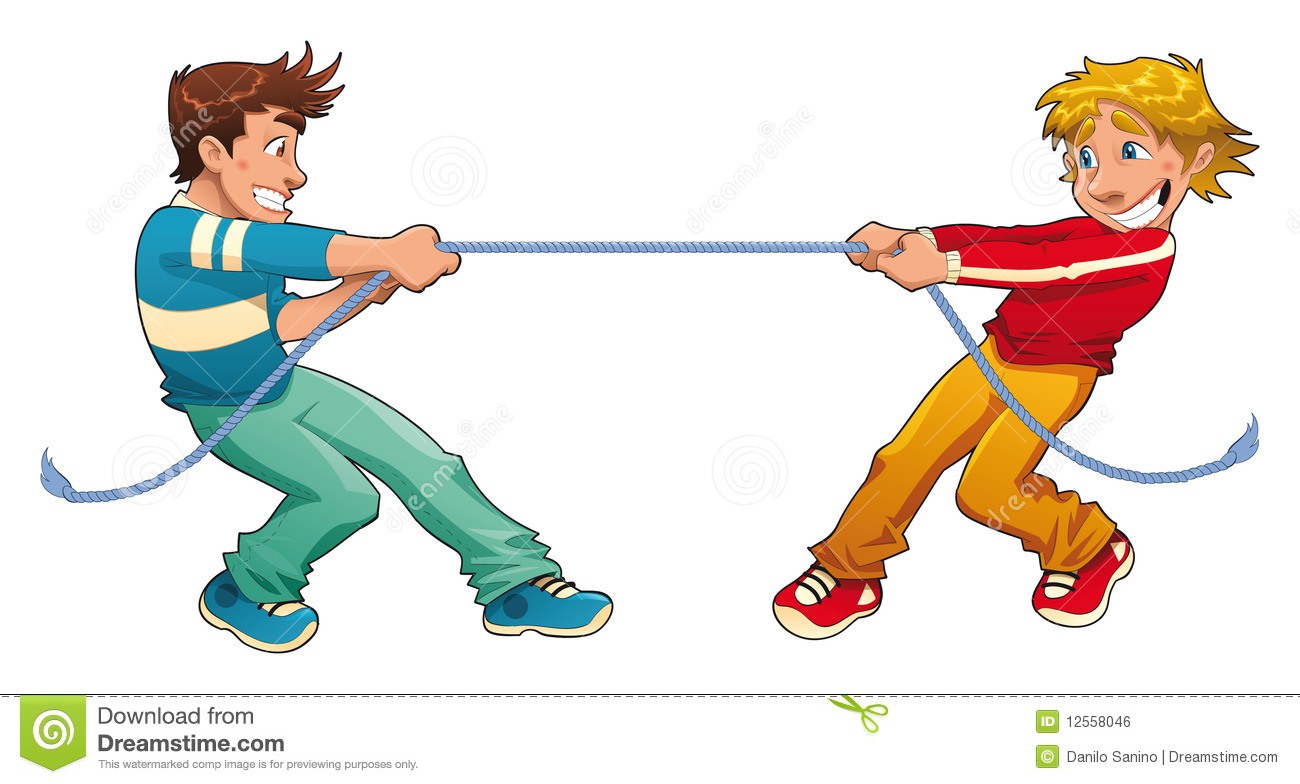
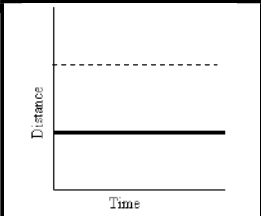

How much force is needed to accelerate a 130 pound runner at 2 m/sec?


During which segment is the object moving at the fastest speed?
A
B
C
D
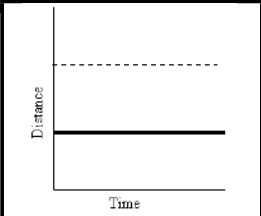
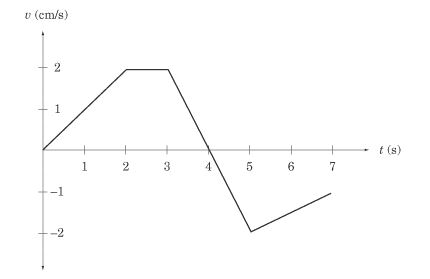
What is happening between 2 and 3 seconds?
The object is not moving.
The object is not accelerating.
The object is slowing down.
The object is speeding up.

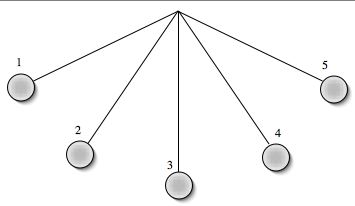
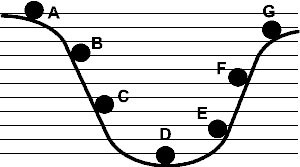
It takes more force to move a shot put than a softball
Seat belts and airbags stop you from going through the windshield of a car if you are in an accident
The more force you throw a football with, the faster it will go


A hobbyist collected data about the motion of a toy train on a straight track and then recorded the data in the graph. Which of these accurately describes the motion of the toy train?
The toy train speeds up while going forward and then slows down.
The toy train slows down while going forward and then moves backward.
The toy train moves forward at a constant speed, slows down, and then stops.
The toy train moves forward at an increasing speed, stops, and then moves forward.

Question 117
A
B
C
D

Question 132
A
B
C
D

Question 140
A
B
C
D
Four students push carts filled with sports equipment across the gym. Each student pushes with the same amount of force. Which card has the greatest change in speed?


The diagram shows two different forces acting on a cyclist riding a bicycle. The total mass of the cyclist and the bicycle is 100.0 kg. Based on this information, what is the acceleration of the cyclist?
0.66 m/s2 backward, because the force of the air slows the cyclist down.
0.66 m/s2 forward, because the applied force is greater than the force of the air.
2.3 m/s2 backward, because the forces are opposite and not equal
2.3 m/s2 forward, because the cyclist's inertia is greater than the force of the air.
Two cars with different masses travel at the same speed down a hill toward a stop sign. What will happen when both cars apply brakes at the same time to stop?
The car with the smaller mass will require less force to stop than the car with the larger mass.
The car with the larger mass will maintain its velocity while traveling down the hill.
The car with the smaller mass will take longer to stop than the car with the larger mass.
The car with the larger mass will have less inertia than the car with the smaller mass.
Which of the following best describes the velocity of an object?
30 m/s
30 m east
30 m/s east
30 m/s2

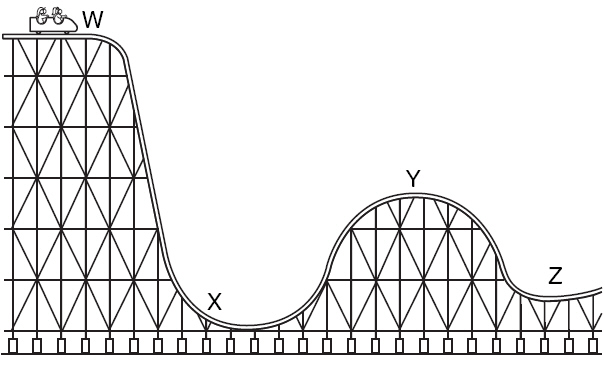
A student drew the diagram to show the movement of water through a hydroelectric dam. The student used the diagram to describe changes in the potential and kinetic energy of the water. At which location is the gravitational potential energy of the water the greatest?
Location W
Location X
Location Y
Location Z

A block is pulled 0.90 m to the right in 2.5 s. What is the block's average speed to the nearest hundredth of a m/s?
2.78 m/s
2.25 m/s
0.36 m/s
2.78 f/s
A student runs two times around a running path at a local park. Each lap is 3 km. The student completes the first lap in 20 minutes. The student then sits on a bench and rests for 5 minutes before completing the second lap in 25 minutes. Which graph best represents the student's motion?



