wayground logo

Free Printable Worksheets

Font size

S
M
L
XL
Worksheets

Last Chance #2

Total questions: 120

Worksheet time: 40mins

Name
Class
Date
1.
What moon phase is this picture?
a)
This is the full moon phase.
b)
This is the waxing gibbous moon phase.
c)
This is the waning gibbous moon phase.
d)
This is the first quarter moon phase.
2.
What moon phase is this picture?
a)
This is the waning crescent phase.
b)
This is the waxing gibbous phase.
c)
This is the waning gibbous phase.
d)
This is the new moon phase.
3.
What is this moon phase?
a)
This is the waxing crescent phase.
b)
This is the full moon phase.
c)
This is the waxing gibbous phase.
d)
This is the last quarter moon.
4.
What is this moon phase?
a)
This is the waxing gibbous moon phase.
b)
This is the last quarter moon phase.
c)
This is the first quarter moon phase.
d)
This is the new moon phase.  
5.
What moon phase is this picture?
a)
This is the full moon phase.  
b)
This is the waxing crescent moon phase.
c)
This is the waning gibbous moon phase.
d)
This is the waning crescent moon phase.
6.
What moon phase is this picture?
a)
This is the new moon phase.
b)
This is the waxing crescent moon phase.
c)
This is the waxing gibbous moon phase.
d)
This is the waning crescent moon phase.
7.
What moon phase is this image?
a)
This is the full moon phase.
b)
This is the last quarter moon phase.
c)
This is the waxing gibbous moon.
d)
This is the new moon phase.
8.
What phase of the moon is this image?
a)
This is the last quarter moon phase.
b)
This is the full moon phase.
c)
This is the first quarter moon phase.
d)
This is the waxing gibbous moon phase.
9.
What is the difference between a gibbous moon and a crescent moon?
a)
The gibbous shows more than half of the bright side of the moon.
b)
The crescent shows more than half of the bright side of the moon.
c)
The gibbous shows less than half of the bright side of the moon. 
10.
The moon seems to change shape from day to day in a cycle that lasts about a month as it goes through _.
a)
revolutions
b)
phases
c)
rotations
d)
eclipses
11.
As the moon's shape appears to get smaller, we say that the moon is _.
a)
swelling
b)
waxing
c)
waning
d)
disappearing
12.
Phases of the moon in which the moon appears to be getting larger are referred to as _.
a)
waxing
b)
waning
c)
new
d)
eclipse
13.
The cycle of the moon lasts about a _.
a)
day
b)
year
c)
week
d)
month
14.
How long is a lunar month?  
a)
30
b)
29.5
c)
27
d)
27.3
15.
What moon phase is this picture?
a)
This is the full moon phase.
b)
This is the waxing gibbous moon phase.
c)
This is the waning gibbous moon phase.
d)
This is the first quarter moon phase.
16.
What moon phase is this picture?
a)
This is the waning crescent phase.
b)
This is the waxing gibbous phase.
c)
This is the waning gibbous phase.
d)
This is the new moon phase.
17.
What is this moon phase?
a)
This is the waxing crescent phase.
b)
This is the full moon phase.
c)
This is the waxing gibbous phase.
d)
This is the last quarter moon.
18.
What is this moon phase?
a)
This is the waxing gibbous moon phase.
b)
This is the last quarter moon phase.
c)
This is the first quarter moon phase.
d)
This is the new moon phase.  
19.
What moon phase is this picture?
a)
This is the full moon phase.  
b)
This is the waxing crescent moon phase.
c)
This is the waning gibbous moon phase.
d)
This is the waning crescent moon phase.
20.
What moon phase is this picture?
a)
This is the new moon phase.
b)
This is the waxing crescent moon phase.
c)
This is the waxing gibbous moon phase.
d)
This is the waning crescent moon phase.
21.
What moon phase is this image?
a)
This is the full moon phase.
b)
This is the last quarter moon phase.
c)
This is the waxing gibbous moon.
d)
This is the new moon phase.
22.
What phase of the moon is this image?
a)
This is the last quarter moon phase.
b)
This is the full moon phase.
c)
This is the first quarter moon phase.
d)
This is the waxing gibbous moon phase.
23.
What is the difference between a gibbous moon and a crescent moon?
a)
The gibbous shows more than half of the bright side of the moon.
b)
The crescent shows more than half of the bright side of the moon.
c)
The gibbous shows less than half of the bright side of the moon. 
24.
The moon seems to change shape from day to day in a cycle that lasts about a month as it goes through _.
a)
revolutions
b)
phases
c)
rotations
d)
eclipses
25.
As the moon's shape appears to get smaller, we say that the moon is _.
a)
swelling
b)
waxing
c)
waning
d)
disappearing
26.
Phases of the moon in which the moon appears to be getting larger are referred to as _.
a)
waxing
b)
waning
c)
new
d)
eclipse
27.
The cycle of the moon lasts about a _.
a)
day
b)
year
c)
week
d)
month
28.
How long is a lunar month?  
a)
30
b)
29.5
c)
27
d)
27.3
29.
Changes in the moon's appearance are
a)
phases
b)
eclipses
c)
stages
d)
cycle
30.

What causes the moon's phases

a)

Where you are standing on Earth

b)

the amount of sunlight reflected onto the moon from the sun

c)

The tilt of Earth

d)

how fast the moon is moving

31.
Define Waxing
a)
Moon is increasing and light part appears to be growing
b)
Completely illuminated
c)
dark side is facing earth
d)
Moon is decreasing and light part appears to be shrinking
32.
How many phases does the moon go through?
a)
4
b)
8
c)
10
d)
16
33.
As the moon's shape appears to get smaller, we say that the moon is _.
a)
swelling
b)
waxing
c)
waning
d)
disappearing
34.
The cycle of the moon lasts about a _.
a)
day
b)
year
c)
week
d)
month
35.

The spinning of the earth on its axis that causes day and night is called

a)

orbit.

b)

axis.

c)

rotation.

d)

revolution.

36.

The path of an object in space around another object is a(n)

a)

orbit.

b)

axis.

c)

rotation.

d)

revolution.

37.

It takes about _____ for the earth to complete one rotation.

a)

28 days

b)

24 hours

c)

365 hours

d)

365 days

38.
If the last full moon was on April 4th, when can you expect to see the next full moon? 
a)
April 29th
b)
July 4th
c)
May 4th
d)
September 12th
39.
Changes in the moon's appearance are
a)
phases
b)
eclipses
c)
stages
d)
cycle
40.

What causes the moon's phases

a)

Where you are standing on Earth

b)

the amount of sunlight reflected onto the moon from the sun

c)

The tilt of Earth

d)

how fast the moon is moving

41.
Define Waxing
a)
Moon is increasing and light part appears to be growing
b)
Completely illuminated
c)
dark side is facing earth
d)
Moon is decreasing and light part appears to be shrinking
42.
How many phases does the moon go through?
a)
4
b)
8
c)
10
d)
16
43.
As the moon's shape appears to get smaller, we say that the moon is _.
a)
swelling
b)
waxing
c)
waning
d)
disappearing
44.
The cycle of the moon lasts about a _.
a)
day
b)
year
c)
week
d)
month
45.

The spinning of the earth on its axis that causes day and night is called

a)

orbit.

b)

axis.

c)

rotation.

d)

revolution.

46.

The path of an object in space around another object is a(n)

a)

orbit.

b)

axis.

c)

rotation.

d)

revolution.

47.

It takes about _____ for the earth to complete one rotation.

a)

28 days

b)

24 hours

c)

365 hours

d)

365 days

48.
If the last full moon was on April 4th, when can you expect to see the next full moon? 
a)
April 29th
b)
July 4th
c)
May 4th
d)
September 12th
49.

Other than "The Moon" what is a name for Earth's moon?

a)

Miranda

b)

Lunar

c)

The Moon

d)

Luna

50.

What phase of the moon is this?

a)

Full Moon

b)

Waxing Gibbous

c)

Waning Gibbous

d)

Half Moon

51.

Which phase is shown?

a)

Waning Gibbous

b)

Waxing crescent

c)

Waxing Gibbous

d)

Waning crescent

52.

Which phase is shown?

a)

New Moon

b)

Waning Gibbous

c)

Waxing Gibbous

d)

Full Moon

53.

Other than "The Moon" what is a name for Earth's moon?

a)

Miranda

b)

Lunar

c)

The Moon

d)

Luna

54.

What phase of the moon is this?

a)

Full Moon

b)

Waxing Gibbous

c)

Waning Gibbous

d)

Half Moon

55.

Which phase is shown?

a)

Waning Gibbous

b)

Waxing crescent

c)

Waxing Gibbous

d)

Waning crescent

56.

Which phase is shown?

a)

New Moon

b)

Waning Gibbous

c)

Waxing Gibbous

d)

Full Moon

57.

The moon phases occur because...

a)

the sun, the earth, and the moon do a dance and create shadows

b)

the moon grows and shrinks

c)

the moon revolves around the earth

d)

the moon produces its own light

58.

The moon goes through every phase..

a)

once a month

b)

twice a month

c)

once a year

d)

the moon doesn't have phases, it has seasons

59.

In relation to the moon, waxing means...

a)

growing

b)

shrinking

c)

shining

d)

i don't know, the karate kid does it

60.

In relation to the moon, waning means...

a)

growing

b)

shrinking

c)

crying

d)

don't horses wane?

61.

We always see the same side of the moon

a)

True

b)

False

62.

the moon affects

a)

the coriolis effect

b)

global conveyor belt

c)

the tides

d)

how we behave

63.

the moon is a natural satelite

a)

true

b)

false

64.

The moon is twice as large as the earth

a)

False

b)

True

65.

The moon is made of cheese

a)

yep, swiss cheese

b)

no.. pretty sure its just a rock

66.

As the moon moves from a new moon to a full moon, you see:

a)

the moon appearing increasingly lighter

b)

the amount of light the moon gets staying constant

c)

the amount of light the moon is receiving is decreasing

d)

more light and then less light

67.

Mrs. Smith says "the moon looks larger than the stars!" What explains this?

a)

the moon soaks up the star's light

b)

the moon is larger than stars

c)

the moon is larger than earth

d)

the moon is closer to earth than the stars are

68.

Define gibbous

a)

less than half of moon visible

b)

all of moon visible

c)

more than half of moon visible

d)

none of moon visible

69.

The diagram shows how Earth spins on its axis, causing day and night. Which term describes the movement shown?

a)

tilt

b)

orbit

c)

rotation

d)

revolution

70.

How long does it take Earth to complete one orbit around the sun?

a)

1 day

b)

27 days

c)

60 days

d)

365 1/4 days

71.

When Earth moves into the moon's shadow, a solar eclipse takes place. Which phase represents the appearance of the moon during a solar eclipse?

a)

full moon

b)

new moon

c)

third quarter

d)

waning gibbous

72.

Which gravitational pull has the greatest effect on tides?

a)

the sun's gravitational pull on Earth

b)

the moon's gravitational pull on Earth

c)

Earth's gravitational pull on the moon

d)

the sun's gravitational pull on the moon

73.

Which term describes the periodic rise and fall of the water level in the oceans and other large bodies of water?

a)

current

b)

neap

c)

tide

d)

wave

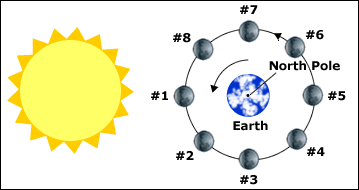
74.
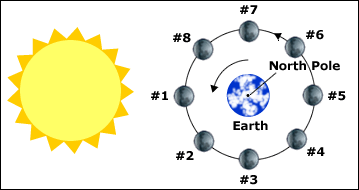
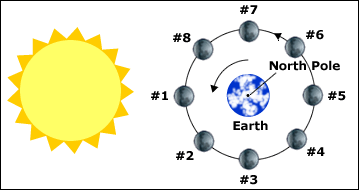
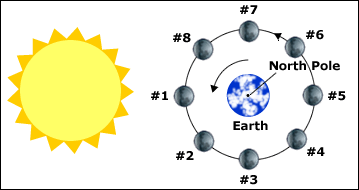
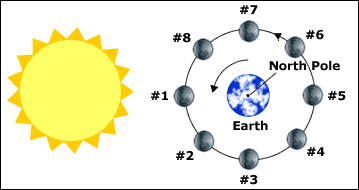
What phase is the moon when in position #5?
a)
New Moon
b)
First Quarter
c)
Full Moon
d)
Third Quarter
75.
What phase is the moon when in position #6?
a)
Waning Gibbous
b)
Waxing Gibbous
c)
Waning Crescent
d)
Waxing Crescent
76.
 In what phase is the moon when in position #3?
a)
First Quarter
b)
New Moon
c)
Waxing Gibbous
d)
Waning Crescent
77.
In what phase is the moon when in position #2?
a)
Waning Crescent
b)
Waning Gibbous
c)
Waxing Crescent
d)
Waxing Gibbous
78.
In what phase is the moon when in position #8?
a)
Waning crescent
b)
First Quarter
c)
Waxing crescent 
d)
Third Quarter
79.
Why does none of the moon appear lit during a new moon?
a)
The sun's light is blocked by Earth's shadow
b)
Because the moon is between the Earth and the Sun
c)
Because the moon is located at a right angle to Earth, relative to the sun
d)
Part of the moon that is lit faces away from the sun and Earth
80.
What is a difference between spring and neap tides?
a)
Spring tides occur when the earth and sun are IN LINE with the new or full moon. 
b)
Spring tides occur when moon in 3rd or 1st quarter phases
c)
Spring tides are LOWER than neap tides
d)
Spring tides occur in Spring and neap tides can occur in any season
81.
What happens when there is a spring tide
a)
Short Tides and semi-short tides
b)
High tides and very low tides
c)
low tides and medium tides
d)
small tidal ranges
82.
What type of tides would this arrangement of earth-moon-sun create?
a)
neap tide
b)
spring tide
c)
new moon tide
d)
full moon tide
83.
What type of tide would this arrangement of earth-moon-sun create?
a)
full moon tide
b)
new moon tide
c)
neap tide
d)
spring tide
84.
Which body has the greater effect on Earth's tides?
a)
Sun
b)
Saturn
c)
Moon 
d)
Venus
85.

As the moon revolves around the earth, the water follows the motion and causes...

a)

sea levels

b)

waves and currents

c)

moon phases

d)

high tides and low tides

86.

Spring tides have the largest tidal ranges because...

a)

the earth, moon, and sun are aligned for greater gravitational force.

b)

the moon has the strongest gravitational force.

c)

the sun has the most gravitational force.

d)

none of the above

87.

During neap tides, the gravitational effects of the sun and moon ______________ together.

a)

do not add

b)

are added

c)

increase

d)

don't change

88.

High tides and low tides each happen _____ times per day.

a)

4

b)

2

c)

1

d)

24

89.

A space object spinning is...

a)

Rotation

b)

Revolution

c)

Axis

90.

An imaginary line that a space object spins on is...

a)

Rotation

b)

Revolution

c)

Axis

91.

A space object goes around another object is...

a)

Rotation

b)

Revolution

c)

Axis

92.

What causes moon phases? (SELECT TWO ANSWERS)

a)

The earth's shadow

b)

The moon revolving around the earth

c)

The moon reflects light from the sun

d)

The rotation of the moon

93.

What is the missing phase?

a)
b)
c)
d)
94.

What is the missing phase?

a)
b)
c)
d)
95.

What is the missing phase?

a)
b)
c)
d)
96.

What happens as the moon revolves around the earth?

a)

The shadow gets darker and darker.

b)

The illuminated (lit) side gets lighter and lighter.

c)

The shadow slowly disappears until it's fully lit, then the lit part slowly disappears until it's completely dark.

97.

Can you see the moon during the day?

a)

Yes

b)

No

98.

What moon phase comes after this?

a)
b)
c)
d)
99.

True or False: The moon is always half lit by the sun.

a)

True

b)

False

100.

True or False: We have moon phases because the earth casts a shadow on the moon.

a)

True

b)

False

101.

What is the result of the moon's orbit being tilted?

a)

A lunar eclipse EVERY month

b)

A lunar eclipse every few years

102.

When the lit part of the moon is getting bigger, we call that ...

a)

Waxing

b)

Waning

103.

When the lit part of the moon is getting smaller, we call that ...

a)

Waxing

b)

Waning

104.

True or False: One side of the moon is always facing the sun.

a)

True

b)

False

105.

A space object spinning is...

a)

Rotation

b)

Revolution

c)

Axis

106.

An imaginary line that a space object spins on is...

a)

Rotation

b)

Revolution

c)

Axis

107.

A space object goes around another object is...

a)

Rotation

b)

Revolution

c)

Axis

108.

What causes moon phases? (SELECT TWO ANSWERS)

a)

The earth's shadow

b)

The moon revolving around the earth

c)

The moon reflects light from the sun

d)

The rotation of the moon

109.

What is the missing phase?

a)
b)
c)
d)
110.

What is the missing phase?

a)
b)
c)
d)
111.

What is the missing phase?

a)
b)
c)
d)
112.

What happens as the moon revolves around the earth?

a)

The shadow gets darker and darker.

b)

The illuminated (lit) side gets lighter and lighter.

c)

The shadow slowly disappears until it's fully lit, then the lit part slowly disappears until it's completely dark.

113.

Can you see the moon during the day?

a)

Yes

b)

No

114.

What moon phase comes after this?

a)
b)
c)
d)
115.

True or False: The moon is always half lit by the sun.

a)

True

b)

False

116.

True or False: We have moon phases because the earth casts a shadow on the moon.

a)

True

b)

False

117.

What is the result of the moon's orbit being tilted?

a)

A lunar eclipse EVERY month

b)

A lunar eclipse every few years

118.

When the lit part of the moon is getting bigger, we call that ...

a)

Waxing

b)

Waning

119.

When the lit part of the moon is getting smaller, we call that ...

a)

Waxing

b)

Waning

120.

True or False: One side of the moon is always facing the sun.

a)

True

b)

False