wayground logo

Free Printable Worksheets

Font size

S
M
L
XL
Worksheets

Newton's Laws of Motion

Total questions: 121

Worksheet time: 6hrs 28mins

Name
Class
Date
1.

What is the unit for FORCE? (a)  

Choose from the below words
N (Newtons)
lbs (pounds)
g (grams)
m/s (meters per second)
2.

Balanced or Unbalanced? (a)  

Choose from the below words
Balanced 
Unbalanced
3.

Forces that have a net force of zero (a)  

Choose from the below words
Balanced force
Unbalanced force
4.

What is the net force? (a)  

Choose from the below words
10 N
0 N
25 N
1 N
5.

When Izzy and Zoe pull on the rope with the same amount of force, the forces are (a)   .

6.

A force of 40 N acts upon a 2 kg block. Calculate the acceleration of the object. (a)  

Choose from the below words
20 m/s2
20 m/s
80 m/s2
80 m/s
7.

An object with a mass of 100 kg is observed to accelerate at the rate of 5 m/s2. Calculate the force required to produce this acceleration. (a)  

Choose from the below words
20N
500 M/S
500 Kg
500N
8.

Stacy is rowing a boat. She wants the boat to move forward. According to Newton's Third Law, in which direction should she move her paddle in the water?

a)

Backwards

b)

Above her head

c)

Forward

d)

East

9.
A rocket pushes exhaust 10, 000 N. Without any other forces acting on the rocket, how much force does the rocket go forward?
a)
15,000 N
b)
1,000 N
c)
10, 000 N
10.
A baseball player bats a ball with a force of 1,000 N. The ball exerts a reaction force (without any additional forces action on it) against the bat of...
a)
Less than 1, 000 N
b)
1,000 N
c)
More than 1,000 N
11.

An archer shoots an arrow. The action force is the bowstring against the arrow, the reaction force is...

a)

Air resistance against the bow

b)

the arrow's push against the bowstring

c)

the grip of the archer's hand on the bow

12.

Mathematician, Astronomer, & Physicist who discovered gravity, laws of motion, calculus, reflecting telescope. (a)  

Choose from the below words
Isaac Newton
Marie Curie
Stephen Hawkings
AlexanderFleming
13.

A student inflates a balloon attached to a plastic straw. A string is threaded through the straw and tied to opposite ends of the room. When the air in the balloon is released, the balloon travels the length of the string. Which of Newton's laws explain this? (a)  

Choose from the below words
The law of action-reaction
Newton's law of magnetism
The law of force and acceleration
The law of gravity
14.

If a 40 kg student is pushed in a rolling chair with a force of 30 N, what is the student's acceleration?

(a)  

15.

A car driving down the road runs out of gas. Which of Newton's laws explains why the car continues to move without gasoline? Be able to explain why. This will be a constructed response question.

(a)  

16.
According to Newton's second law, if you increase the force applied to an object :
a)
it accelerates more
b)
it doesn't move
c)
you get more inertia
d)
it decelerates
17.

Which of the following would be a good example of Newton's third law of motion?

a)

An air freshener hanging from the rear-view mirror of a car hangs still while the car moves forward with a constant acceleration

b)

A carbon dioxide-fueled rocket launches upward into the air as carbon dioxide gas accelerates toward the ground below the rocket

c)

Two balls of different masses are rolled with the same force, resulting in the ball with larger mass stopping faster than the ball with the smaller mass.

d)

All of the above

18.
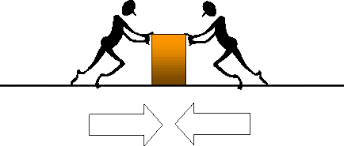
What Newtons law does this picture represent
a)
Newtons 2nd law 
b)
Law of gravity 
c)
Newtons 1st law
d)
Newtons 5th law
19.

Match the following Law of motion with the correct example

a)

Newton's 1st law of motion

1.

Roll a ball across smooth/rough surfaces. The ball rolls faster on smooth because less fiction

b)

Newton's 2nd law of motion

2.

Hit a ball with 2 different forces, the ball will have greater acceleration due to larger force

c)

Newton's 3rd of motion

3.

Bouncing the ball on the court is the action, the floor pushing the ball back up is the reaction

20.
What is the formula for force?
a)
F=M/A
b)
F=A/M
c)
F=M*A
d)
F=M*F
21.

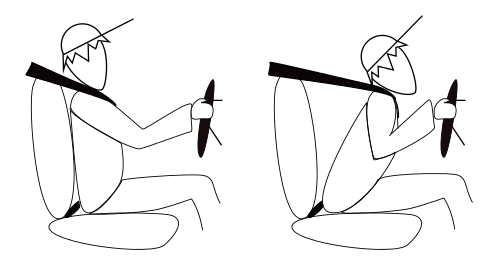
The risk of injury in a car accident is much greater if occupants do not wear a seat belt. Which of Newton's laws explain why this is true?

a)

Law of force and acceleration

b)

Law of gravity

c)

Law of action and reaction

d)

Law of inertia

22.
What is Newton's First Law known as? The Law of
a)
Friction
b)
Mass
c)
Inertia
d)
Gravity
23.
What is Newton's Third Law?
a)
Object in motion stays in motion and an object at rest stays at rest unless acted on by a outside force
b)
Force = mass x acceleration
c)
For every action there is an equal and opposite reaction
24.
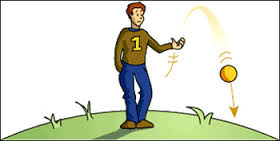
What law of motion does this picture represent?
a)
Newtons 1st law
b)
Newtons 4th law 
c)
Newtons 3rd law 
d)
Newtons 2nd law
25.
What is Newtons 2nd law of motion?
a)
Pancakes 
b)
Force= Mass multiplied by acceleration
c)
For every action there is a equal and opposite  re-action.
d)
Law of gravity 
26.

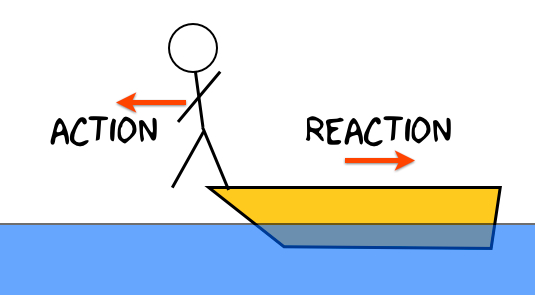
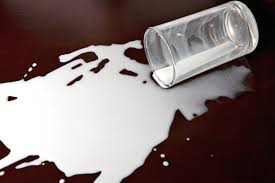
Read the example given in the picture. Drag and drop correct answer to each box. Not all answers will be used.

These ​ (a)   are an example of the law ​ (b)   .

Choose from the below words
forces
action-reaction
unbalanced forces
gravity
force and acceleration
27.

Which best explains the law of force and acceleration (Newton's 2nd Law of Motion)

a)

Restraints keep passengers from falling out of a roller coaster

b)

Riders must be certain heights so they have enough mass to ride

c)

A larger force will be required to accelerate a roller coaster with more people

d)

A roller coaster that goes up must also come down due to the force of gravity

28.

This law of motion states that heavier objects need a larger force to make them move.

a)

Newton's First Law of Motion

b)

Newton's Second Law of Motion

c)

Newton's Third Law of Motion

d)

All of the Above

29.
Which of Newton's laws are illustrated with a rocket launch?
a)
1st Law, the Law of Inertia. 
b)
2nd Law, the Law of Acceleration.
c)
3rd Law, the Law of Action Reaction
d)
The Law of Conservation of Mass
30.

When the force on a car is doubled, the acceleration is doubled.

a)

Newton's 1st Law

b)

Newton's 2nd Law

c)

Newton's 3rd Law

31.

A skater pushes another skater forward, but the one pushing moves backwards.

a)

Newton's 1st Law

b)

Newton's 2nd Law

c)

Newton's 3rd Law

32.

The harder you hit a baseball, the faster it accelerates.

a)

Newton's 1st Law

b)

Newton's 2nd Law

c)

Newton's 3rd Law

33.

You push against a wall and the wall is pushing back on you.

a)

Newton's 1st Law

b)

Newton's 2nd Law

c)

Newton's 3rd Law

34.
Which of these is an example of Newton's First Law, inertia?
a)
pushing against a brick wall, and the brick wall does not move
b)
pushing against a stationary wheelbarrow, and the wheelbarrow accelerates forward
c)
pushing a wheelbarrow full of bricks, and the bricks slide back toward the handles
d)
pushing a wagon to the top of a hill, and the wagon to the top of hill and the wagon accelerates down the hill without assistance
35.
Why is it harder to push a van filled with bowling balls than it is to push a van with basketballs?
a)
The mass of the car is greater than the mass of the basketballs
b)
The mass of the bowling balls is greater than the mass of the basketballs
c)
The van with the basketballs is bigger than the van with the bowling balls
d)
It should be equally as hard to push the two vans
36.
Why do you lean towards the left when a car turns right
a)
because of inertia
b)
because of gravity
c)
because of buoyancy
d)
because of velocity
37.
A 260.5N unbalanced force applied to push a chair across the room causing an acceleration of 4.2 m/s2. What is the mass of the chair?
a)
62.02 kg
b)
63.69 kg
c)
263.3 kg
d)
1123.5 kg
38.
When a Civil War era cannon is fired, the force of the gas produced by exploding powder propels the cannonball forward at a high speed. According to Newton's 3rd law
a)
the cannon itself moves backward
b)
the cannon itself does not move due to inertia
c)
the cannon itself moves forward as well with the momenturm
d)
the cannon itself moves forward with the inertia of the cannonball
39.

An object in motion stays in motion and an object at rest stays at rest UNLESS

a)

acted on by a balanced force.

b)

acted on by an unbalanced force.

40.

Force is related to mass and acceleration. Which law is this?

a)

Law 1

b)

Law 2

c)

Law 3

41.

The momentum of an object depends upon the object's ___________&_____________.

a)

size and shape

b)

mass and speed

c)

mass and veloctiy

d)

mass and energy

42.
Determine the momentum of 1000-kg car moving northward at 20 m/s......... 
a)
20000 N
b)
20000 Joules
c)
20000 Kg * m/s
d)
20000 kg * m/s north
43.
The definition of momentum is
a)
Mass in Motion
b)
The size of an object
c)
The velocity of an object
d)
A comparison between two objects
44.
What is the net force?
a)
40 N left
b)
0 N Balalnced
c)
400 N right
d)
40 N right
45.
What are the units of Force?
a)
kg m/sec
b)
kg m
c)
N
d)
N sec
46.
How is Kinetic Energy different from Potential Energy?
a)
Kinetic Energy is stored energy while Potential Energy is motion energy.
b)
Potential Energy is much stronger than Kinetic Energy
c)
Potential Energy is stored energy within an object while Kinetic Energy is energy in motion.
47.
What is the definition of Energy?
a)
Energy is the ability to do WORK. It is how things CHANGE and MOVE and takes all sorts of forms.
b)
Energy is the strength is takes to make an object move.
c)
Energy is when an object is exhausted and does not move.
48.
TRUE or FALSE: An object has ZERO energy when it is not moving.
a)
True: Objects only have energy when they are in motion.
b)
False: Objects have both stored energy and motion energy.
49.

Which would increase the kinetic energy of a wagon? Select all that apply.

a)

add mass to the wagon

b)

decrease the mass of the wagon

c)

increase the speed of he wagon

d)

decrease the speed of the wagon

50.

A kite stuck in a tree has ______ energy due to its position.

a)

potential

b)

kinetic

c)

chemical

d)

thermal

51.
If there are two forces going in the SAME direction, you would ...?
a)
(-) Subtract the forces
b)
(+) Add the forces
c)
Neither
d)
(x) Multiply
52.

If there are two forces going in opposite directions how would you find the net force?

a)

Subtract

b)

Add

c)

Neither

d)

Multiply

53.
What is the net force?
a)
5.5 N left
b)
5.5 N right
c)
2.5 N left
d)
2.5 N right
54.
What is the net force?
a)
65 N left
b)
65 N right
c)
35 N left
d)
35 N right
55.
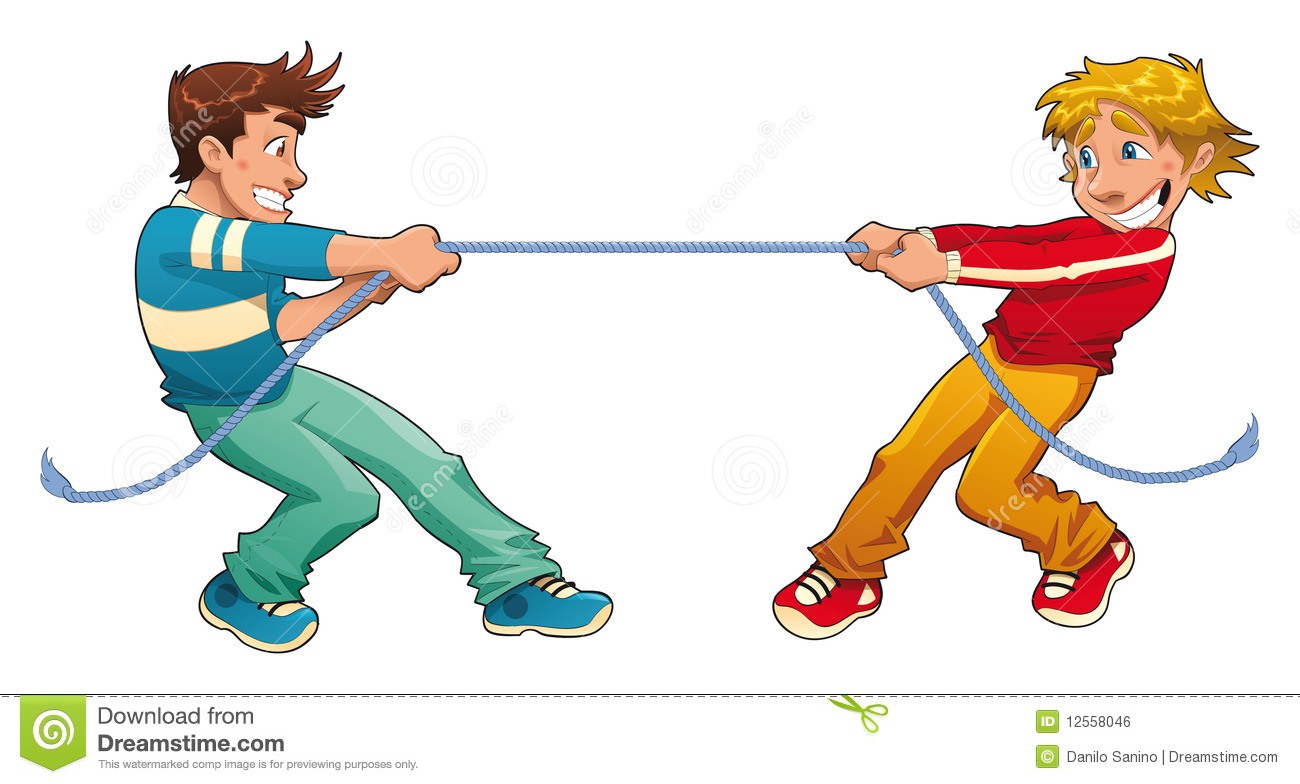
If these boys are pulling with the same amount of force.  What will happen?
a)
The boy in blue will win.
b)
They will not move at all.
c)
The boy in red will win.
d)
Both will fall down.
56.
What is the net force?
a)
4.2 N left
b)
4.2 N right
c)
2.2 N left
d)
2.2 N right
57.
What is the net force?
a)
11 N left
b)
11 N right
c)
3 N left
d)
3 N right
58.

Newtons law states that for every action, there is an_________ reaction

a)

unequal and opposite

b)

stronger and opposite

c)

equal and similar

d)

equal and opposite

59.

A baseball bat hits a baseball with a force of 100 Newtons. What is the force and its direction exerted by the ball on the bat?

a)

100 Newtons, same direction

b)

100 Newtons, opposite direction

c)

200 Newtons, opposite direction

d)

200 Newtons, same direction

60.
What pulls a ball back to earth?
a)
Gas
b)
Friction
c)
Gravity
d)
Molecules
61.
What is the standard unit force is measured in?
a)
Newton
b)
Gram
c)
Pound
d)
Meter
62.
If these boys are pulling with the same amount of force.  What will happen?
a)
The boy in blue will win.
b)
They will not move at all.
c)
The boy in red will win.
d)
Both will fall down.
63.
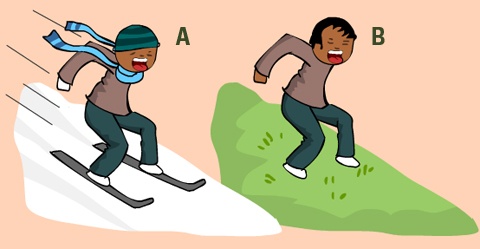
Why is it harder for the boy in Image B to get down the hill?
a)
Motion
b)
Friction
c)
Work
d)
Displacement
64.
It takes more force to accelerate the iron man on the left than the iron man on the right because the iron man on the left has more mass. This best describes
a)
Newton's first law, the law of inertia
b)
Newton's second law, the law of acceleration
c)
Newton's third law, the law of action reaction 
d)
The law of universal gravitation
65.
The formula 
? = mass x acceleration
or 
? = m x a 
is used to find 
a)
Force
b)
Velocity
c)
Momentum
d)
Gravity
66.
For every action, there is an equal and opposite reaction.
a)
Newton's
1st
Law of Motion
b)
Newton's
2nd
Law of Motion
c)
Newton's
3rd
Law of Motion
67.
a)
1st
b)
2nd
c)
3rd
68.
a)
1st
b)
2nd
c)
3rd
69.
If an object is stationary (not moving) the forces acting upon it are _____________
a)
unbalanced
b)
weak
c)
balanced
d)
Hulk Smash!
70.

A squirrel sits on the ground and eats a donut. We know the forces on him must be balanced because...

a)

Forces are always balanced

b)

the squirrel is not accelerating

c)

squirrels are projectiles

d)

he's eating a donut

71.
What is the net force
a)
10 N
b)
0 N
c)
25 N
d)
1 N
72.

Whats Newtons First Law?

a)

The more force applied to an object the faster it will accelerate.

b)

An object in motion will stay in motion and an object at rest will stay at rest unless acted by an outside force.

c)

for every ection there is an equal and oposite reaction

73.

The Law of Inertia

a)

Newtons 1st Law of motion

b)

Newtons 2nd Law of motion

c)

Newtons 3rd Law of motion

74.

The tendency of an object to resist changes in its motion is...

a)

Acceleration

b)

Velocity

c)

Inertia

d)

Force

75.

Newton's third law states that any action will have a(n) ___ and ___ reaction

a)

Equal and similar

b)

Equal and opposite

c)

Equal and different

d)

Greater and opposite

76.

Acceleration: is the rate of change in _____.

a)

distance

b)

Speed

c)

Velocity

d)

displacement

77.
What is the net force?
a)
30 N 
b)
25 N 
c)
5 N 
d)
55 N 
78.
What is the standard unit force is measured in?
a)
Newtons
b)
pounds
c)
grams
d)
meters
79.
Who is the scientist who came up with the Laws of Motion?
a)
Sir Issac Newton
b)
The Greeks
c)
John Dalton
d)
Sir John Newt
80.
What is Newtons 2nd law of motion?
a)
Pancakes 
b)
Force= Mass multiplied by acceleration
c)
For every action there is a equal and opposite  re-action.
d)
Law of gravity 
81.
Which has more Inertia? (so need more force to move) 
a)
Truck
b)
Ant
c)
A cat
d)
A skateboard
82.
What is a PUSH or PULL of an object?
a)
Motion
b)
Force
c)
Friction
d)
Gravity
83.
Why is it harder for the boy in Image B to get down the hill?
a)
Motion
b)
Friction
c)
Work
d)
Displacement
84.
If these boys are pulling with the same amount of force.  What will happen?
a)
The boy in blue will win.
b)
They will not move at all.
c)
The boy in red will win.
d)
Both will fall down.
85.
It takes more force to accelerate the iron man on the left than the iron man on the right because the iron man on the left has more mass. This best describes
a)
Newton's first law, the law of inertia
b)
Newton's second law, the law of acceleration
c)
Newton's third law, the law of action reaction 
d)
The law of universal gravitation
86.
The formula 
? = mass x acceleration
or 
? = m x a 
is used to find 
a)
Force
b)
Velocity
c)
Momentum
d)
Gravity
87.
For every action, there is an equal and opposite reaction.
a)
Newton's
1st
Law of Motion
b)
Newton's
2nd
Law of Motion
c)
Newton's
3rd
Law of Motion
88.
a)
1st
b)
2nd
c)
3rd
89.
a)
1st
b)
2nd
c)
3rd
90.
What is the attractive force that exists between all objects that have mass?
a)
Weight
b)
Mass 
c)
Gravity
d)
Viscosity
91.
If an object is stationary (not moving) the forces acting upon it are _____________
a)
unbalanced
b)
weak
c)
balanced
d)
Hulk Smash!
92.

A squirrel sits on the ground and eats a donut. We know the forces on him must be balanced because...

a)

Forces are always balanced

b)

the squirrel is not accelerating

c)

squirrels are projectiles

d)

he's eating a donut

93.
Are forces balanced or unbalanced when a marble speeds up rolling down a ramp?
a)
Balanced
b)
Unbalanced
94.
What is Newton's First Law known as? The Law of
a)
Friction
b)
Mass
c)
Inertia
d)
Gravity
95.
What is Newton's First Law
a)
F=ma
b)
Every action has an equal and opposite reaction
c)
An object at rest stays at rest, an object in motion stays in motion. 
d)
Friction 
96.
Newton's third law states that any action will have a(n) _______ and ______ reaction
a)
Equal and similar
b)
Equal and opposite
c)
Equal and different
d)
Greater and opposite
97.

This equation goes with which law?

a)

Newton's first law of motion

b)

Newton's second law of motion

c)

Newton's third law of motion

98.

When the force on a car is doubled, the acceleration is doubled.

a)

Newton's 1st Law

b)

Newton's 2nd Law

c)

Newton's 3rd Law

99.

You push against a wall and the wall is pushing back on you.

a)

Newton's 1st Law

b)

Newton's 2nd Law

c)

Newton's 3rd Law

100.

You are carrying a lunch tray when you bump into the edge of a table. Although the tray did not tip, your milk falls off of the front of the tray.

a)

Newton's

1st

Law of Motion

b)

Newton's

2nd

Law of Motion

c)

Newton's

3rd

Law of Motion

101.
Why is it harder to push a van filled with bowling balls than it is to push a van with basketballs?
a)
The mass of the car is greater than the mass of the basketballs
b)
The mass of the bowling balls is greater than the mass of the basketballs
c)
The van with the basketballs is bigger than the van with the bowling balls
d)
It should be equally as hard to push the two vans
102.

How many Laws of Motion did Isaac Newton Create?

a)

2

b)

4

c)

5

d)

3

103.

In Newton's first Law of Motion, an object at rest will ___________.

a)

defy gravity

b)

want to move

c)

remain at rest

d)

Go to the Moon!

104.

According to Newton's Second Law of Motion, an object in motion will _________.

a)

Stay in motion

b)

want to stop right away

c)

spontaneously combust

d)

Go to the Moon!

105.

Mass of an object can be defined by...

a)

how small an object is

b)

how large an object is

c)

how far an object is from the sun

d)

How much matter an object is made out of.

106.

The greater the mass of an object, the greater the amount of ______ is needed to make it accelerate.

a)

Force

b)

Matter

c)

Acceleration

d)

Velocity

107.

In the equation f=ma, what does the "m" stand for

a)

acceleration

b)

matter

c)

mass

d)

force

108.

If you have a balloon and a bowling ball, which object would need more force to make it move. Explain why. (answer in complete sentences)

4 lines
109.

In the equation f=ma, what unit of measure is used for force?

a)

Kilogram

b)

Newton

c)

Feet per second

d)

Meters per second

110.

According to Newtons Third Law of Motion, every action has an equal and opposite _________.

a)

gravity

b)

force

c)

mass

d)

reaction

111.

In the equation f=ma, "F" stands for _______.

a)

force

b)

mass

c)

velocity

d)

acceleration

112.

Solve the following equation to find the force.

F = 10kg x 5m/s

a)

20 newtons

b)

50 newtons

c)

2 newtons

d)

50 kilometers

113.

Solve the following equation to find the acceleration of the object.

20n = 10kg x a

a)

2 kilometers

b)

200 meters per second

c)

8 meters per second

d)

2 meters per second

114.

Jumping into the air is an example of _________.

a)

Action-reaction forces

b)

Momentum

c)

electromagnetic fields

d)

Mass

115.

Which choice below best defines MOMENTUM?

a)

Gravitational forces pulling an object from earth

b)

How fast an object can speed up

c)

An object at rest wants to stay at rest

d)

Characteristic of moving objects dealing with its mass and velocity

116.

True or False. If an object is hit opposite sides with the same amount of force on each side, the forces cancel out and the object will NOT move.

a)

True

b)

False

117.

What is velocity?

a)

It is only the acceleration of an object

b)

It is the speed AND direction of an object.

c)

Only the direction of an object

d)

None of the above

118.

True or false. If you change ONLY the direction of an object, you have then changed its velocity.

a)

True

b)

False

119.

If you saw a bus and a car slowly rolling down a hill, which object would gain greater momentum? Why?

4 lines
120.

Which choice below best defines gravity?

a)

A force that pushes away

b)

an objects ability to accelerate

c)

An objects mass attracting other objects towards it

d)

The ability to change the speed and direction of an object

121.

Select the term that BEST matches the definition below.

Definition: Energy that causes movement.

a)

Force

b)

Gravity

c)

Momentum

d)

Newton's Third Law of Motion